


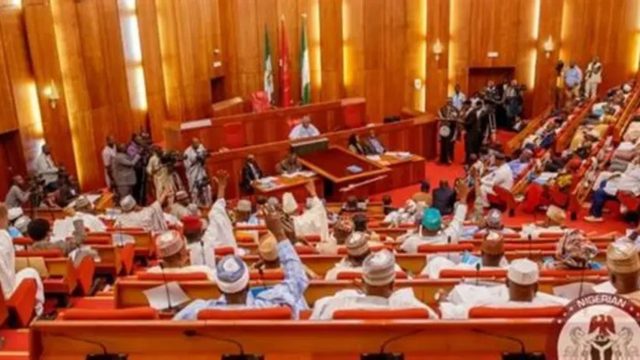
The National Assembly resumes plenary in Abuja today with lawmakers expected to intensify efforts to conclude the long-running review of Nigeria’s 1999 Constitution, while the House of Representatives has unveiled an ambitious legislative scorecard highlighting its activities over the past three years.
At the Senate, attention is set to focus on outstanding constitutional amendment proposals following the passage of the State Police Bill on June 24, a development that temporarily delayed consideration of other reform measures.
Sources within the legislature disclosed that senators are now poised to resume debate on the remaining amendment bills after setting aside the state police legislation for urgent consideration due to its significance to national security and governance.
The Joint Senate and House of Representatives Committee on Constitution Review had earlier completed its report on all proposed amendments, but presentation of the document was postponed to allow lawmakers concentrate on the state police initiative.
Deputy Senate President, Barau Jibrin, who chairs the review committee, had revealed that the panel examined 69 constitutional amendment bills, alongside 55 requests for the creation of new states, two boundary adjustment proposals and 278 applications for additional local government councils.
One of the most closely watched proposals awaiting consideration is the Special Seats Bill, which seeks to boost women's participation in politics through the creation of 182 additional seats reserved exclusively for women across federal and state legislatures.
Under the proposal, 37 seats would be added to the Senate, another 37 to the House of Representatives, while 108 seats would be created in state Houses of Assembly without affecting existing constituencies.
Although the bill failed during the last constitutional amendment exercise amid resistance from several lawmakers, advocates have renewed campaigns for its passage. However, political observers say its fate remains uncertain.
Chairman of the Senate Committee on Media and Public Affairs, Yemi Adaramodu, recently indicated that the upper chamber intends to complete work on all pending constitutional amendment bills before the current legislative session ends.
Beyond constitutional reforms, senators may also turn their attention to allegations involving the Director-General of the Presidential Economic Advisory Council/Presidential Foreign Intervention Promotion Council (PEAC/PFIPC), Adeniyi Adeyemi, who accused the President’s Chief of Staff, Femi Gbajabiamila, of demanding a ₦400 million bribe and seeking a 48 per cent share of the agency’s proposed ₦27.4 billion take-off grant.
The Presidency has strongly denied the allegations. The controversy has attracted public interest, particularly after the National Assembly approved ₦1.3 billion for the agency in the 2026 budget, raising expectations that lawmakers could scrutinise the matter upon resumption.
Meanwhile, the House of Representatives says it has maintained a vigorous legislative pace since the inauguration of the 10th National Assembly in June 2023.
Speaking ahead of the commencement of the fourth legislative session, Chairman of the House Committee on Rules and Business, Francis Waive, disclosed that lawmakers considered 2,747 bills between June 2023 and June 15, 2026, passing 363 of them.
According to him, the bills comprised 57 Executive proposals, 95 Senate concurrence bills and 2,595 private member bills.
A breakdown of the figures shows that during the first legislative year, the House introduced 1,351 bills and passed 89. In the second year, lawmakers sponsored 912 bills, with 148 eventually passed. The third session recorded 484 bills, of which 126 secured passage.
Waive further revealed that 1,782 bills are currently awaiting second reading, while 323 have been referred to standing committees. Another 185 are awaiting consideration, 89 have been consolidated and five were rejected.
On parliamentary motions, he said the House referred 192 motions to standing committees and 28 to ad hoc committees during the third session, while 121 motions were treated as matters of urgent public importance.
House spokesman, Akin Rotimi, defended the legislature’s performance, insisting that several laws passed by the chamber were already producing tangible benefits for citizens.
He cited the Nigerian Education Loan Fund (NELFUND) as a major success story, noting that more than 1.6 million Nigerians had benefited from the student loan programme, with over ₦300 billion reportedly disbursed following the enactment of the enabling legislation.
With constitutional reforms, governance issues and key national controversies expected to dominate discussions, the resumption of plenary signals the beginning of what could be one of the most consequential legislative sessions since the inauguration of the 10th National Assembly.

Comments (0)
No comments yet. Be the first to share your thoughts!