


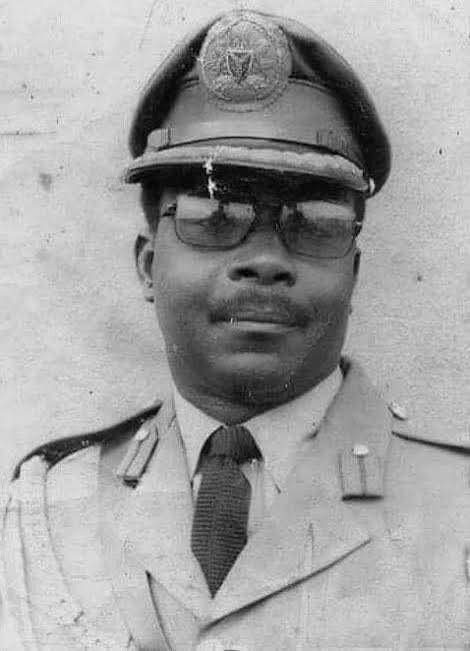
Colonel Ibrahim Taiwo: The Military Governor Whose Service Ended in Nigeria's 1976 Coup
By Staff Writer
Colonel Ibrahim Taiwo remains one of the notable figures of Nigeria's post-independence military era, serving as the Military Governor of Kwara State until his assassination during the failed military coup of February 13, 1976.
Though his administration lasted barely seven months, Taiwo left an enduring legacy in public administration and educational development, particularly through his role in the establishment of the University of Ilorin. His military career also reflected the turbulent political landscape that shaped Nigeria throughout the 1960s and 1970s.
Early Life
Born in Wushishi, present-day Niger State, Ibrahim Taiwo was raised in Kagara, where he spent much of his childhood and became widely known by the nickname "Ibrahim Kagara." His father, Adeosun Taiwo, traced his ancestry to Ogbomosho in present-day Oyo State, illustrating the inter-regional movement that characterized many Nigerian families during the colonial era.
Taiwo attended Senior Primary School in Minna, Bida Middle School and later Provincial Secondary School in Okene before joining the Nigerian Army in 1961, choosing a military career at a time when the newly independent nation was expanding its armed forces.
Military Career
After completing officer training at the Nigerian Military Training College in Kaduna, Taiwo proceeded to the Mons Officer Cadet School in Aldershot, United Kingdom, where he received advanced military training.
He specialized in transport and logistics, serving in several strategic appointments, including Officer Commanding 2 Brigade Transport in Apapa and staff positions at Army Headquarters in Lagos. During the Nigerian Civil War (1967–1970), Taiwo headed the Army's transport and supplies division, playing a vital logistical role in sustaining federal military operations.
Involvement in Military Politics
Like many officers of his generation, Taiwo's career became intertwined with Nigeria's political upheavals.
He participated in the July 1966 counter-coup that overthrew the government of Major General Johnson Aguiyi-Ironsi, aligning himself with a group of officers that included Murtala Mohammed, Theophilus Danjuma and Muhammadu Buhari. The counter-coup reshaped the country's political landscape and elevated a new generation of military leaders.
Nearly a decade later, Taiwo also supported the July 1975 coup that removed General Yakubu Gowon from power. His experience in military logistics made him an important figure in coordinating operational support during the transition that brought General Murtala Mohammed to power.
Military Governor of Kwara State
Following the successful 1975 coup, Taiwo was appointed Military Governor of Kwara State, assuming office in July 1975.
Although his tenure was brief, it coincided with the reform-oriented administration of General Murtala Mohammed, which sought to improve public service efficiency and prepare Nigeria for a return to civilian rule.
Among Taiwo's most significant achievements was his contribution to the establishment of the University of Ilorin, created by federal decree in August 1975. The institution has since grown into one of Nigeria's leading universities and remains a lasting testament to his administration's commitment to educational development.
Assassination During the 1976 Coup Attempt
Colonel Taiwo's tenure came to a tragic end on February 13, 1976, when he was abducted and killed during the failed coup led by Lieutenant Colonel Buka Suka Dimka.
The coup also claimed the life of Nigeria's Head of State, General Murtala Ramat Mohammed, and targeted several senior military officers associated with the ruling government.
Taiwo therefore died while still serving as Military Governor of Kwara State, becoming one of the highest-ranking casualties of the failed uprising.
Following the collapse of the coup, Lieutenant General Olusegun Obasanjo assumed leadership of the country and continued many of the reform programmes initiated under Murtala Mohammed.
Enduring Legacy
Although Colonel Ibrahim Taiwo's public service lasted only a short period, historians regard him as one of the influential officers of Nigeria's post-civil war military establishment.
His career exemplified the growing political influence of the armed forces during Nigeria's early decades of independence, while his role in establishing the University of Ilorin remains his most enduring civilian achievement.
Today, Taiwo is remembered not only as a military administrator but also as one of the prominent officers whose life and career were cut short during one of the most consequential coup attempts in Nigeria's history. His legacy continues to be reflected in the educational institutions and public infrastructure associated with his name, as well as in the historical record of Nigeria's military and political evolution.

Comments (0)
No comments yet. Be the first to share your thoughts!