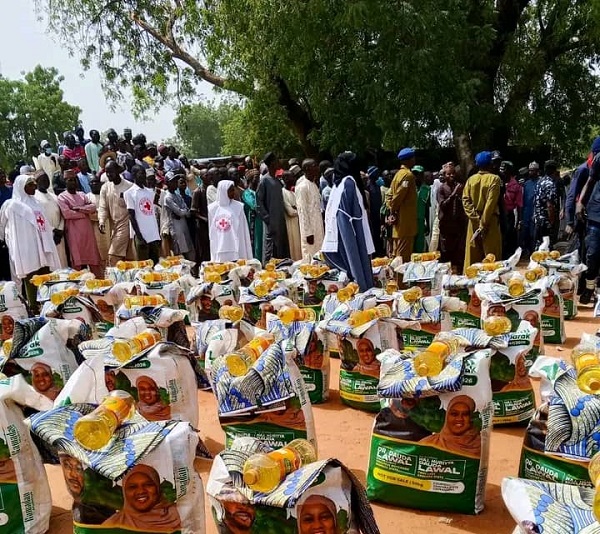
Hajiya Huriyya Dauda Lawal, the First Lady of Zamfara State, has officially launched the 2026 Ramadan Food Distribution Programme, a large-scale social welfare initiative aimed at providing essential supplies to 50,000 beneficiaries.
The programme, which commenced in Shinkafi Local Government Area, is designed to reach vulnerable households across all 147 wards of the state.
As the holy month of Ramadan approaches, the administration has positioned this intervention as a critical measure to ensure that residents can observe the fasting period with adequate nutritional support and dignity.
The launch follows a period of significant economic shifts in Nigeria. Recent data from the National Bureau of Statistics (NBS) indicates that food inflation remains a primary concern for households in the North-West geopolitical zone.
In response to these pressures, the Zamfara state government has scaled its social safety nets. The distribution of these 50,000 packages represents a coordinated effort to mitigate the rising cost of staple grains and legumes, which typically see increased demand during the Ramadan season.
By targeting every ward in the state, the programme aims to provide a decentralized relief structure that reaches the most remote communities.
To facilitate the logistics of the exercise, the First Lady announced the inauguration of ward-level distribution committees.
These bodies are mandated to collaborate with local government authorities and traditional community stakeholders to identify those most in need.
During the flag-off ceremony, Hajiya Huriyya emphasized the necessity of transparency and accountability in the handling of public resources.
She described leadership as a “sacred trust” and explicitly charged committee members to uphold integrity, ensuring that the food items reach the intended vulnerable populations without diversion or political bias.
The First Lady’s role as an Ambassador of the Zakkat and Endowment Board has been central to the design of the state’s welfare strategy.
This specific intervention is part of a broader year-round commitment to supporting orphans and the less privileged across the 19 Emirates of Zamfara.
The 2026 programme is the result of a multi-agency partnership involving the Ministry of Local Government and Chieftaincy Affairs, the Zakkat and Endowment Board, and various international development partners and private donors.
This collaborative model is intended to leverage both public funds and private philanthropy to expand the reach of the state’s social interventions.
The initiative comes at a time when Zamfara State is also navigating complex security and humanitarian challenges.
In many of the areas visited during the flag-off—including Shinkafi, Kaura Namoda, and Zurmi—agricultural activities have faced disruptions in recent years.
Consequently, state-led food distributions serve as a vital bridge for communities that have experienced lower-than-average crop yields or displacement.
The First Lady personally visited several districts, including Jangeru, Bazai, Dauran, and Nasarawar Godal, to oversee the initial handovers and distribute additional support materials to residents.
In her address, Hajiya Huriyya commended Governor Dauda Lawal for maintaining a “people-focused” administrative philosophy.
She noted that the Ramadan food drive is a continuation of the administration’s resolve to prioritize human capital and social welfare as foundational pillars of governance.
Beyond the immediate provision of food, the administration has signaled that it will continue to sustain welfare initiatives through the Sallah period, ensuring that the support system remains active for the duration of the festivities.
The logistical rollout in the coming days will see trucks dispatched to the 147 wards, where community leaders will oversee the final distribution to registered households.
Observers of Northern Nigerian social policy note that such interventions are increasingly necessary to maintain social stability during periods of high seasonal demand.
By integrating traditional emirate structures with modern administrative committees, the Zamfara state government hopes to create a replicable model for efficient aid delivery in a state with a vast and diverse rural population.
As the distribution progresses, the Zakkat and Endowment Board will continue to monitor the impact of the programme on food security metrics within the state.
The successful execution of this 50,000-beneficiary target is expected to provide a template for future large-scale interventions aimed at poverty Alleviation and inclusive growth in the region.
The state government remains committed to evaluating these social programmes to ensure they evolve in line with the actual needs of the citizenry.
culled from Daily Times Nigeria