

Nigeria Will Overcome Insurgency, Jimoh Assures ECOWAS, Calls for Regional Cooperation.
Nigeria’s Permanent Representative to the United Nations, Amb. Jimoh Ibrahim, has expressed confidence that the country will overcome its security challenges, assuring member states of the Economic Community of West African States (ECOWAS) that Nigeria has the resilience to defeat insurgency.
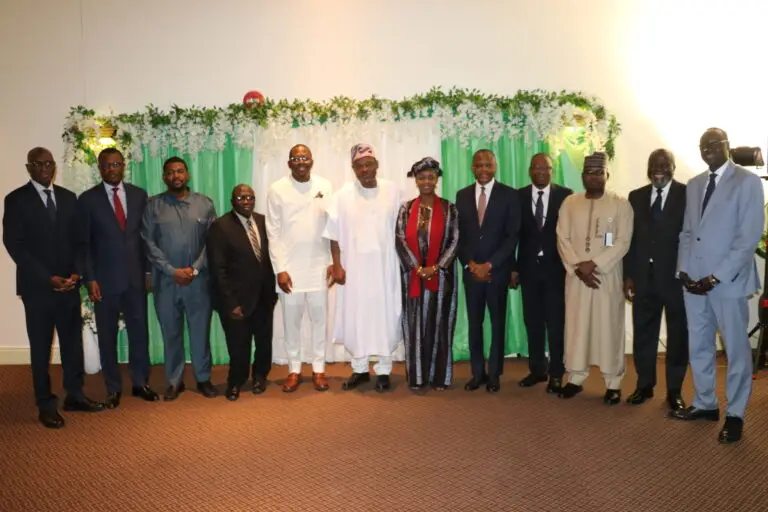
Ibrahim gave the assurance while hosting Ambassadors and Permanent Representatives of ECOWAS member states to the United Nations at Nigeria House in New York.

Speaking during the engagement, the envoy recalled Nigeria’s experience during the Civil War and its prolonged battle against Boko Haram insurgents, saying the country had consistently demonstrated the capacity to overcome difficult challenges.
“Nigeria will surmount insurgency. We survived a Civil War from 1967 to 1970 and fought Boko Haram. We will overcome our problems,” he said.
The ambassador described the security challenges confronting West Africa as manifestations of long-standing societal grievances that require comprehensive solutions beyond military intervention.
“These are not issues we can resolve with missiles alone. Generational grievances demand wider thinking and deeper engagement,” he said.
According to him, the persistence of insurgencies across parts of the region is partly due to an overreliance on military operations without sufficient attention to non-kinetic measures.
“Most insurgencies in West Africa persist because we rely mainly on kinetic approaches instead of combining them with non-kinetic solutions,” Ibrahim stated.
He noted that President Bola Tinubu’s administration was pursuing a broad-based strategy to tackle insecurity while strengthening democratic governance and inclusive dialogue.
“Fortunately, we have a liberal democrat leading a liberal democracy. President Tinubu believes every issue should be discussed before decisions are taken,” he said.
Ibrahim stressed the need for stronger regional collaboration, maintaining that no nation could effectively address contemporary security and development challenges in isolation.
“Let’s work together. No country can do it alone. Even America still seeks collaboration and partnership,” he said.
He urged ECOWAS member states to deepen consultation and cooperation in pursuit of peace, stability and sustainable development across the region.
The envoy also highlighted the importance of international partnerships, noting that the United Nations itself was founded on the principles of cooperation and collective responsibility.
In addition, he advocated greater economic integration among West African countries, including discussions on regional financial institutions and monetary cooperation.
Responding on behalf of the diplomats, Sierra Leone’s Permanent Representative to the United Nations, Amb. Michael Kanu, described Ibrahim’s appointment as timely for Africa and expressed confidence that it would strengthen the continent’s influence within the UN system.
Kanu noted that Nigeria had consistently provided leadership on major global issues affecting Africa.
“In the African Group, Nigeria’s voice has often been the collective voice,” he said.
He also congratulated Ibrahim on his recent election as Chairman of the United Nations Fifth Committee, one of the organisation’s most influential bodies responsible for administrative and budgetary matters.
“That committee is among the most strategic in the United Nations system. Nigeria, West Africa and Africa will be represented at the table with both competence and conviction,” Kanu said.
During the meeting, Nigeria also sought support for Mrs. Esther Eghobamien-Mshelia as its candidate for election to the United Nations Committee on the Elimination of Discrimination Against Women (CEDAW) for the 2027–2030 term.
The dinner marked one of Ibrahim’s earliest high-level engagements with West African diplomats since assuming office as Nigeria’s Permanent Representative to the United Nations.