Katsinatimes
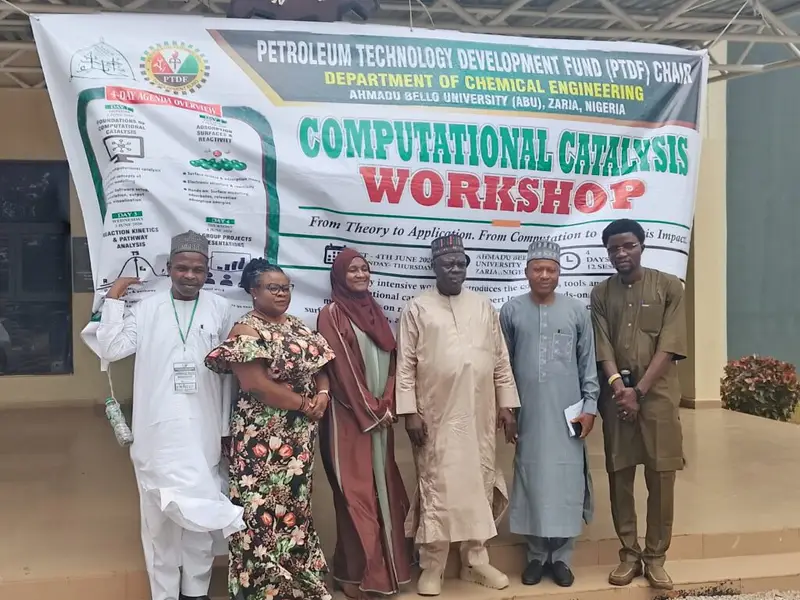
The Petroleum Technology Development Fund (PTDF) has commenced a specialised training programme for 35 researchers in computational catalysis as part of efforts to strengthen Nigeria’s industrial capacity, reduce dependence on foreign expertise and promote homegrown technological solutions.
The workshop, organised in collaboration with Ahmadu Bello University (ABU), Zaria, is themed: “Why It Matters: Opportunities for Research, Industry, and National Development in Nigeria.”
Speaking at the opening ceremony held at ABU’s main campus in Zaria, PTDF Executive Secretary, Prof. Shu’aibu Shehu-Aliyu, said the initiative was designed to equip researchers with advanced skills needed to translate scientific discoveries into practical industrial solutions.
Represented by the Fund’s General Manager for Education and Training, Hajiya Rabi Waziri, Shehu-Aliyu said computational catalysis had become a critical tool for advancing research and innovation in the petroleum, petrochemical and energy sectors.
According to him, the training aligns with PTDF’s mandate to build indigenous human capacity and promote research-driven development in Nigeria’s oil and gas industry.
“For a country like Nigeria, where energy resources remain central to economic growth and sustainability, building capacity in advanced and specialised fields is essential,” he said.
He noted that the PTDF had established Professorial Chair Programmes at ABU and five other universities across the country to address critical industry challenges and support national development through research and innovation.
The Vice-Chancellor of ABU, Prof. Adamu Ahmed, described the institution as a national asset committed to developing indigenous expertise capable of driving Nigeria’s technological and economic transformation.
Represented by the Deputy Vice-Chancellor (Administration), Prof. Bello Sabo, the Vice-Chancellor said the workshop reflected the university’s commitment to promoting local solutions to national challenges.
“This programme is a deliberate investment in Nigeria’s ability to understand, design and optimise the catalytic systems that underpin our petroleum industry, petrochemical sector and emerging clean energy ambitions using computational tools developed and applied by Nigerian scientists,” he said.
Ahmed observed that despite being Africa’s largest crude oil producer, Nigeria still relies heavily on foreign technical expertise in areas such as catalyst design, process modelling and computational optimisation.
He described the situation as an opportunity for local researchers to develop solutions that would strengthen national self-reliance and competitiveness.
Earlier, the PTDF Chair Professor in Chemical Engineering at ABU, Prof. Abdulazeez Yusuf-Atta, said the 35 participants were selected through a competitive process based on their research achievements, innovative capacity and commitment to advancing scientific knowledge.
He explained that computational catalysis enables scientists to predict and optimise chemical reactions using computer-based models before conducting laboratory experiments, thereby reducing costs, saving time and improving efficiency.
“A molecule, under the right conditions on the right catalyst surface, can be transformed into propylene, which serves as a major building block for plastics, fibres and industrial chemicals worth billions of dollars globally,” he said.
Yusuf-Atta disclosed that participants were drawn from various institutions across Nigeria, while one participant came from the Republic of Chad, underscoring the regional relevance of the programme.
He stressed the need to sustain such capacity-building initiatives, noting that increased use of computational tools would help researchers focus laboratory efforts on the most promising areas of study.
“It guides researchers to more specific areas before entering the laboratory, thereby saving cost, time and energy,” he said.
According to him, the long-term objective is to create a critical mass of Nigerian experts capable of applying computational catalysis to address industrial and technological challenges.
“We are building a network of specialists who will return to their institutions and transfer this knowledge to others. They will serve as trainers of trainers,” Yusuf-Atta added.
Participants at the workshop commended PTDF for the initiative and called for its expansion, expressing optimism that the programme would contribute significantly to industrial innovation, technological advancement and economic development in Nigeria.This version follows a standard Daily Trust news structure, with a stronger lead, clearer attribution, tighter paragraphs, and emphasis on the national significance of the programme.