By Zaharaddeen Ishaq Abubakar | Katsina Times | January 6, 2026
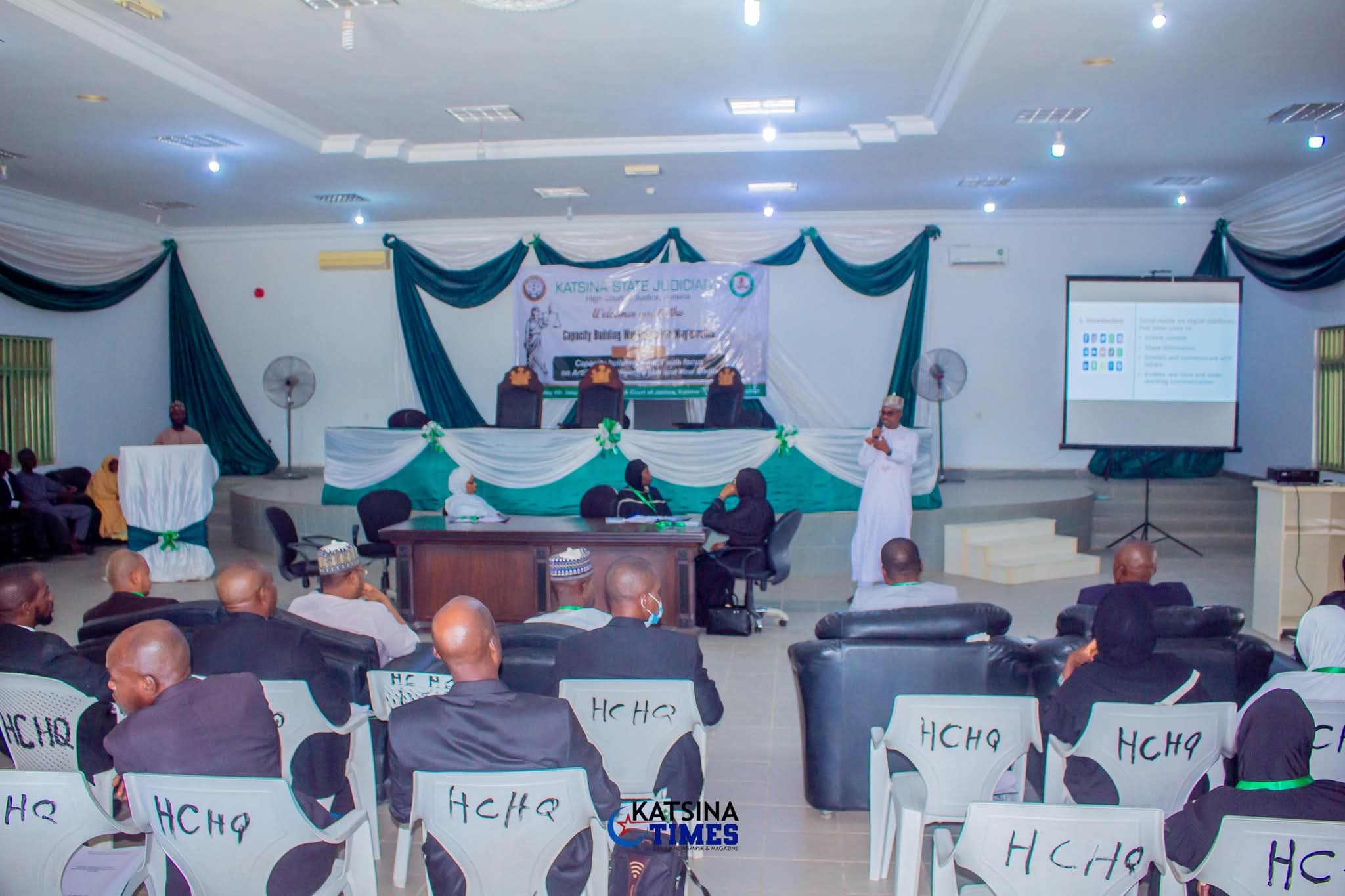
The Katsina State High Court on Tuesday organized a specialized capacity-building workshop for magistrates aimed at strengthening the administration of justice in the digital age, with a focus on Information and Communication Technology (ICT), Artificial Intelligence (AI), and new media.
The workshop, themed “Capacity Building on ICT with Focus on Artificial Intelligence (AI) and New Media,” was held at the Conference Hall of the Katsina State High Court. It was organized by the Katsina State Government in collaboration with Matasa Media Links, publishers of Katsina Times, Katsina City News magazine, and Jaridar Taskar Labarai.
Delivering the opening address, the Chief Judge of Katsina State, Hon. Justice Musa Danladi Abubakar, described technology as an indispensable part of modern human life that can no longer be separated from contemporary judicial practice.
In a symbolic gesture consistent with the theme of the workshop, the Chief Judge delivered his keynote address digitally. Titled “A New Path to Justice Through Technology-Driven Courts,” the presentation highlighted the critical role of technology in accelerating justice delivery, enhancing transparency, and improving efficiency in court operations.
“Thirty years ago, the use of technology in courts was hardly imaginable. Today, ICT has become a vital tool for improving judicial processes,” Justice Abubakar said.
He noted that while courts previously relied heavily on handwritten records and manual documentation, technology now plays a central role in data storage, communication, case management, and expanding public access to justice.
Speaking on behalf of the organizers, Ahmed Abdulkadir, a Director at Matasa Media Links, said the workshop was designed to provide magistrates with deeper insight into the growing impact of artificial intelligence and new media on the justice system.
“AI and new media are no longer emerging concepts; they are now part of everyday life,” he said. “Artificial intelligence can generate text, images, audio, and videos that appear authentic, raising critical legal questions about evidence, authenticity, privacy, and accountability before the courts.”
He emphasized that the objective of the training was not to turn magistrates into technology experts, but to equip them with the awareness, confidence, and sound judgment required to adjudicate cases involving technology and digital communication platforms.
The workshop featured presentations by seasoned academics and professionals, including Professor Mainasara Yakubu Kurfi of the Department of Mass Communication, Bayero University, Kano.
Professor Kurfi presented a paper titled “Justice in the Era of Social Media: Principles, Practices and Best Ethics for Magistrates in Katsina State,” where he outlined best practices for judicial officers in the use of social media, stressing professionalism, ethical conduct, and the preservation of judicial integrity.
Earlier, in her welcome address, the Chief Registrar of the Katsina State High Court, Hajiya Basira, expressed appreciation to the Chief Judge for approving the workshop and commended the magistrates for their commitment to continuous learning and professional development.
She described the training as a crucial educational initiative capable of strengthening the judiciary and improving the quality of justice delivery in the state.
Participants expressed satisfaction with the depth and relevance of the knowledge gained, noting that the training would enhance their capacity to handle emerging legal challenges related to technology and new media.
The workshop underscored the Katsina State High Court’s commitment to continuous judicial capacity building, responsible adoption of technology, and preparedness to address legal challenges in the era of artificial intelligence and modern digital communication.