


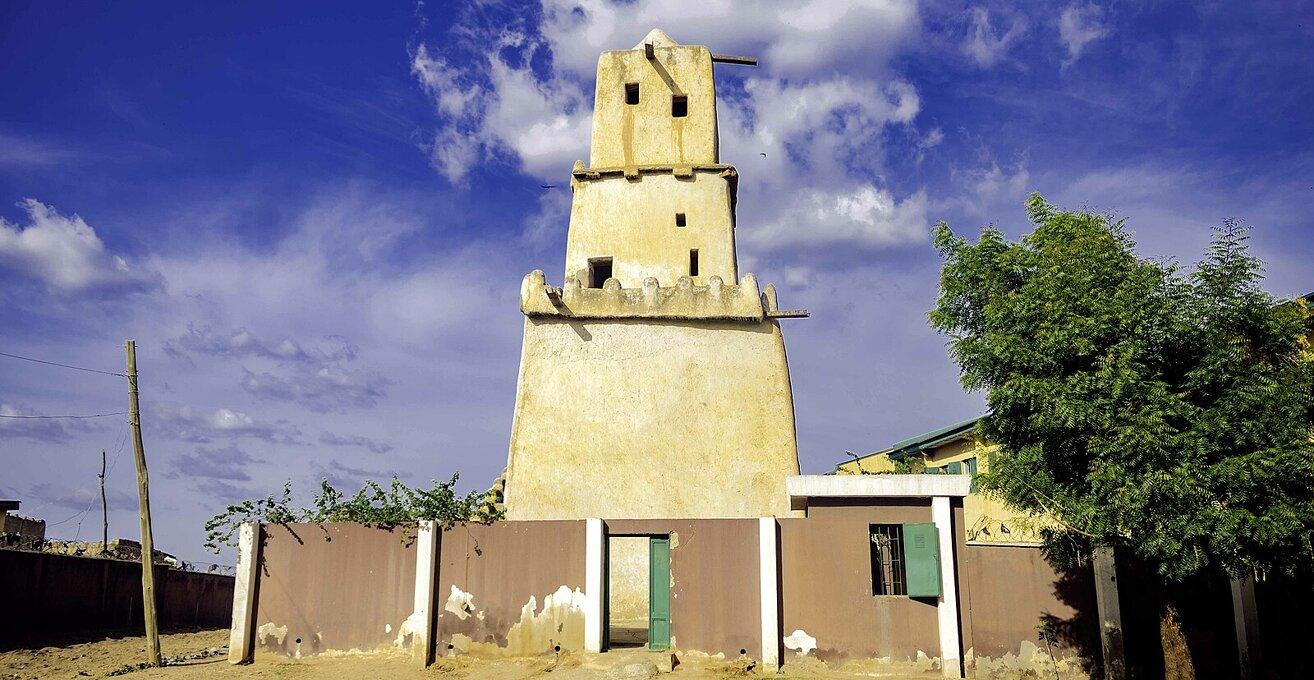
History is often remembered through the rise and fall of kingdoms, the victories of warriors, and the reigns of powerful rulers. Yet, some of the most enduring symbols of civilization are not palaces or battlefields but monuments built in honour of knowledge. In the ancient city of Katsina, one such monument has stood for centuries, silently narrating the story of a people whose greatest strength was learning. That monument is the Gobarau Minaret.
Standing prominently in the heart of Katsina, the Gobarau Minaret is one of the oldest surviving historical structures in Northern Nigeria and among the most treasured symbols of Islamic and intellectual heritage in West Africa. For more than five centuries, it has remained a reminder of an era when Katsina was not merely a commercial city but one of the foremost centres of scholarship and learning on the African continent.
The story of Gobarau begins in the fifteenth century, during a transformative period in the history of the ancient Katsina Kingdom. At the time, Katsina occupied a strategic position along the trans-Saharan trade routes that linked West Africa with North Africa and the wider Islamic world. Merchants crossed vast deserts carrying gold, leather, textiles, and other goods. Along with commerce came ideas, religion, culture, and knowledge. As Islam spread across Hausaland, Katsina emerged as one of its most important centres.
The construction of the Gobarau Mosque and its famous minaret is closely associated with the reign of Sarkin Katsina Muhammadu Korau, regarded as the first Muslim ruler of Katsina. During his reign, the renowned North African scholar Sheikh Muhammad Abdulkarim Al-Maghili visited the kingdom. Al-Maghili, an influential theologian from present-day Algeria, played a significant role in shaping Islamic scholarship and governance across West Africa. Historical accounts attribute the establishment of the Gobarau Mosque to his influence and guidance during his stay in Katsina.
What emerged was far more than a mosque. It became an institution that would define the intellectual identity of Katsina for generations. Constructed in the distinctive Sudano-Sahelian architectural style, the minaret rose approximately fifteen metres above the city. Built from sun-dried mud and strengthened with timber beams, the structure reflected the remarkable ingenuity of indigenous builders who mastered architectural techniques suited to the harsh climate of the Sahel. Even centuries later, the tower remains a testament to the sophistication of traditional African architecture.
The significance of Gobarau, however, extends far beyond its physical appearance. Its greatest contribution lies in its role as a centre of learning. By the sixteenth century, Katsina had become one of the leading intellectual centres in Hausaland, rivaling renowned cities such as Timbuktu in scholarly influence. The Gobarau Mosque evolved into a prestigious institution of higher Islamic education where students gathered to study theology, jurisprudence, Arabic language, literature, philosophy, mathematics, and other branches of knowledge. Scholars travelled from distant regions to teach and learn within its walls, transforming Katsina into a vibrant hub of intellectual exchange.
In many respects, Gobarau functioned as a university long before the emergence of modern higher educational institutions in Nigeria. Its graduates went on to become respected scholars, judges, teachers, and religious leaders whose influence spread throughout West Africa. The reputation of the institution became so extensive that students from across the region regarded Katsina as a destination for advanced learning. The city's name became synonymous with scholarship, literacy, and intellectual excellence.
The rise of Gobarau coincided with a golden age in the history of Katsina. The city prospered economically through trade while simultaneously flourishing as a centre of religious and academic activity. This combination of commercial prosperity and intellectual vibrancy elevated Katsina to a position of prominence among the Hausa city-states. The minaret stood at the centre of this transformation, symbolizing a society that placed immense value on education and knowledge.

Over time, Gobarau became deeply woven into the cultural memory of the people. Various traditions and legends emerged around its origins, adding an element of mystery to its history. One popular account speaks of debates among scholars regarding the correct direction of the qiblah before the mosque was constructed. Such stories, whether historical or legendary, reveal the reverence with which the monument has long been regarded.
Like many ancient institutions, Gobarau eventually experienced decline. Political changes, shifting centres of power, and the construction of newer mosques gradually reduced its role as the principal congregational mosque of Katsina. By the nineteenth century, a new central mosque had been established, and the original Gobarau Mosque lost much of its prominence. Despite these changes, the minaret survived. While portions of the original mosque disappeared, the tower remained standing as a witness to centuries of history.
The survival of the Gobarau Minaret is itself remarkable. Built from mud centuries ago, it has endured changing weather conditions, political upheavals, colonial rule, and the passage of time. Efforts by traditional institutions and conservation advocates have helped preserve the monument, ensuring that it remains an enduring symbol of Katsina's heritage. Today, it continues to attract historians, researchers, tourists, and visitors interested in exploring the rich history of Northern Nigeria.
Beyond its architectural and historical value, Gobarau carries profound symbolic importance. It challenges outdated assumptions that pre-colonial African societies lacked sophisticated centres of learning. The minaret stands as evidence that long before modern universities were established, African communities had already developed thriving institutions dedicated to scholarship, intellectual inquiry, and the preservation of knowledge. Its existence affirms the central role that education played in the development of the ancient Hausa states.
Today, as Katsina continues to grow and modernize, the Gobarau Minaret remains an enduring link between the past and the present. It reminds contemporary society that the greatness of a civilization is measured not only by its wealth or military achievements but also by its commitment to knowledge and learning. The tower continues to tell the story of a city that once illuminated West Africa with scholarship and intellectual leadership.
More than five hundred years after its construction, Gobarau still stands above Katsina—weathered but unbowed, ancient yet relevant. It remains a monument not merely of mud and timber but of ideas, learning, faith, and civilization. In its shadow lies the story of how Katsina became one of the intellectual capitals of West Africa, and in its continued presence lives the legacy of generations who believed that knowledge was the greatest treasure a society could possess.

Comments (0)
No comments yet. Be the first to share your thoughts!