


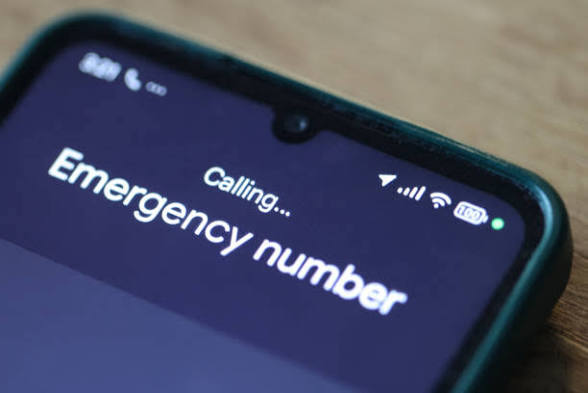
The Federal Government has intensified efforts to establish a unified national emergency response system, unveiling plans to engage state governors and emergency service providers to ensure the nationwide adoption of 112 as Nigeria’s single emergency number.
The move followed a high-level meeting between Vice President Kashim Shettima and a delegation from the Nigerian Communications Commission (NCC), led by the Chairman of its Governing Board, Chief Ibikunle Olorunnimbe, at the Presidential Villa, Abuja.
The development comes shortly after the National Economic Council (NEC), chaired by the Vice President, approved the adoption of 112 as the country’s official emergency number across all tiers of government and relevant agencies.
The initiative is aimed at strengthening Nigeria’s emergency response architecture by creating a coordinated and seamless system capable of responding swiftly to emergencies nationwide.
As part of the implementation framework, NEC had earlier approved the establishment of a multi-agency implementation committee, with coordination to be jointly led by the Office of the Vice President and the NCC.
Speaking during the meeting, Shettima directed stakeholders to develop a clear roadmap that would guide the transition to a single, unified emergency number in line with international best practices.
He also instructed the NCC to work closely with the National Emergency Management Agency (NEMA), citing the agency’s extensive experience in disaster management, emergency relief operations and rehabilitation efforts across the country.
The Vice President assured the delegation of the Federal Government’s commitment to the project, stressing that funding would be mobilised through the National Economic Council and partnerships with the private sector.
According to him, the success of the initiative will depend largely on the commitment of emergency responders and other critical stakeholders, urging all relevant agencies to fully support its implementation.
“The project will be sustained, and we will ensure the necessary support is provided. What is needed now is a coordinated effort and commitment from all stakeholders to make the emergency response system effective,” he said.
Earlier, Olorunnimbe briefed the Vice President on progress made by the NCC toward operationalising the emergency number nationwide.

He disclosed that the Commission has already established about 35 Emergency Communications Centres (ECCs) across the country, leveraging technology to improve access to emergency services.
The NCC chairman commended Shettima for providing leadership on the initiative and for facilitating stakeholder engagement, particularly with the Nigeria Governors’ Forum (NGF), whose support he described as critical to the success of the programme.
He stressed that beyond federal coordination, state governments must play an active role by supporting and maintaining the infrastructure already deployed by the Commission to ensure the centres function efficiently.
Olorunnimbe also underscored the importance of full participation by emergency response agencies, warning that the effectiveness of the system would be measured by how quickly distress calls are received and acted upon.
“If someone places a call requesting police assistance and, for any reason, that call does not reach the police, the person may not get the help they urgently need,” he said.
He noted that the initiative requires commitment from all emergency service providers, including the Nigeria Police Force, ambulance services at state level, and NEMA at the national level.
According to him, every stakeholder must recognise the importance of the project and embrace it as a national responsibility.
“This is a patriotic duty. Anyone in distress should be able to access help quickly and efficiently, regardless of where they are in the country,” he said.
Olorunnimbe added that while Nigeria possesses the resources and structures needed for an effective emergency response system, stronger coordination among agencies remains essential to achieving the desired results.
The planned rollout of 112 as a unified emergency number is expected to simplify access to emergency services, improve response times and enhance public safety across the country.



Comments (0)
No comments yet. Be the first to share your thoughts!