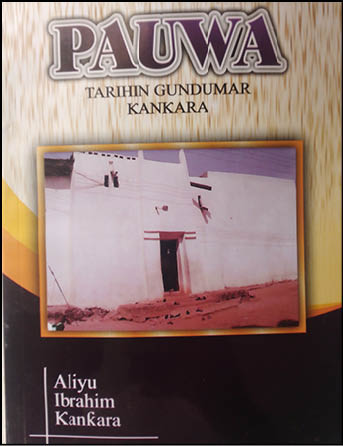
The book, Pauwa: History of Kankara (1848-2022) from its evolution or point of origin was written by Professor Aliyu Ibrahim Kankara who outstepped his original boundary of what he is, a geologist to then and even be a bohemian writer in Africa with intense fervor of passionate feelings along that prefeled direction. The book is so unique that in this era of nescience about historical stages whether it be in written or public speaking, lacking documentation in most of the districts in Katsina State, this one encapsulates the narratives with no exaggerations of the original settlers of the place and from where they came, establishing what is now presently called Kankara.
The book has 280 pages and was published in the year 2022 by the SM Graphics printing press, Kano. It has 29 colorful pictures of historical touch.
The book has five (5) sections and fourteen (14) chapters that make it exciting, very fascinating and readily rich for almost all myriad number of disciplines to pursue, many scholars and readers, researchers to grasp or acquire.
Under section one there are nine (9) chapters with chapter one telling how Pauwa and Kankara came to be, how they were formed in 1793 and 1848 respectively through caravans’ passage and settlement and by establishing a trade-by-Bata system of goods’ exchanges. The three schools of thoughts on the declaration of how Kankara was formed by various conceptions were highlighted here.
Chapter two discusses about the initial rulers of Pauwa, the Kogawa ruling dynasty who ruled from the year 1810 to 1910 starting from Muhammadu Yaro who was the acclaimed flag bearer from Sokoto and whom Sheikh Usman Bin Fodio sent to guard and rules the territory to the last person, Bello Dabakurau who was abruptly overthrown by the then Katsina Emir, Muhammadu Dikko )1906-1944)
Chapter three saw the coming of Habe rulers who got started with Sarkin Pauwa Nuhu in 1810. This dwells on Nuhu’s tenure, and chapter four discusses on Mamuda’s tenure, developmental stages and success from 1943 to 1951.
In chapters five, six and seven, the book swam into the rulings and success of the following district heads, Alhaji Idris Nadabo, Alhaji Muntari Nadabo and Alhaji Muhammadu Lawal Areda. Most of the economic developments through modernizations are seen in these chapters.
The following chapters eight and nine culminated into the termination of the section, of Sarkin Pauwa Yusuf Lawal and Justice (rtd) Ado Bello Mabai.
Section two is almost chapter-free and has full stories of chief wards of the district. There were about fourteen (14) wards before their assimilations or adjustment of 1924 that consumed most of the wards and merged or assimilated them into some.
In section three (3) too it is chapter-free or, having only one chapter and discussed on the creation of new districts wards in the year 1992 which was backed by the sudden rise in the population of the district and its expansion. The new district created here under Pauwa was Ketare, which had two (2) wards: Tudu and Sherere only.
In section four (4) the writer did very well to express many things on the economic and educational development of the districts, surpassing from the beginning of the areas to present time, evolving through pivotal changes and challenges with persistence growth of the populations. This section too discusses about the stages that culminated into higher pedestals, with many local and now outdated industries exposed into it. Here too, the prominent well-to-do individuals that shaped the economy of the area were dealt with. This is in chapter twelve (12) and in chapter thirteen (13), a great deal of extinction and fading of local industries was made with many reasons of that to happen.
The following chapter, number fourteen (14) was on conclusion and remarks. And, in this there were discussions on the creation of first elementary schools in the districts in 1943 and later.
Then, section five (5) was mainly on the appendixes, which were only three (3): important days and years of known and unforgettable happenings within the district, list of first/pioneer students enrolled in the Kankara elementary school established in that year 1943 and the list of economic mineral deposits in the area and their commercial status.