By Isma'il Adamu
At the time when vulnerable families in katsina state are looking for systems that protect dignity, build trust, and create real opportunities for people to stand again on their feet, Governor Dikko Umar Radda created the State Zakkat and Waqf Board to serve that purpose. Rooted in the timeless Islamic tradition of zakat and strengthened by the long-term vision of waqf, the Board represents more than an administrative body. It represents a moral promise: that wealth in society should not circulate among a few, and that community strength is measured by how it treats those who are most vulnerable.
That promise is not only preached. It is practiced, organized, and increasingly expanded through structured collection, transparent distribution, and renewed partnerships across the state. Zakat is a form of worship, but it is also a social stabilizer. It is an obligation on those who have enough to support those who do not, in a way that uplifts without humiliating. It reminds every person that prosperity carries responsibility.
Waqf, on the other hand, is a legacy, it is the practice of dedicating an asset or property for the benefit of the public, usually for education, health, care for the poor, community development, and other long-lasting good causes. When zakat responds to urgent needs, waqf builds lasting foundations so that fewer people fall into those needs in the future.
Together, zakat and waqf create a powerful model of social support: immediate assistance combined with long-term investment. This is the spirit the Katsina State Zakkat and Waqf Board is working to institutionalize.
Just recently, Governor Dikko Umar Radda set a good example by giving out zakkat of ₦50 million for distribution to eligible beneficiaries in the state, as a way of encouraging other wealthy citizens in the state to also follow suit. The moment carried a message. Public leadership can set a tone of giving that encourages others. When government leaders treat zakat not as a slogan but as a concrete commitment, it helps move zakat from private intention into public culture.
It also strengthens confidence in organized zakat administration. Many people want to give, but they want to know their zakat reaches the right people, in the right way, at the right time. When zakat distribution is supported at high levels, it signals seriousness, accountability, and visibility.
From individual giving to a culture of shared responsibility
The Board’s work sits at the intersection of faith, community organization, and public trust. While many people give zakat personally, the structured approach of a zakat and waqf board offers several advantages which include wider reach, better targeting of eligible beneficiaries as well as transparency and confidence building.
The Katsina State Zakkat and Waqf Board under the leadership of Sheik Ahmad Filin-Samji is doing the very good work of a nurturing the newly established agency by starting on a good note and placing it on a sound footing. In 2025, the Board was able to achieve a significant collection milestone of ₦6.7 billion which include both cash and agricultural produce.
The board's leadership, with the active support of Malam Dikko Umar Radda, is positioning zakat and waqf as strategic policy tools to fight poverty and economic imbalance in the state. This was one of the reasons why the Association of Zakat and Waqf Operators in Nigeria (AZAWON) decided to hold its 5th National Conference in Katsina State. Governor Dikko Umar Radda used the gathering to argue that Islamic social finance should no longer be treated as a side conversation as zakat and waqf are not only religious obligations but governance tools for tackling poverty, inequality, and what he called social injustice.
Speaking at the Hillside Conference Hall in Katsina, Radda described the conference as a moment that would “live with the state for a long time", framing the decision to bring AZAWON to Katsina as deliberate and a line with its administration and determination to explore creative ways of fighting poverty.
Radda noted that Katsina wants to be seen as a place where faith-based welfare mechanisms are organized, structured, and tied to measurable outcomes. He said he created the Zakat and Waqf Board as part of a policy approach aimed at supporting the most vulnerable populations in the state. He credited the commission’s leadership for its dedication and transparency, which has helped the board to make significant impact in the first two years of its founding.
In his speech, the AZAWON’s national chairman, Sheik Muhammad Lawal Maidoki noted that over 133 million Nigerians live in multidimensional poverty as youth unemployment remains above 30 percent, arguing that zakat, waqf, and sadaqah form a humane system for responding to inequality. He said AZAWON member institutions had recorded over ₦10 billion in zakat collections, ₦3.7 billion in waqf, and about ₦465 million in sadaqah distributed to those in need.
For Katsina, the profile of the event mattered as much as the content; the conference attracted traditional rulers and representatives from about 30 states, with the Emir of Kazaure representing the Sultan of Sokoto and urging Muslims to fulfill zakat and embrace waqf as ongoing charity (sadaqatul jariyat). It also drew participants from outside Nigeria. In political terms, that kind of gathering does two things at once: it boosts the state’s visibility, and it helps a government to project leadership on an issue that blends morality, social welfare, and public administration.
The commission’s executive chairman, Dr. Ahamed Filin Samji, reinforced this framing by praising the governor’s move toward a structured and transparent system, emphasizing coordination, accountability, and ensuring funds reach eligible beneficiaries according to Islamic principles. If the promise of zakat administration is trust, then transparency is the currency that makes it scalable.
Radda’s bet, ultimately, is that people will see zakat and waqf not as symbolism, but as infrastructure --- a system that can stand alongside budgets, interventions, and institutions, and still speak the language of faith. Hosting AZAWON in Katsina allowed him to tell that story on a national stage, and to project the fact that in Katsina, social finance is being treated with the kind of seriousness it deserves.
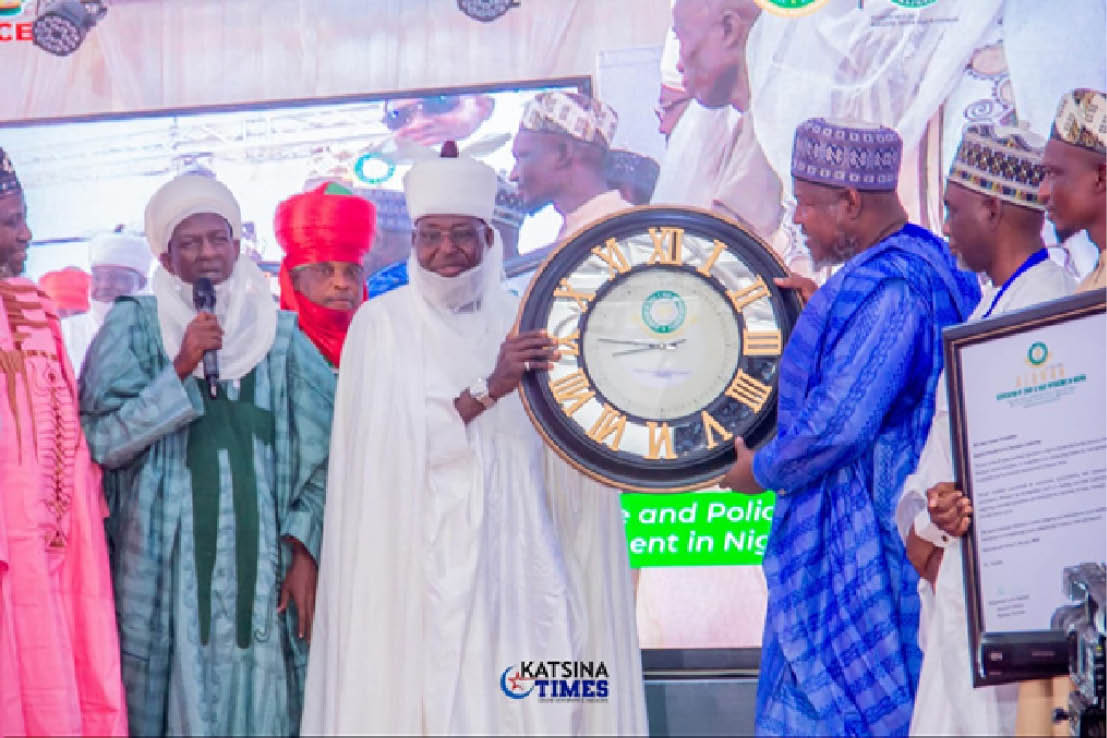
Meanwhile, KAZWAB used the occasion to present special awards to selected district heads who distinguished themselves in Zakat mobilisation, distribution and Waqf development within their emirates. Galadiman Katsina, District Head of Malumfashi in Malumfashi Local Government Area, was recognised as the highest Zakat collector in the state for 2025. Sarkin Maskan Katsina, District Head of Funtua in Funtua Local Government Area, was honoured for establishing what was adjudged the most efficient and well-structured system for Zakat collection and distribution during the year.
Similarly, Dan Madamin Katsina, District Head of Daddara in Jibia Local Government Area, received commendation for initiating the first Waqf project in the state in 2025, while Marusan Daura, District Head of Yandi in Mai’adua Local Government Area, was recognised for the most timely remittance of Zakat.
Governor Dikko Umaru Radda personally presented special commendation awards to the traditional leaders at the conference, applauding their commitment to strengthening institutional Zakat administration through the emirate structure.
UPDATE ON WAQF ASSETS IN AND AROUND KATSINA METROPOLIS
10 shops along WTC Road owned by Majalisin Juma'ah, Bilal Bin Rabah Juma'at Mosque, Kofar Marusa New Lay-Out Katsina. The shops have been rented to selected members of the community while the proceeds are being utilized in running affairs of the Masjid.
Skills acquisition centre at Majalisain Juma'ah new lay out Dandagoro, Katsina. It provides variety of skills training and life support to different categories of the less privileged.
In addition, the centre currently has 32No. Housing units which accommodate 198 children and 50no. Nursing mothers. Also, there are more than 3,000 date plantations and fish farnm whose income provides part of the resources needed to effectively run the centre.
The institution of Waqf in all its ramifications no doubt has needed potential to positively impact and change the current narrative of want, extreme poverty, insecurity, massive youths unemployment if and only if all hands are put on deck by the Ummah.
The Katsina State Zakat and Waqf Board makes a clarion call to the generality of the Muslim Ummah, to wholeheartily embrace making waqf donations in terms of cash, school, college, mosques, orphanages, hospitals, orchards, lands, graveyards among others. In this wise, the prevailing state of economic, educational, and political backwardness beveling the ummah would be eliminated, thus paving way for economic prosperity, peace security and stability.
SOME OF KAZWAB'S ACHIEVEMENTS SO FAR
- Formation of working organizational structure.
- Constitution and inauguration of the Board Members Constitution and inauguration of 62 District Zakat and Waqf Committees across the State.
- Constitution and Inauguration of village Heads and Ward Zakat and Waqf Committees in All Districts across the State.
- Collection and distribution of agricultural produce for the year 2024 farming season.
- Collection and distribution of N86,820 No. bags offarm produce.
- Estimate monetary value of the collected farm produce put at (N4,787,910,150).
- 2.69,162 No. of people benefited from the farm produce distribution.
- Collection of monetary Zakat amounting to (N53,940,121) 596 individuals benefitted from the cash Zakat
- Total agricultural produce and monetary Zakat collected is estimated to the sum of (N4, 841,850,271).
- The monetary value of the certified Wagf assets estimated to the tune of (N7,740,600:00)
- Cash Waqf distributed to various individual- (N2,500,000)
- Total collection of both Zakat and Waqf within 2024/2025 amounted to (N6,582,475,270)
- Ongoing upgrade of Danmnarna cemetery at the cost of (N190,000,000)
- Planting and maintenance of over 2000 date palmn plantation in the new Government House.