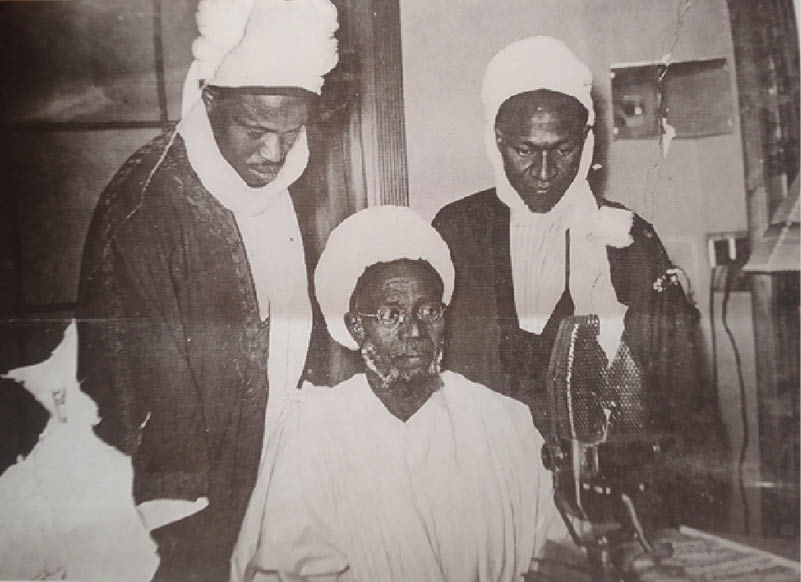
On Tuesday, January 4, 1944, the emir returned from the tour of southern area of the emirate tired and exhausted. The following day, an Arab teacher of his children and grand children, Malam Muhammadu Abdullahi died. The death affected the emir, for he remarked, “Oh! So he left us,” implying he had died before him. His mood reflected a sense of premonition. It was from that day that people noticed that the emir’s health had really deteriorated, though he still attended to some affairs.Some sources say from that day he fell ill and the seriousness of the ailment forced him to stay indoors. Other sources say his terminal illness began when he returned with fever from his usual afternoon hunting at Sauri Lake. His grandchildren, Ladan Fari and Ladan Baki, who usually slept in his room, noticed the seriousness of the illness, when he asked his wives to nurse him.
The wives moved to his room and kept sleeping there instead of the grandchildren, who only came in the morning.’ Naturally, the family, friends a nd officials of the emir became concerned and anxious, belfeving that the energy and time he had spent in seeing to the development and welfare of the emirate had_affected his health. Henceforth, he did not leave his room though he was fully conscious and recognised all those who came to see him. Dr. Nicholson, the town doctor, came regularly and attended to him. His sons, who were living outside the town returned and waited anxiously.
Before he was terminally ill, he had informed his children that in the event of his death he should be buried in his garden, which was near the palace not at Kofar Sauri, where his father and uncle were buried. He told them his wives had threaded and woven the cloth for his shroud, and the where about of the perfume which would be put on his shroud”.
The night of Friday, January 28, the electric lights were left throughout the night contrary to the practice of switching them off at 11pm as the condition of the emir became critical. Ladan Baki, in his usual habit, came to the emir’s room in the following morning. He was alone sitting by the side of his grandfather’s bed when he noticed the emir had fainted. At the same time, Usman Nagogo and Usman Liman came into the room. Aware that their father was dying they began to intone shahada. Usman Nagogo sent out Ladan Baki to his house to fetch food for them. Ladan Baki was aware that his grandfather was dying, and was sent out as a pretext so that he would not see the death of his grandfather. He left the room and on his way to Usman Nagogo’s house, he heard the wailing of women from the palace. Emir Dikko died at 12.40 pm on that Saturday, 29 of January, 1944 after reigning Katsina for 37 years.
Within minutes, the news of the death had spread like wild fire. People were profoundly grieved, many who were under forty, who did not know any emir but Muhamman Dikko, could not imagine living without him. Markets were deserted; people abandoned whatever they were doing and streamed towards the satace, where they stood by speechless. After a while, Waziri Zaiyana requested the people to come for the funeral. Earlier, the deceased’$ sons had, according to his wish, washed his body and shrouded him. Thereafter, they carried the bier outside for he final ritual. The Chief Imam of Katsina led the multitude to prayer. Already a grave was dug at the exact position he requested. With the completion of the prayer, his sons took the bier, still respecting and observing their father’s wish to the graveside, lowered the body and began to pour sand. At this time, mild drama followed as some people, who could not imagine parting with Muhamman Dikko tried to prevent the burial until they were held back.
Emir Dikko had amply justified his choice, and had succeeded in achieving the goal he had set himself - progress and welfare of his people. He was a very able administrator, keenly interested in his people. He proved to be most progressive emir in the Northern Provinces. He was the first to visit England, perform hajj, own a car, fly in an aeroplane and open school for girls. He turned the emirate into a farming belt. His emirate was the first to establish Native Treasury in the Northern Provinces. He saw to the establishment of the departments of education, medical, agriculture, veterinary and works in the Native Administration of his emirate. When the Brits asked him of what reward he liked after he built a fort for them in Katsina, he named the whole kingdom. Well, he got it, for even after his death, hardly is the kingdom mentioned without the kirari “Katsina’s Dikko.”
Like all remarkable men, Emir Dikko, who had helped in shaping the Nigerian history, had his own shortcomings. Born and raised at a time when the idea of public opinion was sarki, his idea of the rights and obligations of prince was that of Abu Abdullah Muhammad ibn Abd al Karim ibn Muhammad al Maghili, which the British considered medieval. However, whenever he insisted on his rights he never failed in his obligations as an emir. In exercising of his power, he was often a bit autocratic - he never believed in delegation of duties and responsibilities. He had a firm grip of the affairs of the emirate to the end. As a result, the council members, except district heads, had no clearly-defined duties and responsibilities vis-a-vis departments of Native Authority. He saw no fault in those dear to him. Despite his somewhat autocratic stance, he had a progressive outlook on affairs, which the British Administrative Officers believed was enlightened even if rated with the European concept. His remarkable administrative ability enabled him to bridge the two without any seeming contradiction.
The article was culled from a book titled;MUHAMMAN DIKKO EMIR OF KATSINA AND HIS TIMES.1865-1944 BY LABO YARI