


BY TAIBAT UMMI YAKUBU
Human rights advocates and diplomats from Australia, Germany and Spain have renewed calls for Nigeria to abolish the death penalty, drawing attention to more than 3,000 people on death row and urging the government to formally halt executions.
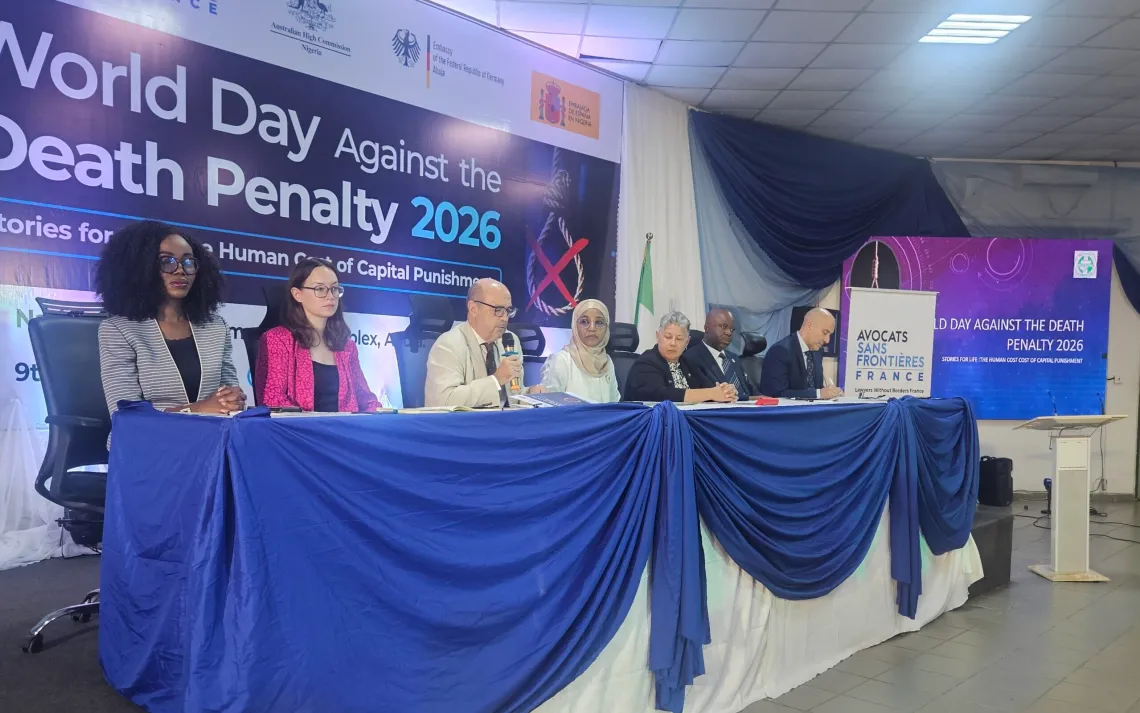
The call was made on Friday in Abuja during an event organised by the National Human Rights Commission (NHRC), in collaboration with Avocats Sans Frontières France and the diplomatic missions of Australia, Germany and Spain, to mark the International Day Against the Death Penalty, observed annually on October 10.
The organisations urged Nigerian authorities to move beyond the longstanding absence of executions and establish a formal moratorium, while reviewing laws that permit capital punishment.
Speaking through the Director of Legal Services and Enforcement, Rabir Anwar, the NHRC Executive Secretary, Tony Ojukwu, said Nigeria needed to translate its prolonged period without executions into an official government policy.
Ojukwu noted that the country was approaching 10 consecutive years without a state execution by December, a development he described as meeting the international standard for a de facto moratorium. However, he expressed concern that thousands of inmates remained on death row for extended periods.
He called on the government to review relevant provisions of the Constitution and the Nigeria Correctional Service Act, including measures that would allow death sentences to be commuted to life imprisonment.
The Australian High Commissioner to Nigeria, Leilani Bin-Juda, commended Nigeria for maintaining the informal halt to executions but urged the government to consider making the arrangement official.
She said Australia opposed capital punishment in all circumstances, describing it as cruel, inhumane and degrading, with no place in a modern justice system.
Bin-Juda also stressed that death sentences affected not only the individuals convicted but also their families and communities, whose lives could be permanently altered by decisions made within the justice system.
While acknowledging Nigeria’s sovereignty and right to determine its own laws, she encouraged the government either to formalise the existing moratorium or reduce the number of offences punishable by death.
Spain’s Ambassador to Nigeria, Felix Costales Arteida, also advocated a review of capital punishment, arguing that there was no convincing evidence that executions deter crime more effectively than other forms of punishment.
He warned that the irreversible nature of the death penalty made it particularly troubling in cases involving wrongful convictions, as judicial errors could result in the permanent loss of innocent lives.
Citing the United States as an example, Arteida said 130 people sentenced to death had been exonerated and released from death row since 1973.
He argued that the strength of a society should be judged not by how harshly it punishes offenders but by its ability to protect fundamental human rights, even when dealing with difficult criminal justice cases.

The Spanish envoy maintained that reviewing the death penalty would not amount to weakness but could instead demonstrate a commitment to justice and the protection of human life.
Representing the German ambassador, Lorena Moore acknowledged the importance of justice for victims but argued that executing another human being could not be the answer to society’s legitimate demand for accountability.
Angela Uzoma-Iwuchukwu, Country Head of Avocats Sans Frontières France, also reaffirmed the organisation’s commitment to campaigning against capital punishment, describing it as a violation of the right to life.
She further argued that the death penalty disproportionately affected vulnerable people, particularly those from poorer backgrounds who might have limited access to adequate legal representation.
The commemoration attracted other diplomatic and legal representatives, including Belgium’s Ambassador, Patrick Englebert, representatives of the European Union and the Nigerian Bar Association, as well as Italy’s Ambassador, Roberto Mengoni.
Meanwhile, the Nigerian Correctional Service reaffirmed its commitment to treating inmates with professionalism and humanity, regardless of the ongoing debate over capital punishment.
Representing the Comptroller-General of the service, Sylvester Nwakuche, Comptroller Olufemi Oluyemi said inmates awaiting execution should not be reduced to case files or statistics.
He explained that correctional officers interacted with inmates daily in different settings and remained aware of the personal experiences of prisoners, the suffering of victims and the concerns of affected communities.
Oluyemi said the service would continue to discharge its responsibilities with integrity and respect for the law, whatever decision the country eventually reached on the future of the death penalty.
A daughter’s story highlights the human cost
The event’s theme, “Stories for Life: The Human Cost of Capital Punishment,” brought personal experiences into the debate through a testimonial from Amanda Arthur, the 21-year-old daughter of Angel Arthur, a survivor of death row.
She recounted how her father was imprisoned at the age of 21 and spent 16 years behind bars before his name was removed from the list of people scheduled for execution. Her father has maintained that he was wrongfully imprisoned.
According to Amanda, the experience continued to shape her father’s life and left a lasting impression on their family, influencing how they viewed society and the justice system.
Her account highlighted the long-term consequences of prolonged imprisonment and the emotional burden carried by relatives of people facing execution.
As calls for reform grow, the debate in Nigeria centres on whether the country should retain capital punishment under existing laws, restrict its application or move towards complete abolition.
For the advocates at Friday’s event, the nearly decade-long absence of executions presents an opportunity for Nigeria to reconsider its position and strengthen safeguards against irreversible miscarriages of justice.



Comments (0)
No comments yet. Be the first to share your thoughts!