



By Muhammad T.I.Safana, mtsafana001@yahoo.com
Before the Standard Was Raised — Katsina in the Age of Kings, Scholars, and Rival Powers
Long before the winds of reform swept across Hausaland, Katsina stood as one of the most illustrious of the original Hausa States. It was a land of prestige and influence, counted among the foremost in power, commerce, and intellectual life. Its capital, encircled by formidable walls stretching nearly eight miles, was not merely a defensive stronghold but a thriving center of trans-Saharan and Sudanese trade. Merchants, scholars, and travelers alike found in Katsina a meeting point of cultures, ideas, and wealth.
Renowned across Hausaland for learning, Katsina produced generations of scholars whose influence extended far beyond its borders. Islamic scholarship flourished, and the city became a beacon of knowledge, rivaling even Timbuktu in reputation within certain circles.
Yet beneath this prosperity lay constant political tension. For centuries, Katsina had contended with Kano in a rivalry marked by frequent warfare. By the eighteenth century, however, a new and more formidable adversary had emerged—Gobir. Following their migration from Ahir, the Gobirawa rose rapidly in military strength and ambition. Their expansion into Zamfara destabilized the regional balance of power.
Katsina, unwilling to see Gobir dominate, aligned itself with the resistance forces of Zamfara. Through towns like Kiyawa, resistance was sustained against Gobir’s advances. These prolonged conflicts, though necessary, drained both sides. Eventually, in 1801, Katsina struck a decisive blow, defeating Gobir and killing its ruler, Sarkin Gobir Yakuba.
It was a victory—but one that came at a cost. The state was left strained, its military and political structures weakened. Unknown to its leaders, a far greater transformation was already on the horizon.
The Call of Reform — The Stirring of a New Order and the Path to Umaru Dallaji
At the dawn of the nineteenth century, Katsina was not only a land of commerce and scholarship but also one of pastoral wealth. Its fertile lands supported large herds of cattle, and among its people lived a significant Fulani population—many of whom were deeply rooted in Islamic learning and reformist thought.
Although Shehu Usman dan Fodio is not recorded to have formally preached in Katsina, his influence was unmistakable. His teachings had already reached the region through disciples and students. Among those connected to him was Umaru Dallaji, a man whose destiny would become inseparable from that of Katsina itself.
When the jihad began, the rulers of Katsina initially observed events with caution. The conflict between Shehu and Gobir seemed, at first, a distant struggle. Indeed, when Yunfa of Gobir called for assistance before the decisive Battle of Tabkin Kwatto, Katsina did not respond.
But after Gobir’s defeat, the perception changed. The jihad was no longer a localized uprising—it had become a powerful and expanding movement. Yunfa himself warned other rulers in a now-famous message: what began as a small flame had grown into an uncontrollable fire.
This warning reached Katsina before Shehu’s own conciliatory message. When Shehu’s letter eventually arrived, it was rejected outright—torn apart by the Sarkin Katsina. That act symbolized more than defiance; it marked the beginning of open hostility.
Soon after, the reformers and their supporters—many of them Fulani—were declared outlaws. Persecution began. Yet, as history often proves, suppression does not extinguish conviction. Instead, it forged unity and resistance.
The Sword and the Standard — Umaru Dallaji’s Campaign for Faith, Justice, and Authority
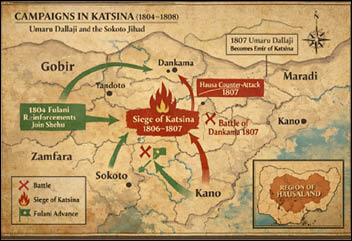
As persecution intensified, the Fulani and reformist elements within Katsina organized themselves into disciplined groups. In 1804, two significant contingents broke through hostile territory and joined Shehu, becoming some of his earliest reinforcements. Their arrival strengthened the jihad both militarily and symbolically.
Among Shehu’s trusted followers was Umaru Dallaji—a figure of courage, discipline, and strategic insight. Having fought in the early campaigns, including the pivotal engagements of the jihad, he distinguished himself as both a warrior and a leader.
By mid-1805, following key developments in Kebbi and Zamfara, Umaru Dallaji was entrusted with a critical mission: to return to his homeland and lead operations in Katsina. This was not merely a military assignment—it was a test of leadership in a land divided against itself.
His timing proved decisive. The Hausa forces had just suffered setbacks against Fulani fighters under Dan Tunku. Seizing the moment, Umaru Dallaji launched an offensive, capturing towns across southern Katsina and establishing a growing base of influence.
Yet one major obstacle remained—Yandoto, a renowned center of Islamic scholarship that rejected Shehu’s teachings. In a conflict driven as much by ideology as by arms, Yandoto represented a powerful intellectual opposition.
Recognizing its importance, Shehu dispatched Bello to address the situation, supported by Umaru Dallaji and others. Attempts at peaceful dialogue were rejected. The town stood firm in opposition. In response, Bello acted decisively, and Yandoto was taken.

With that, the balance shifted. Southern Katsina increasingly fell under reformist control, and Umaru Dallaji’s position strengthened.
The Crown of Katsina — Conquest, Victory, and the Establishment of Dallaji’s Emirate
With the south secured, attention turned to the ultimate prize—the capital of Katsina. Under the coordinated leadership of Umaru Dallaji and his allies, Fulani forces advanced methodically, capturing key military points such as Ranko and Awai.
Reinforcements came from the north under Umaru Dumyawa, whose support added both strength and strategic advantage. The city was soon surrounded, and a prolonged siege began during the dry season of 1806–1807.
Inside the walls, conditions deteriorated rapidly. Food became scarce to the point of desperation—prices soared to unimaginable levels, with even the smallest creatures becoming commodities of survival.
Attempts at negotiation failed. Suspicion ran deep, and trust was absent. Eventually, the Hausa forces were forced to leave the safety of the walls and confront the besiegers in open battle.
The result was decisive.
The Fulani forces, under the determined command of Umaru Dallaji, achieved a complete victory. The Sarkin Katsina was killed, and the city fell. Though a brief counterattack later recaptured the city, it was short-lived. At Dankama, the Hausa resistance was crushed once more.
This final victory sealed the fate of Katsina.
In recognition of his leadership, resilience, and central role in the campaign, Shehu Usman dan Fodio appointed Umaru Dallaji as the first Fulani Emir of Katsina.
It was a moment of profound transformation—the falling of the old order and the rise of a new emirate rooted in reform, faith, and structured authority.
A Legacy Beyond the Throne — The Enduring Heritage of Umaru Dallaji
The establishment of Umaru Dallaji as Emir marked not just a political change, but a deep social transformation. Across Katsina, administrative structures shifted, and new leadership emerged—largely drawn from those who had fought and sacrificed for the cause.
The impact of this change extended beyond Katsina. The victory strengthened the broader jihad, isolated rival like Gobir, and contributed directly to the eventual fall of Alkalawa.
Yet, as with all great transformations, resistance did not vanish. The displaced Hausa elite regrouped under new leadership and established themselves around Maradi. From there, they continued to challenge Fulani authority for generations.
Still, the foundations laid by Umaru Dallaji endured.
His rule was not marked by unchecked absolutism. Through deliberate political arrangements, power within the Emirate was balanced among key leaders, ensuring stability and continuity. This structure distinguished Katsina from other emirates and shaped its governance for years to come.
Today, the legacy of Umaru Dallaji is not confined to history books. It lives on—in institutions, in traditions, and in the lineage of those who trace their heritage to him.
He was more than a commander.
More than an emir.
He was a founder of a new Katsina—one whose impact echoes across centuries.



Comments (0)
No comments yet. Be the first to share your thoughts!