


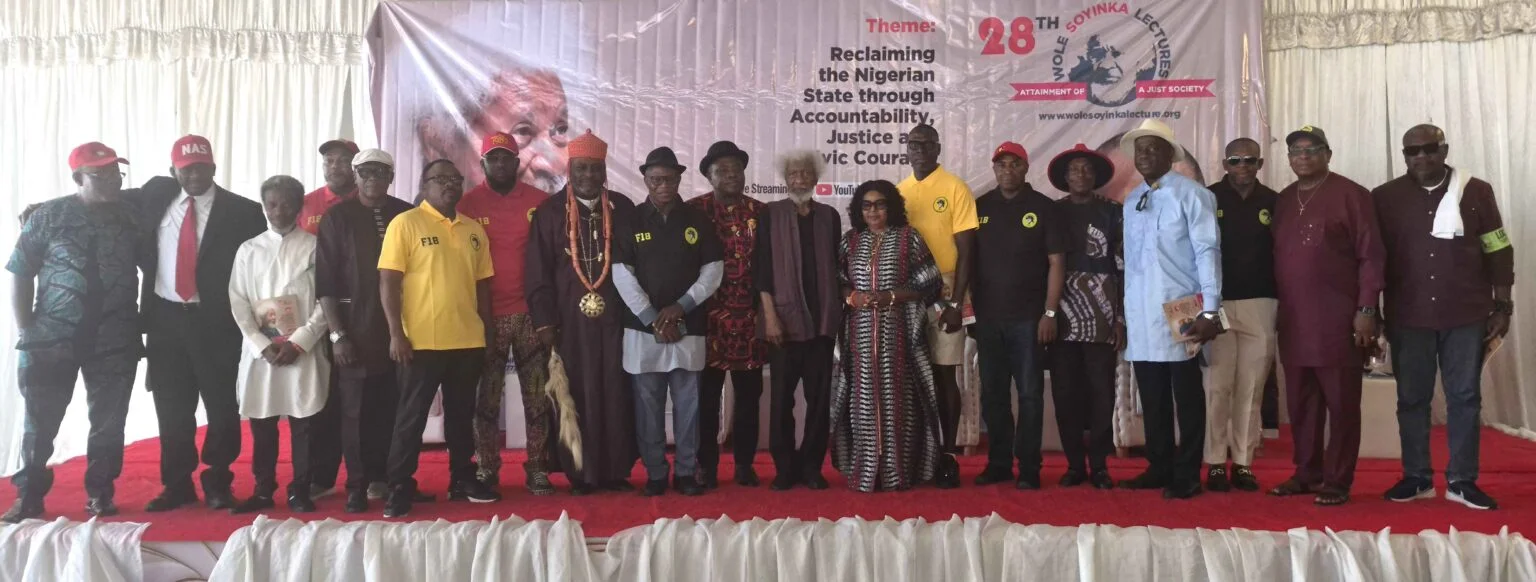
Nobel Laureate, Prof. Wole Soyinka, has challenged President Bola Ahmed Tinubu to make public the findings of investigations into unresolved assassinations and extrajudicial killings, warning that Nigeria risks normalising impunity if justice continues to be delayed or denied.
Soyinka made the appeal on Friday in Port Harcourt during the 28th Wole Soyinka Lecture organised by the National Association of Seadogs (Pirates Confraternity), an event that also commemorated the association’s annual Martyr’s Day.
Speaking on the theme, “Reclaiming the Nigerian State through Accountability, Justice and Civic Courage,” the renowned playwright expressed concern over what he described as Nigeria’s troubling history of unlawful arrests, prolonged detentions, unresolved political killings and extrajudicial executions.
He said successive administrations had failed to provide answers for victims and their families, leaving many high-profile cases buried under years of silence and inaction.
“This lecture is dedicated to the martyrs, to those who have needlessly and avoidably had their lives wasted,” Soyinka declared.
The literary icon argued that countless Nigerians had lost their lives at the hands of state actors or other perpetrators without anyone being brought to justice, creating a dangerous precedent that undermines public trust in democratic institutions.
Referring to the killing of Deborah Samuel, the Sokoto student who was lynched by a mob, Soyinka described the incident as one of the country's enduring symbols of injustice and institutional failure.
According to him, the tragedy extended beyond the act itself to the inability of authorities to ensure accountability.
“The crime is not only the killing. The greater crime is the silence that followed and the failure to hold those responsible accountable,” he said.
Soyinka stressed that no democracy could thrive when citizens are killed in broad daylight and those responsible escape punishment. He rejected suggestions that discussions about such cases were intended to inflame ethnic or religious tensions, insisting that the protection of human life must remain the cornerstone of any democratic society.
“I want the justice system in Nigeria not to fail us again. I don’t want it to create a pattern of impunity where human lives are treated as disposable,” he stated.
The Nobel Laureate recalled that shortly after assuming office in 2023, President Tinubu reportedly requested files relating to unresolved assassinations and extrajudicial killings. He urged the President to release the findings and ensure those responsible are held accountable.
“I want Nigerians to join me in asking President Tinubu to bring out those files. We want to know what happened, why it happened and who should be held accountable,” Soyinka said.
He noted that the annual lecture was designed not only to honour victims of injustice but also to remind citizens of their collective duty to defend human dignity, demand accountability and resist all forms of impunity.
Soyinka further called on Nigerians to work towards building a society where justice is not selective and where respect for human life remains sacrosanct.

In his keynote address, former Minister of Aviation, Chief Osita Chidoka, argued that justice begins long before a matter reaches the courtroom. He said the foundation of a fair justice system lies in how complaints are handled by security agencies and whether decisions are guided by merit rather than political or personal influence.
Chidoka raised concerns over the growing number of inmates awaiting trial across the country, revealing that about 64 per cent of individuals in custodial centres had yet to be convicted.
According to him, more than 50,000 Nigerians remain behind bars awaiting trial, a situation he described as a serious human rights concern.
“Each of these 50,000 is a life in suspension. When the state causes that delay and citizens pay with their liberty, the delay becomes a form of violence,” he said.
He maintained that justice must apply equally to all citizens, regardless of their political affiliation, ethnicity, religion or social standing.
“The law is not established when it protects only our family and friends. Justice must defend the accused, the unpopular, the political opponent and the minority,” Chidoka added.
Also speaking at the event, Chairman of the occasion and former Managing Director of the Niger Delta Development Commission (NDDC), Timi Alaibe, identified tribalism, weak institutions and poor accountability as some of the major factors hindering Nigeria’s progress.
Alaibe noted that despite its vast human and natural resources, Nigeria continues to struggle because institutions responsible for enforcing accountability have been weakened, while policy implementation remains inconsistent.
According to him, the country’s challenge is not a shortage of solutions but a failure to act on existing knowledge and recommendations.
“Too often, the institutions designed to hold power accountable have been weakened, while justice remains a privilege rather than a right for many Nigerians,” he said.
The former NDDC chief also highlighted the founding ideals of the National Association of Seadogs, saying the organisation was established on principles that reject colonialism, ethnic chauvinism, clannishness and partisan interests.
He emphasised that rebuilding the Nigerian state would require both strong institutions and courageous citizens willing to uphold justice without fear or favour.
“Reclaiming the Nigerian state will not come through one dramatic event but through the steady accumulation of principled choices by citizens, institutions and leaders,” Alaibe said.



Comments (0)
No comments yet. Be the first to share your thoughts!