



By Zaharaddeen Ishaq Abubakar | Katsina Times
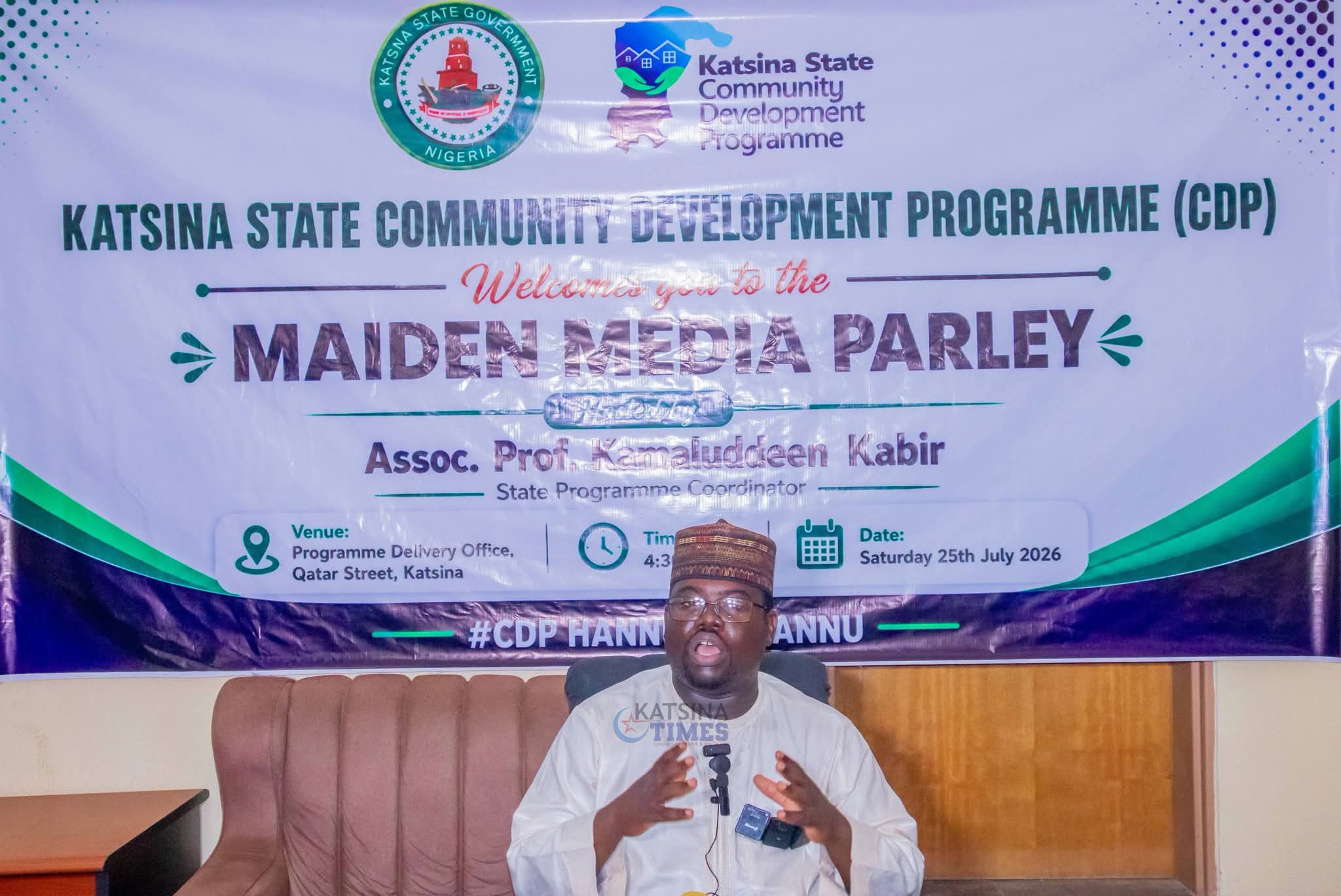
The Katsina State Government says its Community Development Programme (CDP) has transformed governance at the grassroots by allowing communities to identify, prioritise and execute projects that directly address their needs across the state's 361 political wards.
Speaking during the maiden media parley of the Katsina State Community Development Programme held at his office in Katsina on Saturday, July 25, 2026, the State Programme Coordinator, Assoc. Prof. Kamaluddeen Kabir, said Governor Dikko Umaru Radda introduced the initiative to ensure that development decisions originate from local communities rather than government offices.
"The governor does not want to remain in Government House deciding what communities need. He wants the people themselves to determine their priorities and participate in implementing them," Kabir said.
According to him, the programme was conceived following Governor Radda's inauguration pledge to transform rural communities through a community-driven development model that gives residents direct ownership of projects affecting their lives.
Kabir explained that the implementation framework rests on three committees comprising the State Steering Committee chaired by Governor Radda, the Joint Planning Committee headed by Deputy Governor Faruk Lawal Jobe, and Community Development Committees established in each of the state's 361 wards.
He said every ward now has three trained officers—a Community Development Officer (CDO), Community Liaison Officer (CLO) and Community Support Officer (CSO)—bringing the total workforce deployed under the programme to 1,083 personnel.
The coordinator noted that the community committees comprise representatives of women, youths, persons living with disabilities, traditional institutions and other stakeholders responsible for identifying development priorities through town hall meetings before forwarding them to government for implementation.
Kabir disclosed that the state government released ₦10 million to each of the 361 wards, amounting to ₦3.61 billion, to finance small-scale community projects requiring immediate intervention.
He said the funds have enabled communities to rehabilitate schools, primary healthcare centres, drainage systems, water facilities, solar-powered street lighting and other public infrastructure without going through lengthy bureaucratic procedures.
"As of last month, communities had repaired and rehabilitated more than 3,900 public facilities, while many additional projects are ongoing across the state," he said.
He added that the initiative has revived abandoned water points, improved public schools and health facilities, and strengthened community ownership of public assets.

Kabir further stated that the programme has enhanced inclusion by ensuring that women, youths and persons living with disabilities actively participate in decision-making and benefit from government interventions.
He explained that community structures also help government accurately identify genuine beneficiaries for empowerment programmes, including farmers, nano-business operators and vulnerable groups.
On budget planning, the coordinator said Governor Radda directed all 361 wards to organise town hall meetings before preparing the 2026 budget so that community priorities could be incorporated into the state's appropriation.
According to him, the same process has already commenced for the 2027 budget, allowing residents to determine projects they want government to execute in their respective communities.
Kabir described the approach as a major departure from conventional governance, saying it ensures public resources are allocated according to the actual needs of citizens.
He cited a community that requested the training of local plumbers instead of additional infrastructure because residents previously travelled to neighbouring local governments whenever public water facilities developed faults.
"Today, that community now has more than seven trained plumbers capable of maintaining its water infrastructure," he said.
The coordinator said the programme's current priority is to intensify public awareness through media campaigns and advocacy so that every resident knows the designated Community Development Officer, Community Liaison Officer and Community Support Officer responsible for his or her ward.
He urged residents to utilise the community structures to report urgent development needs and monitor projects being implemented in their localities.
Kabir maintained that the Community Development Programme has become one of the state government's key instruments for deepening participatory governance and accelerating sustainable grassroots development across Katsina State.

Comments (0)
No comments yet. Be the first to share your thoughts!