


By Zaharaddeen Ishaq Abubakar
The Katsina State Government has unveiled a comprehensive reform agenda aimed at improving the quality, transparency and efficiency of public project procurement, with plans to institutionalise quarterly technical reviews, strengthen professional standards and integrate Artificial Intelligence (AI) into project management.
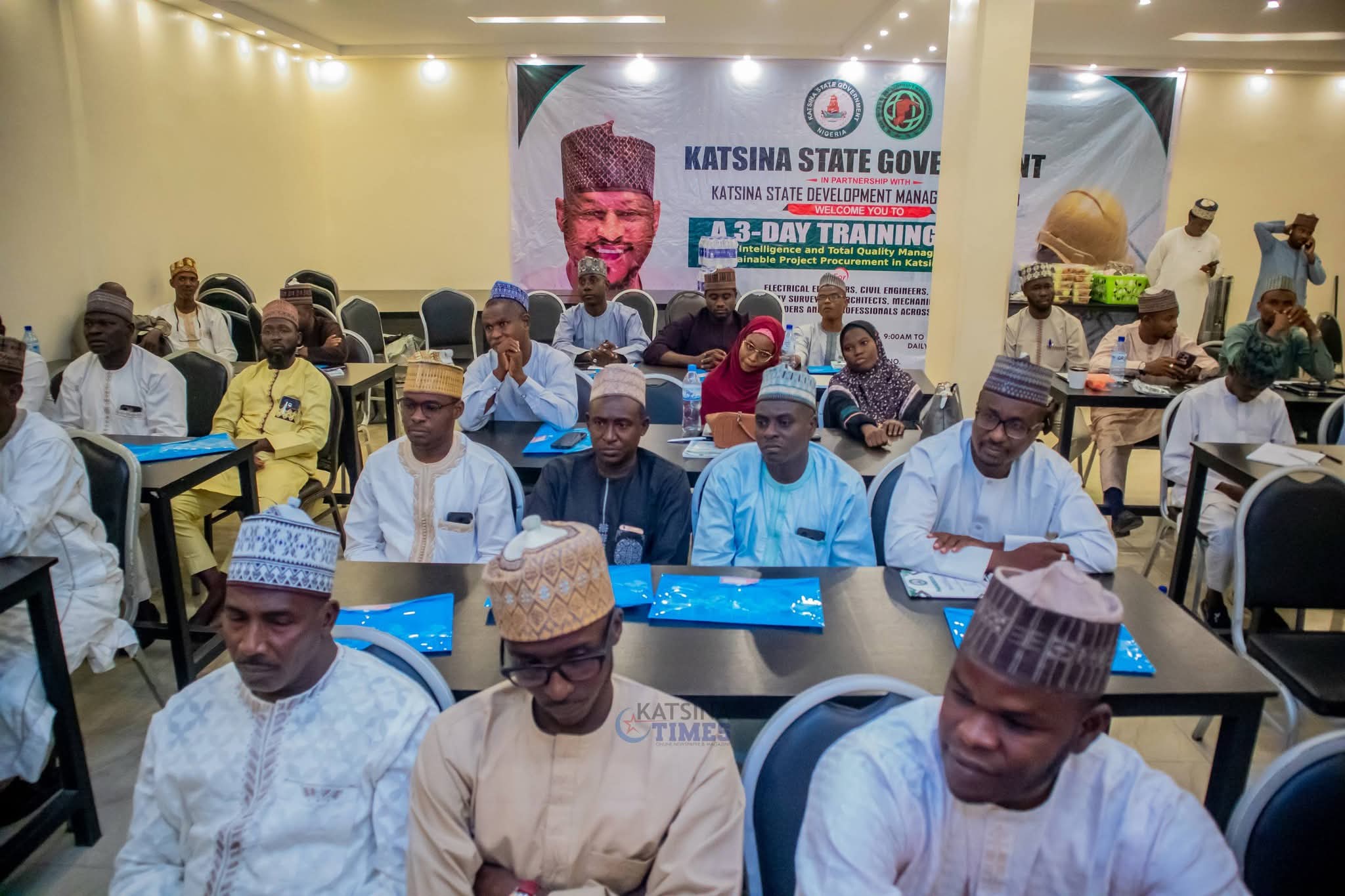
The reforms were announced during a two-day workshop on the implementation of Total Quality Management (TQM) and Price Intelligence in Sustainable Project Procurement, organised by the Katsina State Government in collaboration with Ahmadu Bello University Consultancy Services (ABUCONS) in Kano.
The workshop brought together engineers, quantity surveyors, procurement officers, project managers and senior government officials from ministries, departments and agencies (MDAs) to enhance technical capacity and promote value-for-money in public projects.
Quarterly reviews, AI integration planned
Speaking at the opening of the workshop, the Executive Secretary of the Katsina State Development Management Board (KTDMB), Dr Mustapha Shehu, disclosed that the state government had approved quarterly professional review meetings to continuously evaluate procurement practices and address emerging challenges.
He said the reviews would provide a platform for professionals to improve technical standards while advising government on policy reforms.
According to him, future engagements will also explore how Artificial Intelligence can ethically support engineers and other professionals in preparing, reviewing and monitoring technical documents.
"Our objective is not only to review technical documents but also to agree on administrative reforms that will strengthen professionalism across the civil service," he said.
Dr Shehu stressed the need for continuous professional licensing and certification for engineers, administrators, ICT professionals and other specialists, saying professional development remained essential to improving public service performance.
He revealed that the government was considering funding annual renewal of professional licences for relevant officers either through the Ministry of Works or another approved mechanism.
Better welfare for project supervisors
The KTDMB Executive Secretary also called for improved welfare for engineers and project supervisors, lamenting that many officials were expected to supervise multi-billion-naira projects without official vehicles, transport support or field allowances.
He argued that effective monitoring could only be achieved when professionals were adequately equipped and compensated.
Dr Shehu further criticised situations where contractors prepared technical documents themselves before presenting them for official endorsement, describing the practice as a major weakness that undermined professional integrity.
He assured participants that the government would continue to protect the statutory rights of professionals and strengthen their participation in policy formulation and project implementation.
Radda administration committed to procurement reforms
Declaring the workshop open, the Special Adviser to the Governor on Public Service Administration Reforms, Alhaji Usman Isyaku, said the programme aligns with Governor Dikko Umaru Radda's reform agenda of promoting accountability, transparency and prudent management of public resources.
He said the administration had established several oversight institutions to strengthen governance, including agencies responsible for procurement regulation, anti-corruption, project monitoring and public service reforms.
According to him, improving technical competence in Total Quality Management and Price Intelligence would help government standardise pricing, reduce waste, eliminate avoidable expenditure and improve value for money in public projects.
He urged participants to apply the knowledge gained during the workshop and share it with colleagues to institutionalise best procurement practices across government.

Quality, transparency remain critical
The Commissioner for Works, Housing and Transport, Engr. Dr Sani Magaji Ingawa, described quality assurance and price intelligence as indispensable tools for successful infrastructure delivery.
He said government projects should not only be completed but must also meet quality standards, remain durable and satisfy public expectations.
The commissioner noted that effective price intelligence enables government to make informed decisions, prevent inflated project costs, encourage healthy competition and ensure prudent utilisation of public funds.
He called on participants to use the training to strengthen expertise in project planning, monitoring, quality control and financial management.
Monitoring and evaluation key to project success
The Special Adviser to the Governor on Strategic Policy, Implementation, Monitoring and Evaluation (SPIME), Aminu Ibrahim Ida, said the workshop came at a critical time as government intensifies efforts to improve monitoring and evaluation of public projects.
He observed that weak monitoring often leads to poor project delivery despite huge investments.
According to him, effective monitoring and evaluation remain essential complements to engineering and procurement processes, stressing that government would continue collaborating with relevant agencies to strengthen project oversight.
Lowest bidder not always the best
Also speaking, the Director-General of the Katsina State Bureau for Public Procurement, Alhaji Badamasi Ya'u 'Yantumaki, challenged the widespread belief that government contracts should automatically be awarded to the lowest bidder.
He explained that procurement laws require contracts to be awarded to the lowest evaluated responsive bidder, whose pricing is realistic and technically compliant.
According to him, unrealistic pricing often results in abandoned or substandard projects and poses greater risks than inflated costs.
He said price intelligence has become one of government's strongest tools against procurement fraud, adding that the workshop would improve participants' understanding of cost management, market analysis and quality assurance.
Officials report immediate impact
In his remarks, the Special Adviser to the Governor on Local Government Inspectorate, Alhaji Lawal Rufa'i Safana, said the training had already changed his approach to project supervision.
He disclosed that lessons learned during the sessions had strengthened his confidence in assessing ongoing projects and informed his decision to review a project scheduled for inspection.
Safana welcomed the government's decision to institutionalise quarterly capacity-building programmes and called for more training for officers responsible for project monitoring and evaluation.
He described the workshop as highly interactive and practical, saying it had equipped participants with better knowledge to improve project supervision across the state.
The two-day programme focused on strengthening procurement governance, promoting professional standards and ensuring sustainable delivery of public infrastructure through improved quality management, price intelligence and effective project monitoring.

Comments (0)
No comments yet. Be the first to share your thoughts!