By Zaharaddeen Ishaq Abubakar (Katsina Times) Kano Nigeria
Senior government officials in Katsina State have called for strengthened local governance structures, expanded youth empowerment initiatives and deeper community participation as critical tools for addressing insecurity and sustaining peace across the state.
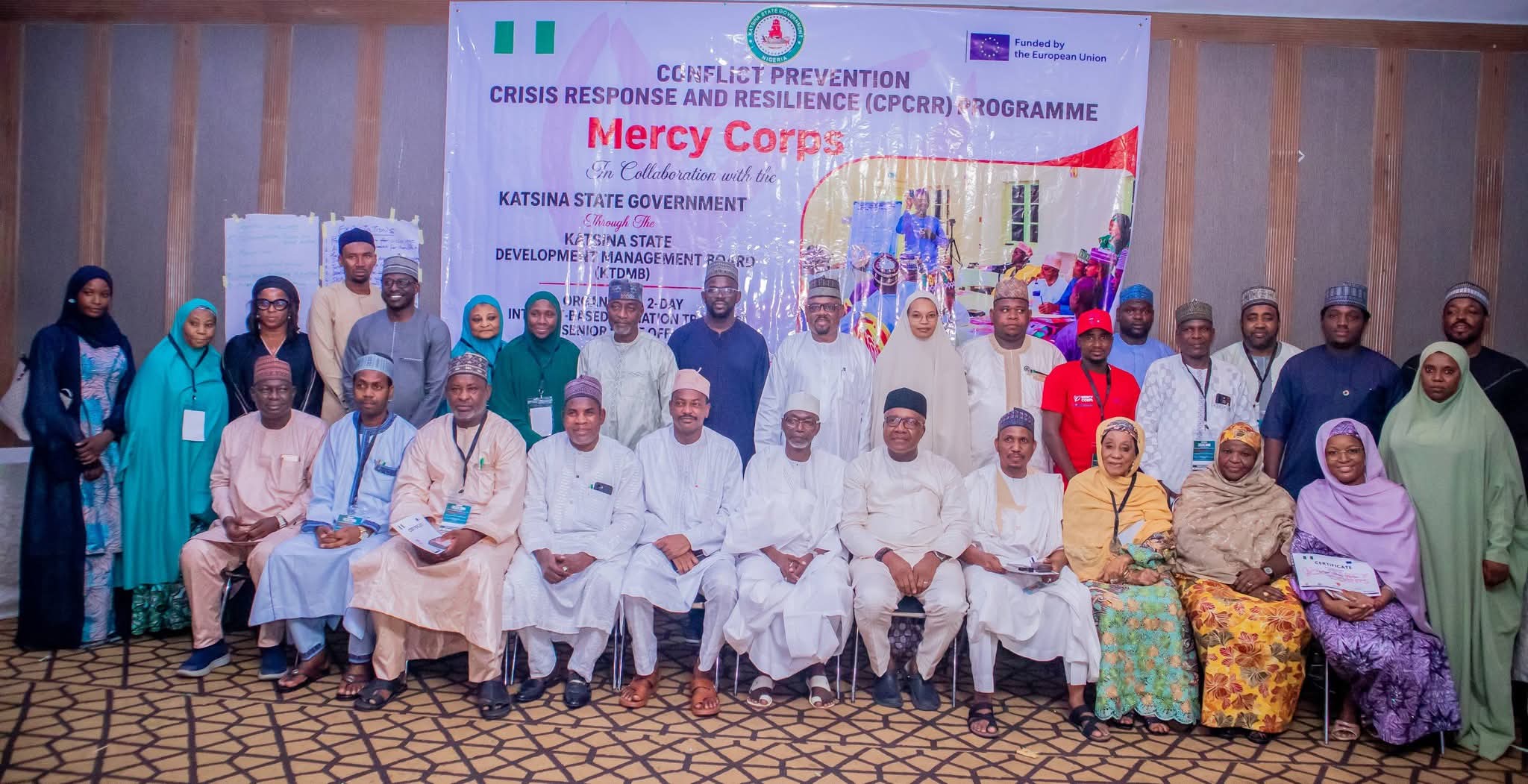
The officials made the call on Friday during the second day of a two-day Interest-Based Negotiation and Mediation (IBNM) training organised under the Conflict Prevention, Crisis Response and Resilience (CPCRR) Programme, implemented by Mercy Corps in collaboration with the Katsina State Government, the Centre for Democracy and Development (CDD), and the International Organization for Migration (IOM).
Speaking during a media engagement session, the Commissioner for Local Government and Chieftaincy Affairs, Bishir Tanimu Gambo Dutsinma, said reforms in the local government system have improved service delivery and helped mitigate the impact of insecurity, particularly in rural communities.
He said local councils are now more functional and better positioned to execute development projects and stimulate economic activity at the grassroots level under the current administration of Governor Dikko Umaru Radda.
According to him, transparency, accountability and effective leadership remain essential for rebuilding public trust and addressing structural drivers of conflict and criminality.
Dutsinma also urged media practitioners to uphold responsible journalism in order to promote peace, stability and social cohesion.
The Commissioner for Basic and Secondary Education, Yusuf Suleman Jibiya, said the ministry is developing skills acquisition programmes for primary and secondary schools aimed at improving employability and reducing youth unemployment.
He said pilot implementation would soon commence across selected schools in the state’s three senatorial districts, with a focus on practical and vocational competencies aligned with labour market demands.
Jibiya also advocated greater inclusion of youths and women in governance and policy processes, noting that both groups remain disproportionately affected by conflict and insecurity.
The Commissioner for Livestock Development, Prof. Ahmad Muhammad Bakori, highlighted ongoing government efforts to address farmer-herder conflicts through structured community-based conflict resolution mechanisms.
He said multi-stakeholder committees comprising traditional rulers, security agencies, farmers, and livestock representatives have been established across the state to facilitate early dispute resolution and promote peaceful coexistence.
Bakori noted, however, that sustained capacity-building is required to strengthen the effectiveness of local peace structures and improve mediation outcomes at the community level.
Senior Special Assistant on Victims of Banditry and Internally Displaced Persons (IDPs), Sa’id Ibrahim Koguna, called for increased investment in vocational training, apprenticeship systems and entrepreneurship support for vulnerable youths, particularly those outside formal education pathways.
He said sustainable peace and security can only be achieved when economic opportunities are expanded to reduce frustration, exclusion and vulnerability among young people.
The Commissioner for Youth and Sports Development, Engr. Surajo Yazid Abukur, said young people must remain central to peacebuilding and development interventions.
He urged stakeholders to expand youth-focused programmes and strengthen community-based organisations to enhance participation in conflict prevention and social development processes.
Abukur commended Mercy Corps, the European Union, IOM and other development partners for their continued support to peacebuilding and resilience initiatives in the state.
The Commissioner for Rural Development, Prof. Abdulhamid Ahmad, emphasised the need for sustainability in development programming, noting that the state government has established institutional frameworks to ensure continuity of rural infrastructure projects beyond donor-funded interventions.
He cited the creation of dedicated agencies for rural access development and road maintenance as part of efforts to institutionalise long-term development planning.
The Commissioner for Agriculture, Aliyu Zakari Shargalle, highlighted progress recorded under youth-focused agricultural empowerment programmes, noting that hundreds of youths across the state’s 34 local government areas have benefited from training and financial support.
He said many beneficiaries have established viable agricultural enterprises, contributing to job creation and local economic development.
Participants at the workshop reiterated that effective conflict prevention requires stronger institutions, inclusive governance systems, meaningful youth engagement, and sustained collaboration among government agencies, civil society organisations and development partners.
The training forms part of ongoing efforts under the CPCRR Programme to strengthen the capacity of senior government officials in conflict prevention, mediation and crisis response in Katsina State.