By Zaharaddeen Ishaq Abubakar (Katsina Times)
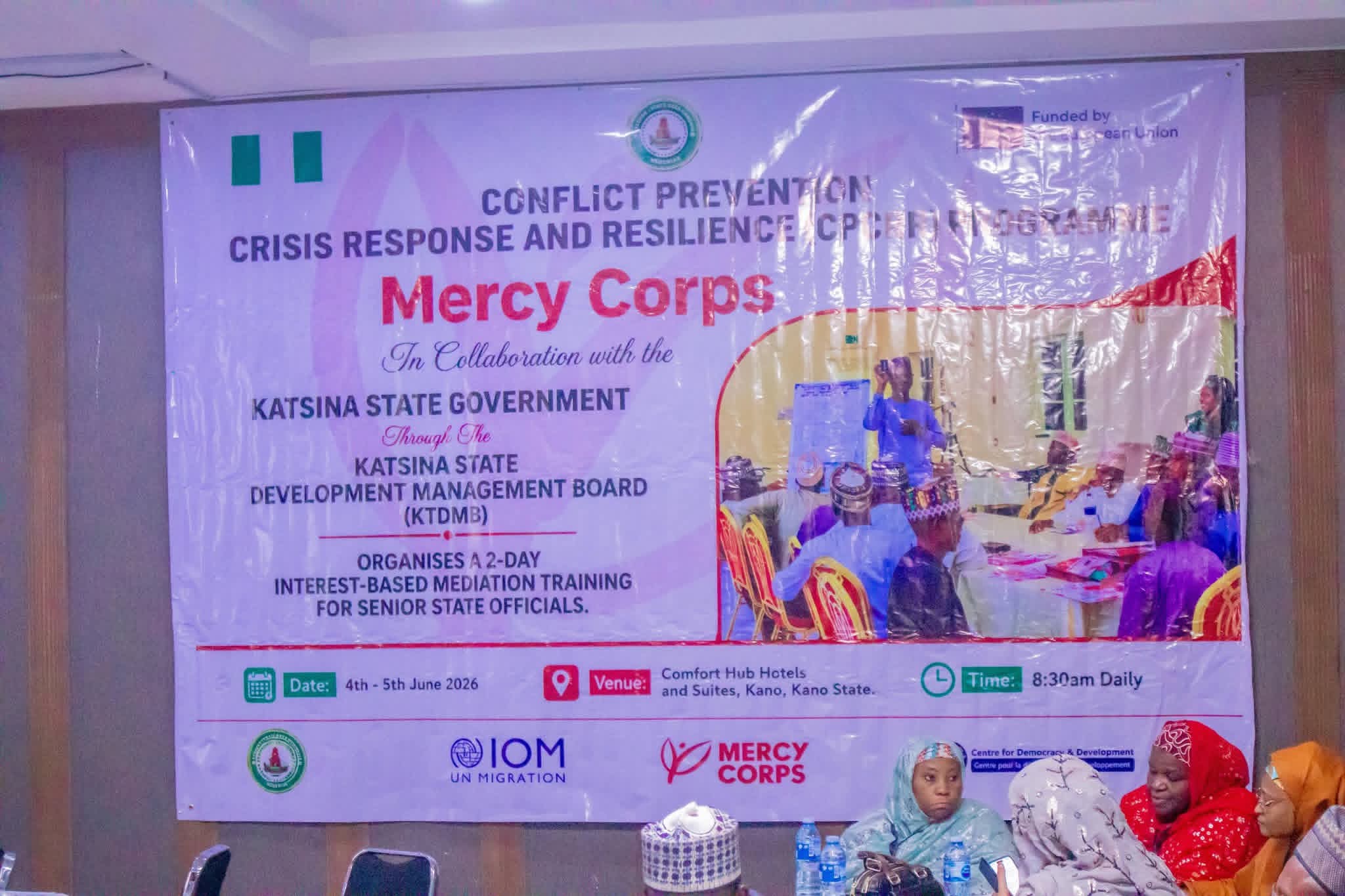
Senior government officials from Katsina State have commenced a two-day training on Interest-Based Negotiation and Mediation (IBN+M) under the Conflict Prevention, Crisis Response and Resilience (CPCRR) Programme implemented by Mercy Corps in collaboration with the Katsina State Government through the Katsina State Development Management Board (KTDMB).
The training, which began on June 4, 2026, at Comfort Hub Hotel in Kano State, aims to strengthen the capacity of state officials in conflict management, mediation, and peacebuilding to promote sustainable development and social cohesion.
Speaking during the opening session, the Executive Director of KTDMB, Dr. Mustapha Shehu, underscored the critical relationship between peace, security, and development, noting that sustainable food production and improved nutrition can only be achieved in a peaceful environment.
Dr. Shehu said discussions held with stakeholders on nutrition highlighted the inseparable link between peace and food security, stressing that farmers must have safe access to their farmlands before communities can achieve adequate nutrition and economic stability.
He emphasized that stakeholders across sectors—including education, health, livelihoods, livestock, women affairs, and community development—have vital roles to play in maintaining peace within their communities.
The KTDMB chief also called for early planning toward sustaining the gains of the CPCRR programme beyond its current implementation cycle. He noted that possible changes in government leadership in the coming year make it necessary to institutionalize peacebuilding initiatives and ensure continuity.
Dr. Shehu further commended the contributions of women leaders and policy advocates who have supported key government reforms, including policies promoting greater female representation in education administration and initiatives supporting the distribution of sanitary materials to girls in secondary schools.
According to him, such stakeholders will continue to serve as a bridge between government and non-government actors to ensure that important policies are effectively implemented.
He also acknowledged the role of the media in promoting peace and accountability, thanking participants for attending the training and expressing optimism that the programme would contribute significantly to strengthening conflict management mechanisms in the state.
The first day of the workshop featured sessions on conflict management, the Interest-Based Negotiation approach, negotiation simulations, and an introduction to Interest-Based Mediation. Participants were also introduced to the Interest-Based Negotiation and Mediation (IBNM) framework and its seven core elements.
The training was facilitated by conflict resolution experts Lynda Emmanuel and Tig Gang.
Speaking during one of the sessions, Gang traced the origins of the Interest-Based Negotiation approach to the Harvard Negotiation Project, founded by legal scholars and conflict resolution practitioners seeking alternatives to violence and adversarial conflict resolution.
He explained that the methodology has been applied globally in addressing complex disputes and has influenced peace processes in several countries. According to him, the approach was utilized in efforts connected to the resolution of the 1979 Iranian hostage crisis, negotiations that helped end apartheid in South Africa, and peace initiatives aimed at resolving the long-standing border dispute between Ecuador and Peru.
Gang noted that Mercy Corps adopted the approach following its merger with the Conflict Management Group in 2004 and has since applied it in peacebuilding and conflict-resolution programmes across various regions of the world.
The CPCRR programme is designed to strengthen resilience, promote peaceful coexistence, and enhance local capacities for conflict prevention and crisis response in communities affected by insecurity and social tensions.