NEWSFLASH
The Katsina State Youth Craft Village (KYCV), in collaboration with the National Board for Technical Education (NBTE), has successfully concluded a comprehensive Quality Assurance Assessors Training Programme at its Katsina centre.
The initiative is designed to strengthen skills-based education and improve competency evaluation across various vocational trades, in line with national standards for technical and vocational education.
The KYCV Coordinator, Engr. Kabir Abdullahi Kofar Soro, said the initiative is the first of its kind in Northern Nigeria and reflects ongoing reforms in skills development.
He noted that the programme is being implemented with the strong support of Katsina State Governor, Malam Dikko Umaru Radda, as part of broader efforts to transform technical and vocational education in the state.
Speaking at the conclusion of the training, NBTE consultant, Khalil Yusuf, explained that the programme began in March with two weeks of intensive classroom instruction, followed by eight to twelve weeks of fieldwork, and a final assessment phase.
He added that while the programme is ideally structured to last three months, it may extend up to six months depending on learners’ progress and performance.
"The programme is ideally structured to last three months, but may extend to six months depending on the performance and pace of the learners," Yusuf said.
He further emphasized that the initiative is intended to bridge the gap between theoretical knowledge and practical industry skills, noting that traditional examination systems alone are no longer sufficient for measuring true competence.
"We are moving beyond paper qualifications to practical, demonstrable skills. What matters now is what an individual can actually do," he added.
According to Yusuf, 35 participants were initially enrolled in the programme, with 33 successfully completing the training. He expressed confidence that the initiative would achieve a success rate of over 90 percent.
Participants were trained across a wide range of vocational areas, including carpentry and joinery, electrical and solar installation, catering and hospitality, fashion design and garment making, as well as ICT-related disciplines.
He also noted that the programme would help formalize the informal sector by properly documenting skilled workers and their contributions to the economy.
"This will not only standardize skills but also enhance job creation and drive economic growth within Katsina State," he said.
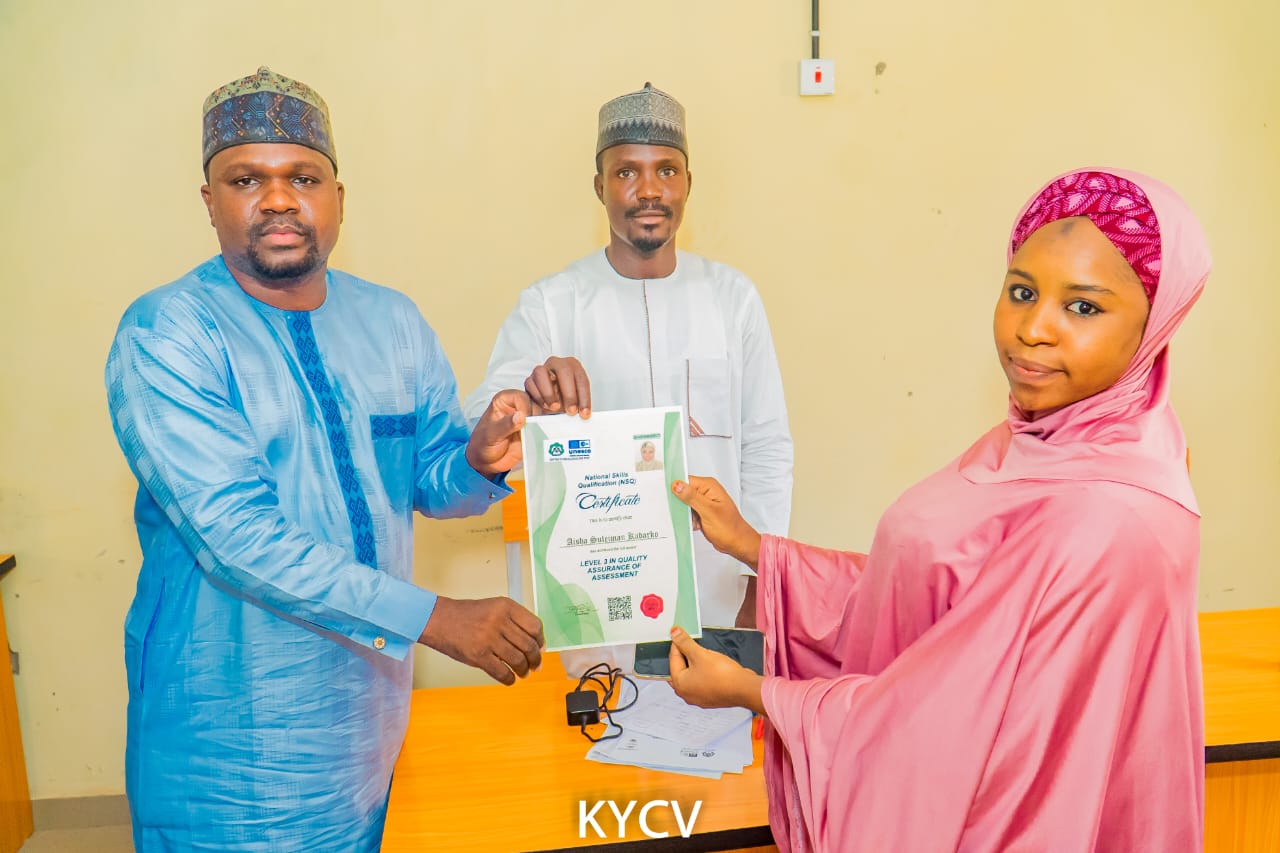
Yusuf explained that the graduates are now certified Quality Assurance Assessors, responsible for evaluating learners in line with National Occupational Standards developed by NBTE.
He added that they are expected to pursue continuous professional development, with progression pathways from Level 3 to Level 4 in Internal Quality Assurance, while Level 5 is reserved for external regulatory roles.
One of the participants, Ibrahim Isa, who specialized in electrical and solar installation, described the training as highly transformative.
"This programme has given me a deeper understanding of competency-based assessment. I have moved from informal methods to a structured system of evaluating learners’ skills," he said.
He added that the blend of classroom learning and field experience enabled him to accurately assess learners’ competencies.
"I am now better equipped to train and assess students effectively. This initiative exceeded my expectations, and I commend the Katsina State Government for making it possible," he stated.
Similarly, Muhammad Ahmad from the ICT department said the training reshaped his understanding of education and assessment.
"It shifts the focus from traditional examinations to practical, skills-based evaluation. Learners are assessed based on what they can actually do," he said.
He noted that the programme aligns with global best practices, where practical competence is prioritized over academic certificates.
"The presence of trained assessors across various trades will greatly strengthen quality assurance within the centre," he added.
Ahmad also commended the Katsina State Government for sponsoring the initiative and expressed optimism that similar programmes would be extended to other institutions.
"This training has positioned us to contribute meaningfully to skills development and economic growth," he said.
The programme, officially known as the Quality Assurance Assessors Training (Level 3) under the National Skills Qualification Framework, represents a significant milestone in aligning vocational education in Katsina State with both national and international standards.
It is expected to further strengthen KYCV’s capacity to deliver competency-based training while contributing to workforce development and broader economic growth in the state.