


Zaharaddeen Ishaq Abubakar | Katsina Times
The Nigerian Institute of Architects (NIA) has called on governments at all levels to give architects greater roles in policymaking, housing delivery, urban planning and infrastructure development, saying their professional expertise is critical to addressing Nigeria’s development challenges.
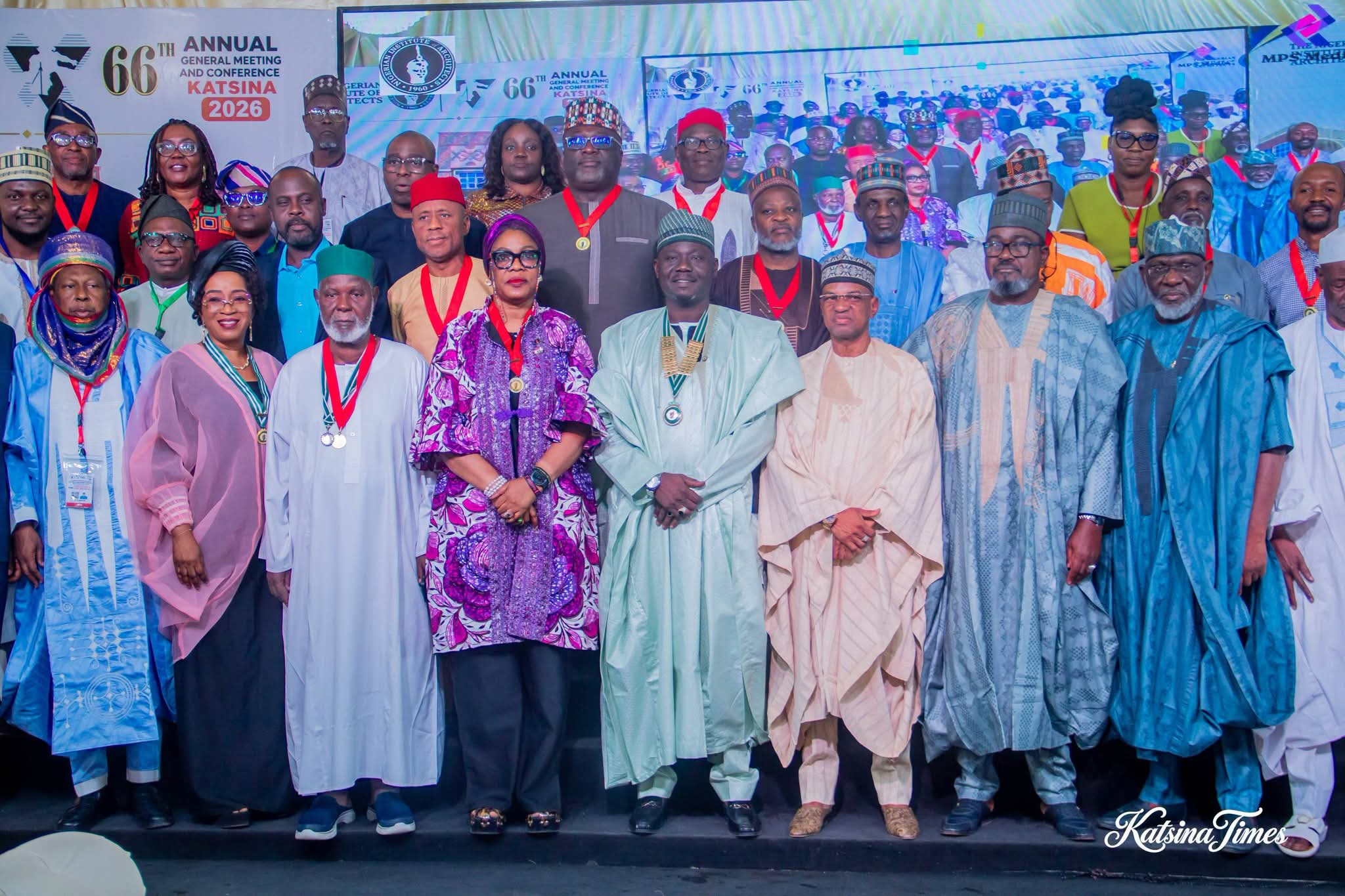
The President of the Institute, Arc. Sani I. Saulawa, FNIA, PNIA, made the call on Thursday at the opening of the NIA’s 66th Annual General Meeting (AGM) and Conference held at the Continental Sports Centre, Katsina State.
Speaking on the theme, “Architects as Agents of Social Transformation 2.0,” Saulawa said architecture extended beyond the design and construction of buildings, stressing that decisions made by architects had far-reaching implications for public health, livelihoods, economic opportunities, social inclusion, environmental sustainability and the dignity of communities.
He said Nigeria’s growing challenges in housing, infrastructure, rapid urbanisation, climate adaptation and equitable development required architects to expand their professional responsibilities and become more actively involved in policy formulation, economic planning and governance.
According to him, architectural excellence alone cannot guarantee social transformation without supportive public policies, responsible investment, institutional collaboration and sustained political commitment.
“Architecture is fundamentally about people. Beyond the buildings and physical spaces, our decisions influence livelihoods, public health, economic opportunities, social inclusion, environmental resilience and the dignity of communities,” he said.
The NIA president observed that technological advancement and changing global realities were reshaping the profession, urging practitioners to embrace innovation, modernise architectural education, adopt digital technologies and strengthen mentorship while maintaining professional ethics.
He said the Institute had made progress over the past three years in rebuilding unity, strengthening institutional governance, restoring professional confidence and creating opportunities for wider collaboration.
However, he maintained that the ultimate measure of the Institute’s achievements should be its relevance and contribution to society.
“Our future cannot depend merely upon defending professional territory. It must be secured by demonstrating measurable value to the Nigerian people,” he stated.
FG Seeks Stronger Partnership With Architects
The Federal Government has called for stronger collaboration with the Nigerian Institute of Architects to improve housing delivery, urban development and the enforcement of building standards across the country.
A representative of the Minister of Housing, Engr. Muttaqa Rabe Darma, Muhammadu Bello, made the call at the conference, describing architects as strategic partners in the Federal Government’s efforts to address the country’s housing deficit and improve the quality of urban settlements.
He said the shortage of decent and affordable housing, coupled with the need to regenerate Nigerian towns and cities, had made the contribution of professional architects increasingly important to national development.
Bello said the Ministry recognised the NIA as a critical partner in housing delivery, urban development, enforcement of building standards, and the planning and maintenance of public buildings and estates.
He stressed that quality architectural designs, professional integrity and compliance with the National Building Code were essential to achieving sustainable housing and urban development.
He urged architects to promote climate-responsive designs, encourage the use of appropriate local building materials and strengthen maintenance practices to ensure that public infrastructure remained functional for future generations.
The minister’s representative also called for stronger measures against quackery and unsafe construction practices, as well as improved mentorship opportunities for young architects, particularly women.
He congratulated former Katsina State Governor, Right Honourable Aminu Bello Masari, CFR, on his conferment with the Honorary Fellowship of the NIA in recognition of his contributions to national development.
Bello reaffirmed the Ministry’s commitment to strengthening its partnership with the Institute to advance housing and urban development in Nigeria.
Katsina Reports 220km Urban Road Projects
The Katsina State Government has disclosed that it has embarked on the construction and rehabilitation of more than 220 kilometres of urban roads across the state's 34 local government areas.
The Commissioner for Works, Engr. Sani Magaji Ingawa, disclosed this while delivering an address on behalf of Governor Dikko Umaru Radda at the conference.
He said the projects were being implemented as part of the administration’s development agenda under its Building Your Future initiative.
According to him, the government’s urban renewal programme covers road modernisation, improved drainage systems, solar-powered streetlighting and perimeter fencing aimed at improving mobility and creating more organised urban centres.
Ingawa also highlighted investments in modern transportation infrastructure, including the development of bus stations, the introduction of high-capacity buses, electric-powered tricycles and other supporting facilities.
On housing development, he said the government remained committed to promoting proper planning standards, quality construction, affordable housing and improved access to decent accommodation.
He urged architects to prioritise sustainable and climate-responsive designs, affordable housing solutions and innovative construction technologies capable of addressing the housing needs of the population.

The commissioner also emphasised the importance of collaboration among architects, engineers, builders, quantity surveyors, urban planners and government institutions to ensure that development projects met the required standards of quality, safety and functionality.
He warned that strict enforcement of building regulations and professional standards was necessary to prevent structural failures, protect lives and safeguard investments.
Ingawa said the state government was open to partnerships with the NIA in urban development, housing policy, capacity building, public infrastructure design and professional advisory services.
He subsequently declared the 2026 Annual General Meeting and Conference open on behalf of Governor Radda.
Chief Judge Raises Concern Over Building Collapse
The Chief Judge of Katsina State, Justice Musa Danladi Abubakar, has expressed concern over recurring incidents of building and infrastructure collapse in Nigeria, calling for greater transparency, professionalism and accountability in the construction industry.
Delivering the keynote address, Justice Abubakar described the conference theme as relevant to Nigeria’s current development challenges, particularly against the background of increasing investments in infrastructure and the economic activities associated with the construction sector.
He identified lack of transparency, inadequate professionalism and corruption as some of the factors undermining infrastructure development, warning that their consequences included preventable loss of lives and property.
The Chief Judge also raised concerns over the deterioration and vandalism of public infrastructure, including roads, schools, hospitals and railway facilities.
He called for more effective attention to the underlying factors responsible for building failures and the deterioration of public assets.
Justice Abubakar described architecture as both a technical and artistic discipline involving the planning, design and construction of buildings and other structures.
Tracing the evolution of architecture from prehistoric times through ancient civilisations to modern and contemporary movements, he explained that architectural designs had historically reflected cultural identities, religious beliefs and political authority.
He also acknowledged his longstanding relationship with members of the architectural profession, noting that several of his close friends and family members, including his son, were architects.
Organisers Identify Six Key Areas for Discussion
Earlier, the Chairperson of the National Organising Committee, Arc. (ESV.) Chioma Wogu-Ogbonna, said the conference was designed to reposition architects as important contributors to social and economic transformation.
She described architects not merely as designers of buildings but also as shapers of cities, builders of communities, protectors of cultural heritage and custodians of the environment.
Wogu-Ogbonna outlined six sub-themes for the conference, covering architecture, tourism and the creative economy; national security, disaster risk reduction and crime prevention; building governance and public policy; digital transformation in architectural practice; social inclusion and regeneration; and housing, urban regeneration and inclusive cities.
She said the issues represented practical challenges confronting Nigeria and urged participants to develop recommendations that would strengthen the profession and contribute to national development.
The committee chairperson appreciated the Katsina State Government, the NIA president, the National Executive Council, members of the organising committee, sponsors, exhibitors and partners for their contributions towards hosting the conference.
She also encouraged delegates to participate actively in technical sessions, exchange professional experiences, mentor younger architects and establish partnerships that would benefit the profession and society.
NIA Delegates Visit Kusugu Well, Buhari’s Burial Site in Daura
As part of activities marking the 66th Annual General Meeting and Conference, members of the Nigerian Institute of Architects embarked on a historical tour of Daura, Katsina State, to explore some of the town’s prominent historical and cultural landmarks.
The planned visit to the palace in Daura was, however, cancelled, and the delegation proceeded to the historic Kusugu Well, a significant cultural landmark associated with the history and traditions of the ancient town.
The architects also visited the resting place of former Nigerian President, Muhammadu Buhari, in Daura, where they paid their respects.
During the visit, the delegation received hospitality from Arc. Bashir, the Sarkin Yaki of Daura, who personally sponsored the entire reception and hosted the visiting architects.
The reception was held at Dan Hause, which served as the venue for entertaining the guests. The hospitality was entirely sponsored by Arc. Bashir, providing an opportunity for interaction and fellowship between the visiting professionals and their host.
The historical tour offered members of the Institute an opportunity to appreciate Daura’s cultural heritage, historical landmarks and the relationship between traditional architecture, history and contemporary society.
The delegation was led by Arc. Kamaluddeen Dahiru, FNIA, Chairman of the Protocol Subcommittee of the National Organising Committee and immediate past Chairman of the NIA Katsina State Chapter.
The 66th NIA Annual General Meeting and Conference, scheduled for November 25 to 28, 2026, brings together architects, government officials, traditional rulers and other stakeholders from across Nigeria.
The conference provides a platform for professional engagement, knowledge exchange and policy discussions on how architecture can contribute to sustainable development, improved housing delivery and social transformation in the country.
Comments (0)
No comments yet. Be the first to share your thoughts!