


By Taibat Ummi Yakubu
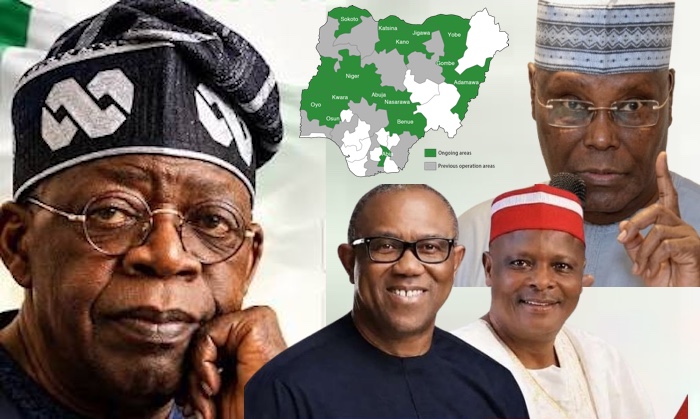
With the January 16, 2027 presidential election approaching, Nigeria’s northern states are shaping up to become critical battlegrounds in what could be another fiercely contested three-way race between President Bola Tinubu, former Vice-President Atiku Abubakar and Peter Obi or the opposition ticket that emerges from the evolving political alignments.
The stakes are particularly high across the North-West, North-East and North-Central, where millions of registered voters, powerful political networks, shifting party loyalties and unresolved security and economic challenges could determine the direction of the presidential contest.
The 2023 election offers an important starting point, but it is no guarantee of what will happen in 2027. While Tinubu enters the race with the advantages of incumbency, governors and established All Progressives Congress (APC) structures, Atiku has a substantial electoral base across several northern states. Obi’s previous performance also demonstrated that voters outside the traditional strongholds of the major parties can influence the outcome.
The growing voter register adds another dimension. More registered voters could expand the electorate available to each candidate, but the eventual outcome will depend on voter turnout, mobilisation, public confidence and the ability of the candidates to translate political support into actual votes.
NORTH-WEST: TINUBU’S POLITICAL MACHINE FACES A TOUGH TEST
The North-West remains one of the most consequential regions in the presidential race. Although the APC commands significant political influence across the zone, the 2023 results exposed vulnerabilities that the ruling party will need to address.
Kano presents the prospect of a major political realignment, while Katsina and Sokoto remain reminders of how narrow presidential victories can be. Kaduna also presents a formidable opposition challenge.
The region’s importance extends beyond its voting strength. Insecurity, economic hardship, agricultural difficulties and the influence of prominent political figures could reshape voting preferences in states where party structures alone may not guarantee victory.
Katsina: Can Buhari’s Political Legacy Deliver for Tinubu?
Katsina could become one of the most closely watched states in the North-West as Tinubu seeks to build on the political legacy of former President Muhammadu Buhari.
The state has 3,876,051 registered voters in 2026, an increase of 359,332 from 2023. Despite Buhari’s enormous popularity in his home state, however, Tinubu narrowly lost Katsina to Atiku in the last presidential election.
Atiku secured 489,045 votes against Tinubu’s 482,283, leaving a difference of just 6,762 votes.
That result demonstrated that Buhari’s political influence did not automatically translate into a presidential victory for the APC candidate, even in the former president’s home state.
Governor Dikko Radda and the APC establishment will be under pressure to prevent another opposition breakthrough. Atiku, meanwhile, has a demonstrated electoral foundation on which to build.
The crucial question is whether Tinubu can convert the influence of the ruling party, the state government and Buhari’s political legacy into a more decisive victory.
The answer may depend heavily on issues affecting ordinary residents. Insecurity in farming communities, the cost of agricultural inputs, disrupted livelihoods and economic pressures could weigh heavily on voters.
For Tinubu, Katsina represents more than a contest for votes. It is a test of whether the goodwill associated with Buhari remains a political asset that can be transferred to his successor.
Jigawa: Can the APC Hold on to Its Lead?
Jigawa presents the APC with an advantage it will be keen to preserve, but its previous victory does not guarantee another one.
The state’s registered voter population has increased from 2,351,298 in 2023 to 2,807,811, representing growth of approximately 19.42 per cent.
Tinubu won Jigawa in 2023 with 421,390 votes, defeating Atiku, who polled 386,587. The margin was 34,803 votes.
The APC will seek to protect that lead through its political structures and grassroots mobilisation. However, the size of the margin leaves room for a determined opposition campaign.
Agricultural productivity, rural economic conditions, local political alliances and the participation of newly registered voters could all influence the outcome.
An improvement in opposition mobilisation, combined with a decline in APC support, could make Jigawa considerably more competitive than the previous result suggests.
Zamfara: Political Influence Versus the Reality of Insecurity
Zamfara is another state where the APC will look to consolidate its position.
The state has 2,224,017 registered voters, compared with 1,926,870 in 2023. Tinubu won the previous election with 298,396 votes, comfortably ahead of Atiku’s 93,978.
The president’s political network in the state includes prominent figures such as campaign director-general Yari, Bello Matawalle and Shinkafi, alongside other influential politicians whose mobilisation capacity could strengthen the APC.
Yet, Zamfara presents a challenge that political endorsements alone may not resolve.
Communities affected by banditry, kidnappings and displacement are likely to judge political leaders partly by their ability to restore security and normal economic activity.
For residents, the ability to travel safely, cultivate farmland, conduct business and sleep without fear may carry greater weight than political calculations.
The APC’s organisational strength could give Tinubu a considerable advantage, but the government’s performance on security will remain a crucial part of the electoral equation.
Sokoto: A Presidential Contest That Could Turn on a Few Votes
Sokoto is among the states where the 2027 election could be decided by a relatively small shift in voter preference.
The state’s register has grown from 2,172,056 voters in 2023 to 2,633,113, an increase of approximately 21.23 per cent.
Atiku won the state in 2023 with 288,679 votes, narrowly defeating Tinubu, who received 285,444. The difference was just 3,235 votes.
Governor Ahmed Aliyu and former governor Aliyu Wamakko provide the APC with significant political and organisational resources as it seeks to reverse that outcome.
However, the previous result suggests that neither candidate can afford to underestimate the opposition.
Turnout, grassroots mobilisation and the distribution of votes across rural communities could prove decisive. Even a modest shift in support could change the state's presidential winner.
Kebbi: Tinubu’s Allies Seek to Reverse Atiku’s Victory
Kebbi presents another opportunity for the APC to recover ground lost in 2023.
The state has 2,309,503 registered voters. Atiku won the previous election with 285,175 votes, defeating Tinubu, who secured 248,088.
Governor Nasir Idris and the APC establishment will be expected to mobilise support for the president and attempt to overturn that result.
But the state's agricultural economy, insecurity in vulnerable communities and the financial pressures facing rural households could influence voting behaviour.
Atiku could remain competitive if he retains his existing support while attracting voters dissatisfied with the ruling party.
Another factor is Abubakar Malami, the former Attorney-General of the Federation and Minister of Justice, who is the African Democratic Congress (ADC) governorship candidate in Kebbi.
Malami’s political influence and his confrontation with the Tinubu administration could introduce another variable into the contest. Whether that translates into significant votes for the opposition will depend on his ability to mobilise supporters and build effective political alliances.
Ultimately, Kebbi could become a contest between the APC's established structures and the opposition's capacity to capitalise on dissatisfaction.
Taken together, the North-West is too politically diverse to be treated as an automatic stronghold for any candidate.
Tinubu has substantial advantages, but the narrow outcomes in Katsina and Sokoto, the competition in other states and the region's unresolved security and economic problems mean that the APC will need more than political endorsements to secure a commanding victory.
NORTH-EAST: ATIKU’S ELECTORAL BASE MEETS SHETTIMA’S POLITICAL TEST
The North-East could provide Atiku with one of his strongest opportunities to challenge Tinubu, based on the results of the 2023 presidential election.
The six states in the region have 13,965,475 registered voters, up from 12,542,429 in 2023. Atiku won five states in the previous election, while Tinubu secured victory in Borno.
That performance gives Atiku a substantial historical advantage, but the political environment has changed since then.
Tinubu now governs the country, while Vice-President Kashim Shettima brings his political experience and northern connections to the administration's efforts to strengthen its support base.
The challenge for the APC will be to improve on its previous performance, while Atiku must retain the voters who supported him in 2023 despite shifting political alliances.
Adamawa: Atiku’s Home-State Advantage
Adamawa remains one of Atiku's most important electoral strongholds.
The state has 2,431,146 registered voters. Atiku secured 417,611 votes in 2023, compared with Tinubu's 182,881 and Obi's 105,648.
The figures reveal the scale of Atiku's advantage in his home state and the considerable ground Tinubu would need to recover to challenge him effectively.
For the APC, the task is to strengthen its existing support and attract voters beyond its traditional base. Atiku, on the other hand, will seek to preserve his advantage and potentially widen the gap.
However, the former vice-president's previous performance does not guarantee another victory. Turnout, local political alliances and the ability of competing parties to mobilise supporters could influence the final result.
Bauchi: A Major Opposition Stronghold Under Pressure
Bauchi, with 3,012,547 registered voters, is the North-East's largest electoral state and another important component of Atiku's previous success.
He won the state in 2023 with 426,607 votes, defeating Tinubu, who received 316,694.
The longstanding political influence of the Peoples Democratic Party (PDP), including the network associated with Governor Bala Mohammed, has helped shape the state's electoral landscape.
However, changing party alignments have introduced uncertainty into the opposition's strategy. Maintaining the previous coalition of voters may require fresh negotiations, stronger grassroots mobilisation and the ability to prevent internal disagreements from weakening its campaign.
Tinubu also has an existing constituency in Bauchi, as demonstrated by his 2023 performance.
The president's challenge will be to expand that support substantially enough to overcome Atiku's previous lead. Without a significant improvement in mobilisation, Bauchi could remain difficult territory for the APC.
Borno: Shettima Must Defend More Than His Home State
Borno is particularly important to Tinubu because it is the only North-East state he won in 2023.
The state has 2,765,165 registered voters. Tinubu secured 252,282 votes in the previous election, while Atiku received 190,921.
The APC's established political structure, including Governor Babagana Zulum's influence and Shettima's political connections, contributed to the president's victory.
Repeating that performance would provide the APC with an important boost in a region where Atiku previously dominated.
However, the vice-president faces a broader political responsibility. Beyond helping Tinubu maintain support in Borno, he must also contribute to improving the administration's standing across the North-East.
Voters will be assessing the government's record on insurgency, displacement, resettlement, reconstruction and economic recovery.
For communities that have endured years of conflict, the impact of government policies on their daily lives could influence their choices at the ballot box.
Shettima's political credibility will therefore be judged not simply by whether the APC retains Borno, but also by whether the party can make meaningful gains elsewhere in the region.
Gombe: Tinubu Faces a Substantial Electoral Deficit
Gombe presents one of the more difficult challenges for the APC in the North-East.
The state has 1,768,566 registered voters. Atiku received 319,123 votes in 2023, compared with Tinubu's 146,977.
The difference was substantial, making Gombe an important target for any APC strategy aimed at improving Tinubu's regional performance.

Governor Muhammadu Inuwa Yahaya's political machinery provides the president with an established platform for mobilisation. Nevertheless, the size of Atiku's previous lead means the APC would need a significant improvement in its electoral performance.
For Atiku, the task will be to defend his existing support against an incumbent president backed by a state governor and the ruling party's organisational resources.
Gombe may ultimately test whether the APC can translate control of political institutions into the kind of voter support needed to overturn a substantial opposition advantage.
Taraba: Three-Way Politics Could Complicate the Race
Taraba stands out as a state where the distribution of votes among competing candidates could be especially consequential.
The state has 2,254,380 registered voters. Atiku won in 2023 with 189,017 votes, followed by Obi with 146,315 and Tinubu with 135,165.
Unlike states where one candidate enjoyed a commanding lead, Taraba's results reflected a more competitive contest.
Its diverse ethnic, religious and political interests could produce another closely fought election involving the APC and competing opposition parties.
The evolving alignments around the ADC and the Nigeria Democratic Congress (NDC), including the political consequences of the Obi-Kwankwaso ticket, could also affect Atiku's efforts to consolidate opposition support.
Another factor is the reported change in political allegiances among influential figures who contributed to Atiku's previous performance, including former military officer Theophilus Danjuma, whose political influence has been a subject of discussion.
How these relationships develop could affect the balance of support in 2027. However, the electoral impact of any perceived realignment will ultimately depend on whether it changes voters' decisions.
Taraba is therefore a state where political endorsements, opposition coordination and grassroots mobilisation could all prove important.
Yobe: Atiku’s Previous Victory Meets APC’s Organisational Strength
Yobe offers Atiku another opportunity to build on his 2023 performance, although the APC has political advantages it will seek to exploit.
The state's registered voter population has risen from 1,485,146 in 2023 to 1,733,671.
Atiku secured 198,567 votes in the previous election, defeating Tinubu, who received 151,459.
That result provides the former vice-president with an electoral foundation, but maintaining it could prove difficult if the ruling party successfully strengthens its local alliances.
Governor Mai Mala Buni's experience in party organisation gives the APC an important political resource. Reports of renewed alignments between Buni and the ruling party could also influence the campaign environment.
The APC will hope that its organisational advantages and established political relationships can reduce Atiku's previous lead.
For Atiku, the challenge will be to retain voters who supported him in 2023 while preventing the ruling party from capitalising on changes in the state's political alliances.
Across the North-East, Atiku enters the contest with the stronger historical electoral record. But the APC has governors, influential political figures and the advantage of incumbency.
The central question is whether those resources can significantly change the voting patterns recorded in 2023.
NORTH-CENTRAL: THE REGION WHERE SMALL SHIFTS COULD CHANGE THE OUTCOME
The North-Central region could be another decisive battleground, particularly because its states have produced sharply different presidential results.
Across Benue, Plateau, Nasarawa, Niger, Kogi and Kwara, the latest voter register stands at 15,233,744, excluding the Federal Capital Territory.
In 2023, Tinubu won four of the six states, while Obi carried Plateau and Nasarawa. Yet, the margins and distribution of votes suggest that the region's political landscape remains open to change.
Party defections, local rivalries, security concerns and the appeal of alternative candidates could all influence the next election.
Benue: Tinubu’s Victory Was Almost a Draw
Benue offers one of the clearest examples of how a small shift in voter preference could determine a presidential result.
The state has 3,057,225 registered voters. Tinubu won in 2023 with 310,468 votes, narrowly defeating Obi, who secured 308,372.
The difference was just 2,096 votes.
Such a narrow margin leaves little room for complacency. The APC will need to consolidate its support, while competing candidates will see an opportunity to reverse the result with effective mobilisation.
Governor Hyacinth Alia's administration, the political influence of Secretary to the Government of the Federation George Akume and rivalries within the APC could all shape the ruling party's campaign.
However, insecurity, attacks on farming communities, displacement and the disruption of agricultural activities may prove more consequential than elite political manoeuvres.
Voters will be assessing whether those in power have made meaningful progress in addressing their concerns.
With the 2023 result separated by barely two thousand votes, Benue could once again be decided by relatively small changes in turnout and voter preference.
Plateau: Can Political Endorsements Win Back Obi’s Voters?
Plateau remains an important test of whether changes among political leaders can translate into changes at the ballot box.
The state has 2,906,570 registered voters. Obi won in 2023 with 466,272 votes, ahead of Tinubu's 307,195 and Atiku's 243,808.
The result demonstrated the strength of Obi's appeal in the state and challenged assumptions that northern voters would necessarily align with the established political parties.
Governor Caleb Mutfwang's participation in the APC's North-Central endorsement of Tinubu illustrates the political realignments that have occurred since the last election.
But a governor's endorsement does not automatically guarantee that voters will follow the same political direction.
Plateau's electorate includes communities with distinct political interests and continuing concerns about insecurity and displacement. Their assessment of government performance could prove more influential than the preferences of political leaders.
The APC will need to demonstrate that its new alliances can attract genuine voter support, while the opposition will seek to preserve the coalition that delivered Obi's previous victory.
Nasarawa: APC Seeks to Reverse Another Opposition Victory
Nasarawa is another state where Tinubu will attempt to improve on his 2023 performance.
The state has 2,137,699 registered voters. Obi won the previous election with 191,361 votes, defeating Tinubu, who received 172,922. Atiku followed with approximately 147,000 votes.
The result exposed the competitive nature of the state's politics and the ability of opposition candidates to attract significant support.
Governor Abdullahi Sule's APC political structure offers Tinubu an opportunity to reverse that outcome, but the task will require more than relying on the advantages of incumbency.
Nasarawa's proximity to Abuja, expanding urban communities, traditional political networks and security concerns could influence how voters assess the competing candidates.
The distribution of votes among the APC and opposition parties will also matter. If competing candidates retain substantial support, the final margin could remain narrow.
Niger: An APC Stronghold Under Pressure
Niger State remains an important part of Tinubu's electoral base in the North-Central region.
The state has 2,983,476 registered voters. Tinubu won in 2023 with 375,183 votes, defeating Atiku, who received 284,898.
Governor Mohammed Umaru Bago's political network and the APC's established support provide the president with a platform for defending that victory.
However, the state's security challenges could complicate the ruling party's efforts.
Insecurity in affected communities has disrupted farming, restricted movement and threatened livelihoods, making the government's response an important consideration for voters.
Tinubu will need to demonstrate that his administration's security efforts are producing results that residents can see and feel.
Niger will therefore test whether the APC can retain its electoral advantage while addressing concerns that may weaken public confidence in the government.
Kogi: Can the APC Turn Its Political Machinery Into a Bigger Victory?
Kogi is another state where Tinubu begins with a strong electoral position.
The state has 2,232,398 registered voters. The president secured 240,751 votes in 2023, comfortably ahead of Atiku's 145,104.
Governor Usman Ododo, former governor Yahaya Bello and the APC's established political networks give Tinubu considerable organisational support.
Nevertheless, the state's ethnic diversity, competition among local political interests and the presence of alternative presidential candidates could influence the final result.
Bello's political influence will be closely watched, particularly given his combative approach to electoral politics and his continued role in the state's political calculations.
At the same time, former PDP figures who have aligned with Atiku, alongside party loyalists who remain sympathetic to the former vice-president, could provide a counterweight to the APC's mobilisation efforts.
The opposition's challenge will be to turn those relationships into a coherent electoral strategy rather than a collection of individual political alliances.
For the APC, victory alone may not be enough. The size of Tinubu's eventual margin will also matter as the party seeks to demonstrate that its political machinery remains effective.
THE BIGGER QUESTION: CAN POLITICAL ALLIANCES OVERRIDE VOTER SENTIMENT?
Across the North, the 2027 presidential election is shaping up to be a contest between political organisation, historical loyalty and voters' assessment of government performance.
Tinubu has the advantage of incumbency, access to the ruling party's structures and the support of governors and influential political figures. Those resources could help the APC consolidate its existing strongholds and recover states it lost in 2023.
Atiku, however, enters the contest with a strong electoral record across much of the North-East and significant support in parts of the North-West. His challenge will be to preserve that base while adapting to the political realignments that have occurred since the previous election.
The competition involving Obi and other opposition figures introduces another layer of uncertainty. Their ability to retain existing supporters, attract new voters and coordinate with other political forces could affect the distribution of votes in closely contested states.
But the most influential factor may not be the number of endorsements announced or the political figures who change parties.
In communities affected by insecurity, farmers whose livelihoods have been disrupted, households struggling with rising costs and young voters demanding better opportunities, the election could become a judgment on the performance of those in power.
The expanding voter register offers all sides an opportunity to strengthen their numbers. Yet, registration alone does not determine an election. Turnout, voter mobilisation, the credibility of the electoral process and the ability of candidates to address public concerns will be crucial.
The North is therefore unlikely to deliver a uniform verdict in 2027. Some states may remain loyal to their previous choices, others could witness substantial changes, while a handful may be decided by narrow margins.
For Tinubu, the challenge is to convert the APC's political machinery into broader electoral support. For Atiku, it is to protect his northern advantage against an incumbent administration with powerful political resources. For Obi and other opposition contenders, it is to demonstrate that their appeal can remain strong enough to influence the outcome.
The battle for the North will not be decided by political endorsements alone. It will be decided by the ability of each candidate to turn alliances into votes and to persuade millions of Nigerians that their future will be better under the government they choose.


Comments (0)
No comments yet. Be the first to share your thoughts!