


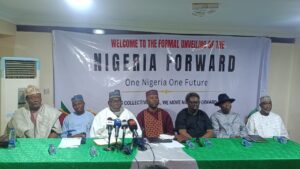
As Nigeria gradually moves towards the 2027 general elections, a new political movement, Nigeria Forward (NF), has emerged with a clear mission: to mobilise support for President Bola Ahmed Tinubu’s re-election while taking the administration’s development message directly to the people.
The movement was formally unveiled in Abuja on Friday, bringing together government officials, political actors, traditional leaders, civil society representatives and other stakeholders who said they were committed to promoting national unity, peace and economic development.
Speaking at the event, the Minister of Innovation, Science and Technology and co-convener of Nigeria Forward, Dr Kingsley Udeh, said the movement was created to build a stronger connection between government policies and the citizens expected to benefit from them.
For Udeh, the story of Nigeria’s development should not be reduced to political speeches or campaign slogans. What matters, he said, is whether government policies and projects are making a noticeable difference in the lives of people in their communities.
He described President Tinubu’s Renewed Hope Agenda as an attempt to create an environment where Nigerians can produce, innovate, invest, work and build more secure livelihoods.
According to him, infrastructure, digital connectivity and investment in agriculture are expected to move the country beyond reforms towards increased production, employment and social stability.
He urged Nigerians to look beyond the announcement of projects and ask practical questions about their impact. Where is a project located? What problem is it solving? Who are the beneficiaries? What opportunities has it created? And, perhaps most importantly, has it actually been completed and delivered?
These, he said, are the questions that should shape informed citizenship.
“A road is more than asphalt when it enables a farmer to reach a market. A railway is more than steel and tracks when it reduces the cost of moving goods,” Udeh said.
He added that reliable electricity becomes meaningful when it allows manufacturers to produce competitively, while digital connectivity becomes valuable when it gives young Nigerians in cities such as Kano, Kaduna, Maiduguri and Minna the opportunity to participate in the global digital economy.
Udeh described the administration’s development trajectory as a chain linking reform to infrastructure, infrastructure to connectivity, connectivity to production, production to jobs and jobs to prosperity.
But even as he urged Nigerians to support the administration, the minister acknowledged the importance of accountability. He said citizens should celebrate progress where it exists, recognise challenges that remain and distinguish between projects that have merely been proposed and those that have been approved, commenced, completed and delivered.
“Patriotism does not require us to abandon accountability; indeed, responsible citizenship demands both,” he said.
That message, according to Udeh, is central to the philosophy of Nigeria Forward, which he described as a bridge between government and citizens. The movement, he said, intends to focus on digital transformation, youth empowerment, enterprise and evidence-based engagement while encouraging citizens to take greater interest in the policies that affect their lives.
The political dimension of the movement, however, was made particularly clear by the Kano State Commissioner for Information and Internal Affairs and co-convener of Nigeria Forward, Ibrahim Waiya.

Waiya called on political actors in the North to support President Tinubu’s second-term bid, basing his argument largely on Nigeria’s informal understanding of power rotation between the northern and southern parts of the country.
He pointed to the eight years spent in office by former President Muhammadu Buhari, a northerner, and argued that the South should be allowed to complete its turn under Tinubu.
“Don’t forget, so as to be fair, the North had its own eight years under Muhammadu Buhari, and now the South is having its own under Tinubu,” Waiya said.
He warned that interrupting the current political arrangement could destabilise the country and affect the continuity of ongoing programmes.
“The North should not be unfair to the South. Interrupting will destabilise a lot of things and jeopardise what we are achieving,” he added.
Beyond the 2027 political contest, Waiya also challenged Nigerians to examine the performance of governments at every level. He argued that developmental problems should not automatically be blamed on the Federal Government, particularly now that states and local governments have greater financial responsibilities.
He cited local government autonomy and the disbursement of federal funds to sub-national governments among developments that should be assessed by citizens.
Security also featured prominently in his remarks, particularly the proposed establishment of state police. Waiya described the policy direction as potentially important in addressing Nigeria’s persistent security challenges, arguing that locally recruited personnel would have a better understanding of the terrain and communities they serve.
He said Kano State had already begun the process of implementing the structure.
Earlier, the Chairman of Kaura Namoda Local Government Area of Zamfara State, Malam Munir Haidara, described Nigeria Forward as a broad platform for citizens and stakeholders who want to promote peace, stability and inclusive economic growth.
He said the movement brings together people from different sections of society, including traditional leaders, women entrepreneurs, civil society organisations and political actors.
At its core, Nigeria Forward says it wants to take the conversation about governance away from Abuja and closer to ordinary Nigerians. Its promoters believe that government policies can have greater impact when citizens understand them, participate in them and demand accountability for their implementation.
With the 2027 elections drawing closer, the movement is positioning itself as part of the growing political mobilisation around the Tinubu administration. Its challenge will be to convince citizens not only through political messaging, but through the concrete evidence of projects, policies and opportunities it says are transforming communities.
For Nigeria Forward, the journey from reform to prosperity is one that requires both government action and citizen participation. And as the political season approaches, the movement intends to make that argument from the national stage down to the grassroots.

.jpg)
Comments (0)
No comments yet. Be the first to share your thoughts!