By Ahamed Abdulkadir
If Mina tested patience and Arafat offered spiritual serenity, then Muzdalifa revealed the rawest and most humbling face of the Hajj.
The journey from Arafat to Muzdalifa began immediately after sunset in accordance with Islamic tradition. Pilgrims are expected to depart Arafat after Magrib without praying there, proceeding instead to Muzdalifa where both the Magrib and Isha prayers are combined.
As usual, the evacuation process began with women pilgrims being conveyed first. For us — members of the Katsina State delegation, Board members, management staff of the Katsina State Pilgrims Welfare Board and members of the State House of Assembly — our turn finally came around midnight.
The journey itself was surprisingly short. Within minutes, we arrived.
But what awaited us there was overwhelming.
If Mina could be described as congested, then Muzdalifa was chaos personified.
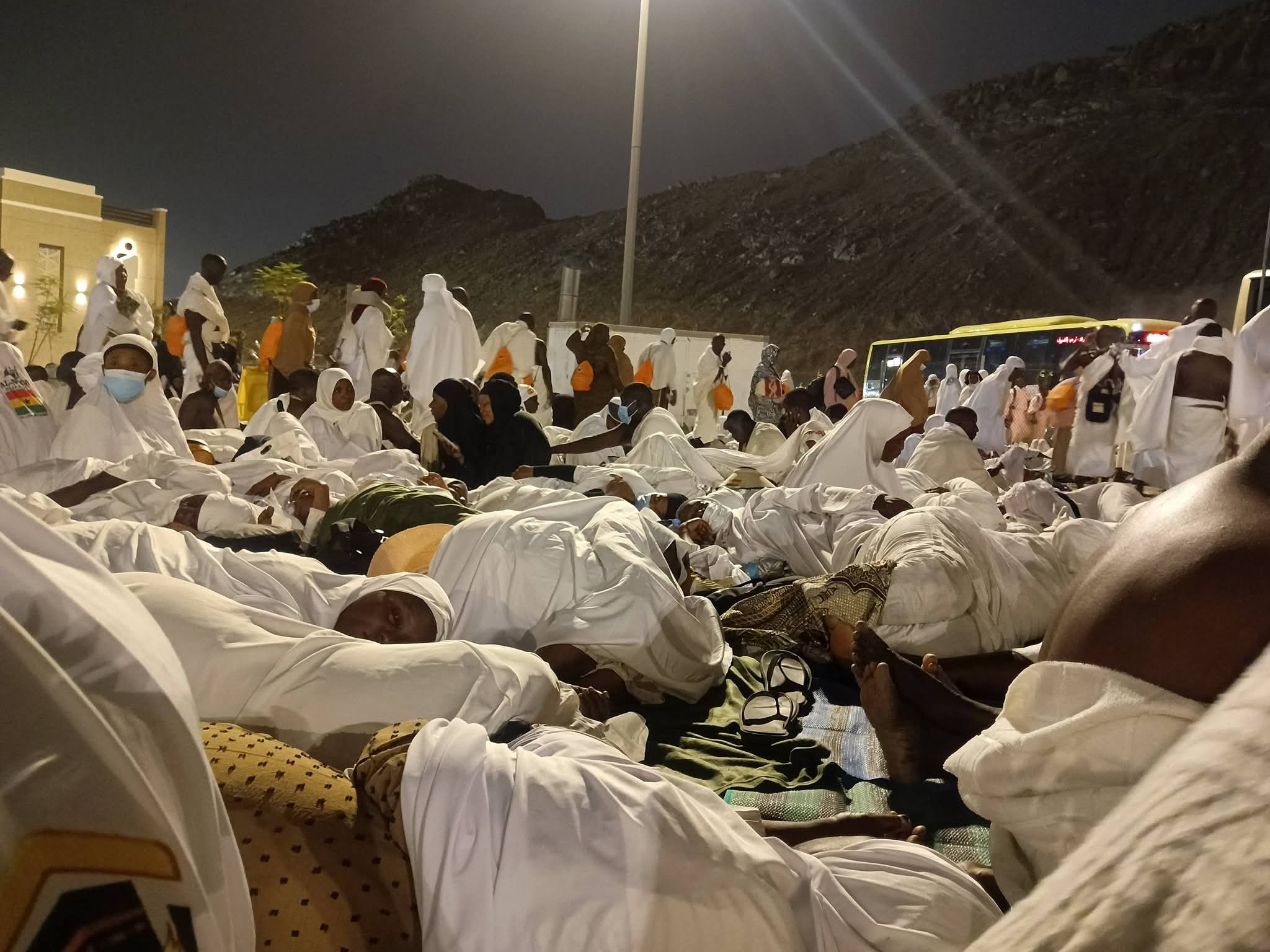
Humanity seemed compressed into every available inch of space. Pilgrims lay on pavements, walkways, bare ground and every open patch visible under the night sky. Unlike Mina and Arafat with their organized tents and allocated spaces, Muzdalifa is largely an open field where millions converge at once after leaving Arafat.
Finding enough space even to pray became a challenge.
The carpeted areas available were grossly inadequate for the sea of worshippers arriving continuously from different parts of the holy sites. We searched desperately for a small place to stand for prayers.
Then came one of those simple but unforgettable acts of kindness that define the Hajj experience.
Some women nearby — strangers to us — spread what appeared to be wrappers or personal coverings on the ground for us to pray on. In that moment, exhaustion, nationality and language differences disappeared. We were simply pilgrims helping one another worship Allah.
Even during the prayers, the congestion remained difficult to manage. People constantly crossed in front of our Imam because there was virtually no room to move elsewhere. Around us, several groups attempted to organize their pilgrims using megaphones and loud instructions.
From the distinct Hausa accents echoing through the night, I realized many of those around us were pilgrims from Ghana.
Muzdalifa felt less like a structured camp and more like humanity gathered at the edge of endurance — millions sleeping under the open sky with little concern for worldly comfort.
Yet perhaps that is exactly the point.
In Muzdalifa, all barriers collapse completely. Wealth offers no advantage. Social status disappears. Everyone sleeps on the same earth beneath the same sky, waiting for dawn and preparing for one of the most symbolic rituals of the Hajj: the stoning at Jamarat.
At dawn, after observing the Subhi prayer, we immediately began the long trek toward Jamarat for the first stoning ritual.
The walk itself became another test of physical endurance.
For one hour and twenty minutes, we moved steadily with the crowd until we finally arrived at the massive Jamarat complex where pilgrims throw pebbles symbolically rejecting Shaytan and reaffirming obedience to Allah. The ritual traces back to Prophet Ibrahim’s rejection of Satan’s temptations during his trial of faith.
After completing the first stone throwing, another journey immediately began.
We trekked roughly another kilometer before reaching a massive transport loading area where buses were waiting to convey pilgrims back to Makkah for Tawaf and Sa’i.
The scale of the operation was staggering.
Hundreds of buses appeared to be operating simultaneously, transporting pilgrims completely free of charge. But even more impressive than the number of buses was the extraordinary crowd-control system put in place by the Saudi authorities.
Long barricaded queue lines — each stretching perhaps 450 meters — had been carefully constructed in zigzag formations. Pilgrims moved slowly through about six layered rows before eventually reaching the buses.
More than ten large buses were loaded at the same time, each carrying approximately 50 passengers.
The organization was almost military in precision.
Once a set of buses filled and departed, movement into the next section was temporarily halted until another group of buses arrived. Entry into the queues themselves was also controlled. At intervals, gates were abruptly blocked to prevent overcrowding.
It was during one of those controlled stoppages that I became separated from my companions.
I had just managed to pass through a gate when it was suddenly shut behind me, leaving the others stranded outside. For some moments, uncertainty set in amid the endless human movement surrounding me.
Yet in one of those strange Hajj coincidences that feel almost miraculous, we eventually reunited near the entrance to the Ka’abah itself.
Together, we proceeded to perform the Tawaf and Sa’i — rituals that by now felt even more physically demanding after the night at Muzdalifa and the exhausting trek to Jamarat.
Seven rounds around the Ka’abah.
Seven movements between Safa and Marwa.
More walking. More prayers. More exhaustion.
By the time we finally returned to our hotel in Makkah, took our baths, shaved and changed out of the ihram garments into regular clothes, my body felt completely drained.
Mentally, I tried calculating the total distance we must have covered that day alone.
It could not have been less than ten kilometers on foot.
Yet the rituals were still not over.
Before sunset, we had to return again to Mina to complete the remaining rites as prescribed in the pilgrimage sequence.
And somewhere amid the exhaustion, the blisters and the endless movement between sacred sites, one truth became clearer with every passing ritual:
Hajj is not designed for comfort.
It is designed to strip a person down physically, emotionally and spiritually — until what remains is patience, faith and total submission to Allah.