


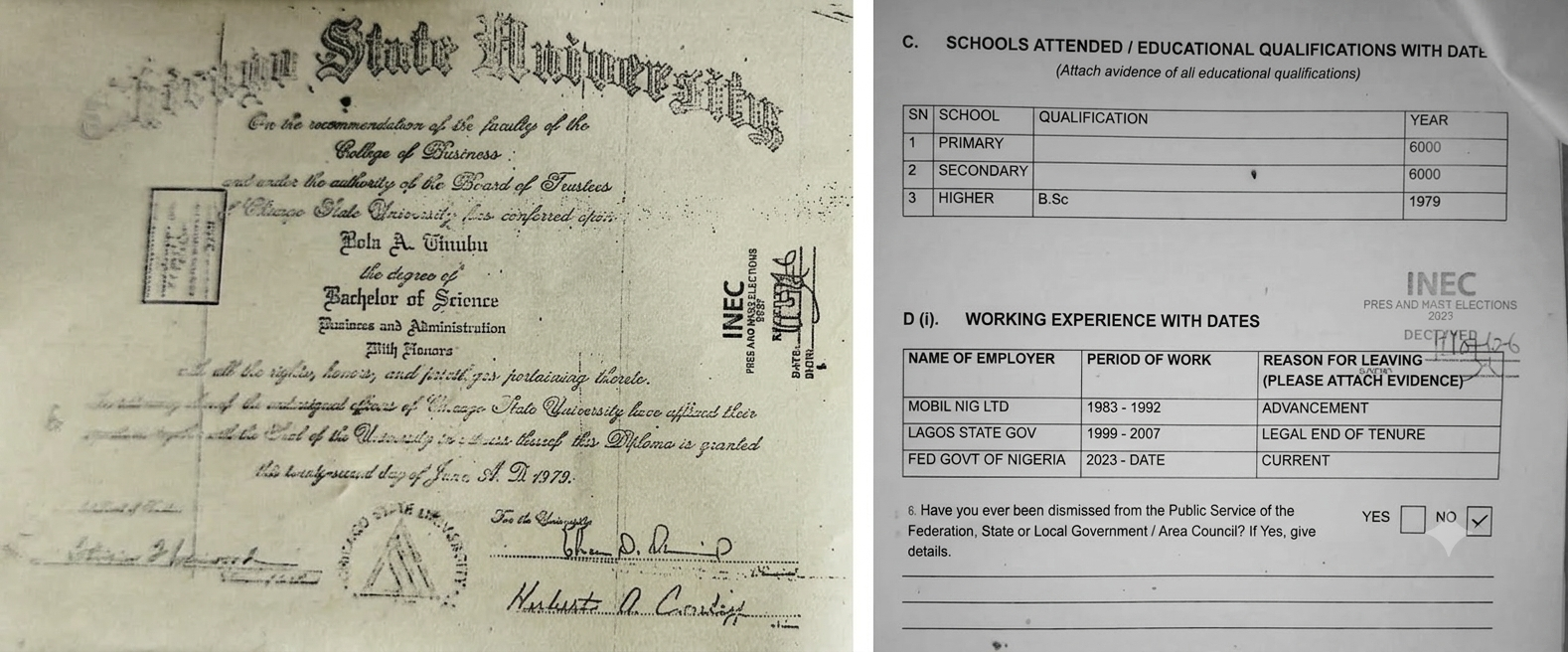
The publication of President Bola Ahmed Tinubu’s nomination documents for the 2027 presidential election has sparked fresh controversy, reopening the long-running debate over his educational credentials and placing the issue back at the centre of Nigeria’s political discourse.
The latest uproar followed the release of candidates’ particulars by the Independent National Electoral Commission (INEC), where Tinubu listed only his Bachelor of Science degree in Business Administration from Chicago State University (CSU), obtained in 1979, alongside his National Youth Service Corps (NYSC) certificate.
However, the sections designated for primary and secondary school qualifications were left blank, a development that quickly attracted criticism from opposition figures, lawyers and political stakeholders.
The omission has revived memories of the fierce legal battles that trailed the 2023 presidential election, when former Vice President Atiku Abubakar challenged Tinubu’s academic records and alleged that a forged CSU diploma was submitted to INEC. Although the university confirmed that Tinubu graduated from the institution in 1979, the controversy over the certificate remained one of the most debated issues during the post-election court proceedings.
In response to the renewed debate, INEC distanced itself from questions surrounding the authenticity of candidates’ credentials, insisting that its role is limited to publishing documents submitted by aspirants for public scrutiny.
The commission said it does not verify certificates before publication, stressing that disputes over the authenticity or adequacy of credentials are matters to be determined by the courts.
The issue has divided legal experts.
Senior Advocate of Nigeria (SAN), Mumini Jimoh, said secondary school education remains one of the constitutional requirements for presidential candidates, warning that any gap in that regard could become a serious issue. He, however, suggested that the omission was more likely an administrative error than evidence of non-compliance with constitutional provisions.
Another SAN, Mohammed Abeni, argued that leaving out secondary school qualifications naturally raises questions, especially given the history of controversies surrounding Tinubu’s educational records. According to him, the omission creates room for suspicion because the constitutional requirement focuses on school certificate-level education rather than university degrees.
Constitutional lawyer Danjuma John also noted that Nigerian law requires a candidate seeking the presidency to possess at least a school certificate or its equivalent as defined by the Constitution.

But another Senior Advocate of Nigeria, Taiye Oniyide, dismissed suggestions that the omission carries legal consequences, arguing that a university qualification is already higher than the minimum educational requirement and therefore sufficient under the law.
Opposition parties wasted no time turning the development into a political issue.
The African Democratic Congress (ADC) accused the president of fueling speculation by failing to disclose his primary and secondary school qualifications, alleging that the omission gives weight to lingering doubts over his educational history. The party questioned why a sitting president would leave such information out of documents submitted to the electoral commission.
The Nigeria Democratic Congress (NDC) also described the development as strange, arguing that university education ordinarily follows successful completion of primary and secondary schooling.
In contrast, the Labour Party dismissed the controversy, maintaining that the Electoral Act does not make the submission of primary and secondary school certificates mandatory. The party also pointed out that Tinubu’s eligibility was extensively litigated after the 2023 election and ultimately upheld by the Supreme Court.
Former Vice President Atiku Abubakar joined the debate, saying the matter goes beyond routine paperwork and touches on issues of transparency, credibility and public trust. He argued that Nigerians deserve clear and verifiable records from anyone occupying the nation’s highest office, insisting that questions surrounding educational qualifications should not be dismissed as mere political attacks.
Adding to the pressure, former Sports Minister Solomon Dalung challenged the president to explain why the sections for his primary and secondary school qualifications were left blank, saying public trust thrives on openness rather than ambiguity.
Despite mounting reactions, the Presidency and the ruling All Progressives Congress (APC) had not publicly responded as of the time of reporting. Attempts to reach presidential aides and APC officials for comments were unsuccessful.
With political activities ahead of the 2027 election beginning to gather momentum, the omission has once again thrust Tinubu’s academic records into the national spotlight, reopening a controversy that many believed had been settled by the courts but which opponents insist still demands answers.



Comments (0)
No comments yet. Be the first to share your thoughts!