


By taibat Ummi Yakubu
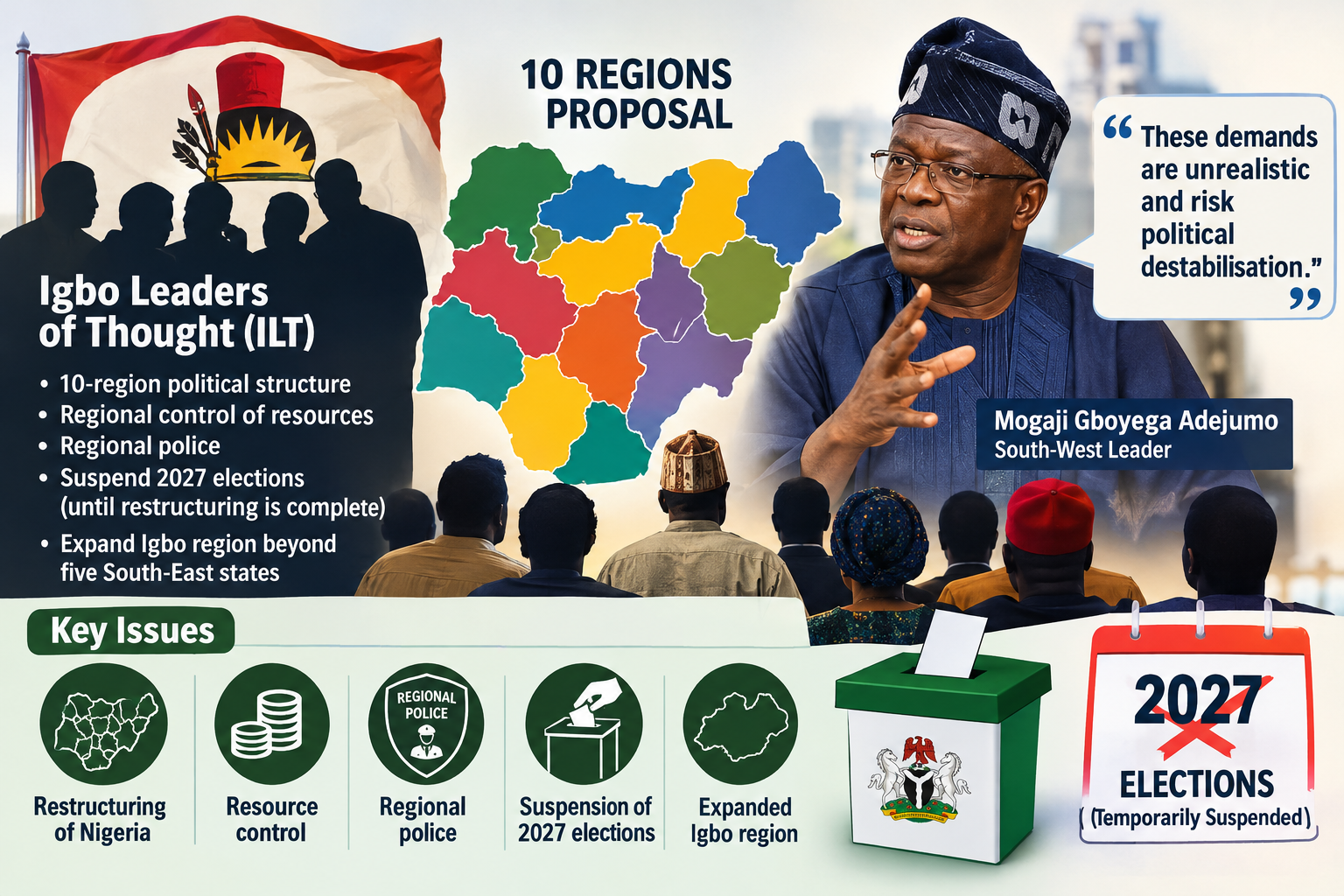
A fresh debate over Nigeria’s political future has erupted following a controversial restructuring proposal by the Igbo Leaders of Thought (ILT), with South-West leader Mogaji Gboyega Adejumo describing aspects of the group’s demands as unrealistic and questioning its position on the country’s constitutional challenges.
The ILT rejected the communiqué issued after the August 20, 2026, restructuring conference in Abuja, alleging that the organisers failed to reflect the views presented by the Igbo delegation. The group subsequently proposed a 10-region political arrangement, regional control of natural resources and the establishment of regional police.
More controversially, it called for the temporary suspension of the 2027 general elections to allow restructuring to be completed before May 2027, after which Nigerians would vote under a new constitutional framework. It also advocated an expanded Igbo region beyond the existing five South-East states.
The proposals have reignited arguments over resource control, regional autonomy, the future of Nigeria’s 36-state structure and the implications of postponing the next general elections. While several voices from the South-West and the North have expressed reservations about aspects of the plan, Adejumo argued that Nigeria’s deeper problem lies in the failure of its constituent groups to agree on a workable model of coexistence.
Speaking on the controversy, Adejumo, who led the South-West delegation to the Patriots Constitutional Conference in Abuja, said uncertainty over the country’s future was not exclusive to the Igbo but reflected a broader struggle among Nigeria’s ethnic groups to determine what they want from the federation.
He argued that dissatisfaction with the existing political arrangement had persisted for decades, noting that many parts of the country had yet to find a structure they considered fair and sustainable. According to him, Nigeria’s difficulties could be traced to flaws in the foundation of its union, despite repeated attempts to address them through constitutional conferences and other political initiatives.
Adejumo maintained that restructuring was not a new demand, pointing to the constitutional and political efforts associated with the Action Group government in the early 1950s and the 1953 London Conference. He argued that the disruption of the country’s earlier political structure had contributed to the renewed calls for a fundamental reorganisation of the federation.
He also said the proposal presented by the South-West at the Patriots Constitutional Conference was broadly consistent with the region’s longstanding demand for restructuring, insisting that its position was not fundamentally different from some of the demands now being advanced by the Igbo Leaders of Thought.
However, Adejumo questioned whether the latest proposal clearly identified the root of Nigeria’s political problems. He argued that the debate should focus less on which region could secure the greatest share of national resources and more on how the country’s different groups could negotiate an arrangement that guarantees fairness and stability.

Reflecting on Nigeria’s political history, he cited decisions taken by major ethnic groups at different stages of the country’s development, including the alliances formed around independence and during the Second Republic. He argued that those historical choices should be examined in their proper context rather than used to fuel present-day ethnic rivalries.
Adejumo also revisited the 1966 coup and the Civil War, referring to former military ruler Ibrahim Babangida’s position that the January 15, 1966, coup should not be characterised simply as an Igbo coup. He said the events surrounding the period and their consequences remained important to understanding the mistrust that has shaped relations among Nigeria’s major ethnic groups.
He further invoked a statement attributed to the late Chief Obafemi Awolowo concerning the possible consequences of the Eastern Region’s secession. Adejumo interpreted the statement as a warning that Nigeria’s political balance depended on the continued participation of its major constituent groups, arguing that the departure of one would have serious consequences for the others.
According to him, the South-West has consistently pursued restructuring through different political and constitutional processes, including the Constituent Assembly discussions of the late 1970s, initiatives associated with Alao-Aka Bashorun, debates during the military era and the 2014 National Conference.
He was particularly critical of the failure to implement the recommendations of the 2014 conference, which he described as one of the most comprehensive attempts to address Nigeria’s constitutional challenges. Adejumo argued that the exercise offered options for those advocating regionalism as well as those who preferred a state-based system, but its recommendations were not fully adopted.
On the question of regionalism, he explained that the South-West’s position should not be interpreted as an unconditional return to the old regional arrangement. He noted that some communities within the region might resist being placed under a regional authority headquartered in Ibadan, arguing that any proposed system must accommodate local identities and political interests alongside broader regional cooperation.
He also questioned the practical foundations of calls for a separate Yoruba nation, asking how its boundaries would be determined, who would negotiate them and which authority would arbitrate competing territorial claims. For Adejumo, such questions demonstrate the need for clearly defined political objectives and a credible process before major constitutional changes can be pursued.
Returning to the ILT’s proposal, he challenged the group to explain how its latest demands differed from earlier restructuring initiatives that had failed to gain national acceptance. He questioned the apparent contradictions he perceived in the group’s position on restructuring, resource control and regional autonomy, asking what specific political arrangement it ultimately wanted Nigeria to adopt.
The controversy has placed the question of restructuring back at the centre of national debate as the country approaches the 2027 general elections. Beyond the proposed 10-region structure, the call to suspend the polls is likely to intensify discussions about constitutional procedures, democratic continuity and whether a major restructuring exercise can realistically be completed within the proposed timeframe.
The emerging debate also highlights the challenge of building consensus among Nigeria’s diverse political and ethnic interests. While advocates of restructuring argue that the current federation requires fundamental changes, the disagreement over the proposed model and the timing of elections underscores the difficulty of reaching a settlement acceptable to all parts of the country.

Comments (0)
No comments yet. Be the first to share your thoughts!