


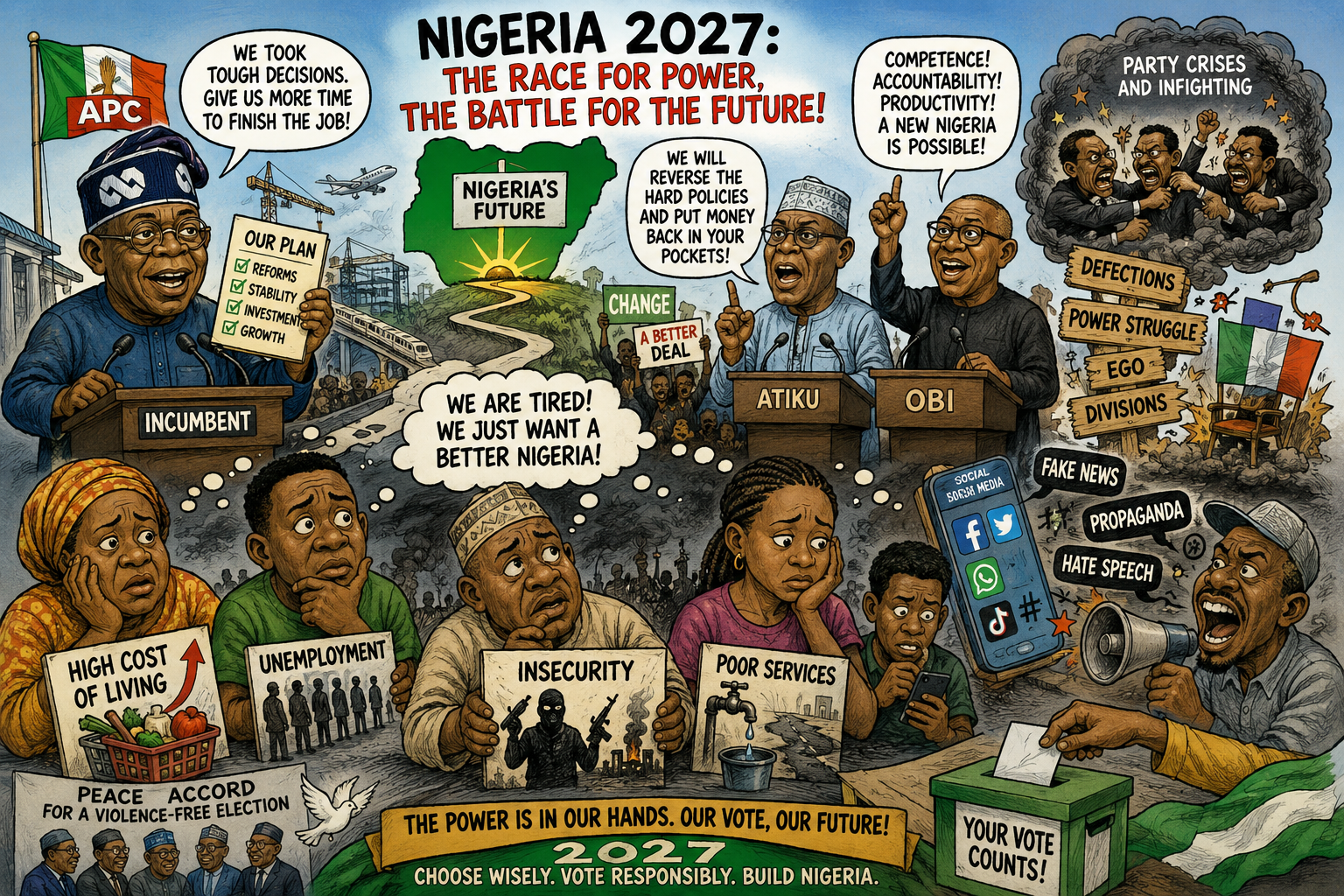
Nigeria is once again entering a familiar but critical season in its democratic journey. With the 2027 general election drawing closer, the political atmosphere across the country is becoming increasingly charged. Campaign posters are appearing on streets and highways, political meetings are taking place behind closed doors, candidates are unveiling ambitious promises, and party loyalists are gearing up for what many observers believe could be one of the most fiercely contested elections in recent years.
From Abuja to Lagos, Kano to Port Harcourt, and Katsina to Enugu, political conversations now dominate public spaces. In markets, offices, universities, mosques, churches and social media platforms, Nigerians are debating the future of the country and weighing the options before them. The countdown to 2027 has begun, and with it comes a mixture of hope, uncertainty, anxiety and expectation.
At the heart of the unfolding political drama is the question that concerns millions of Nigerians: who can genuinely lead the country through its current challenges?
For many citizens, the answer is not straightforward. The country continues to battle economic hardship, rising inflation, unemployment, insecurity and a declining standard of living. Families are struggling with the high cost of food and transportation, businesses are grappling with operational costs, and many young people are worried about their future. Against this backdrop, political leaders are stepping forward with promises of change, recovery and prosperity.
President Bola Ahmed Tinubu enters the race as the incumbent, carrying both the advantages and burdens of office. His administration argues that difficult economic reforms undertaken over the past few years were necessary to stabilise the economy and create a stronger foundation for future growth. Supporters insist that the sacrifices Nigerians are making today will eventually produce positive results.
However, many citizens remain unconvinced. While government officials speak about economic indicators and reforms, ordinary Nigerians often judge success through the realities they face daily. For them, the real questions are simple: Can they afford food? Can they pay school fees? Can they run their businesses profitably? Can they sleep peacefully at night without fear of insecurity?
These concerns have provided fertile ground for opposition figures seeking to convince Nigerians that the country needs a different direction.
Former Vice President Atiku Abubakar has positioned himself as a strong critic of the current administration's economic policies, promising alternative solutions to the nation's challenges. Peter Obi, on the other hand, continues to focus on themes of accountability, prudent management of resources, productivity and competent leadership.
Each candidate is attempting to present himself as the answer to Nigeria's problems. Yet beyond the speeches and campaign slogans lies a deeper political reality: winning elections in Nigeria requires more than good ideas. It requires strategy, alliances, political structures and public trust.
This is where the political landscape becomes even more complicated.
Several political parties are currently battling internal disagreements, leadership tussles and defections. Behind the public displays of unity, many parties are struggling to manage competing interests among powerful political figures. In some cases, long-time allies have become rivals. In others, politicians who once shared the same platform are now pursuing separate ambitions.
Such internal crises are not unusual in Nigerian politics, but they often have significant consequences. A divided party can weaken its chances at the polls, while unresolved disputes can create opportunities for opponents to gain advantage.
At the same time, political realignments continue to reshape the electoral landscape. Alliances are being formed, negotiations are taking place quietly, and politicians are calculating where their interests are best served. As election day approaches, more surprises are likely to emerge.
Perhaps one of the most interesting aspects of the 2027 race is the growing influence of young voters.

Nigeria has one of the youngest populations in the world, and many young people are becoming increasingly vocal about the country's future. They are no longer content with simply watching politics from the sidelines. Through social media and civic engagement, they are demanding greater accountability from leaders and asking harder questions about governance.
Their influence could prove decisive in the coming election.
However, the rise of digital politics also comes with challenges. Social media has become a powerful tool for mobilisation, but it has also become a breeding ground for misinformation, propaganda and political hostility. False stories spread rapidly, and political debates often become emotionally charged rather than fact-based.
This reality places a greater responsibility on both political actors and citizens to promote responsible engagement and avoid actions that could inflame tensions.
Security remains another major concern as the election season unfolds. In several parts of the country, communities continue to face threats from banditry, terrorism, kidnapping and communal conflicts. Many Nigerians hope that political leaders will spend less time attacking one another and more time presenting practical solutions to these challenges.
The stakes could not be higher.
The 2027 election is about far more than determining who occupies Aso Rock for the next four years. It is about the direction of the country, the quality of governance, the management of the economy and the future of millions of citizens.
As campaigns intensify, Nigerians will be bombarded with promises, manifestos and political rhetoric. Candidates will highlight their achievements, defend their records and criticise their opponents. Supporters will argue passionately for their preferred candidates, while critics will point out weaknesses and failures.
But beyond all the noise, one truth remains clear: the election belongs to the people.
In the end, it will be ordinary Nigerians not politicians, party leaders or political strategists—who will decide the country's next chapter.
Until then, the political temperature will continue to rise. The pressure will mount. Alliances will shift. Debates will become louder. And the struggle for Nigeria's future will play out in full view of a nation watching closely.
The road to 2027 has officially begun, and if current developments are any indication, it promises to be a journey filled with intense competition, political surprises and defining moments that could shape the destiny of Africa's largest democracy for years to come.
Comments (0)
No comments yet. Be the first to share your thoughts!