


1- Louis Orok Edet, who served from 1964 to 1966 during the presidency of Nnamdi Azikiwe. He was the first Nigerian to lead the police force and guided it through the delicate years immediately after independence. His leadership set the foundation for a more professional and indigenous police service.
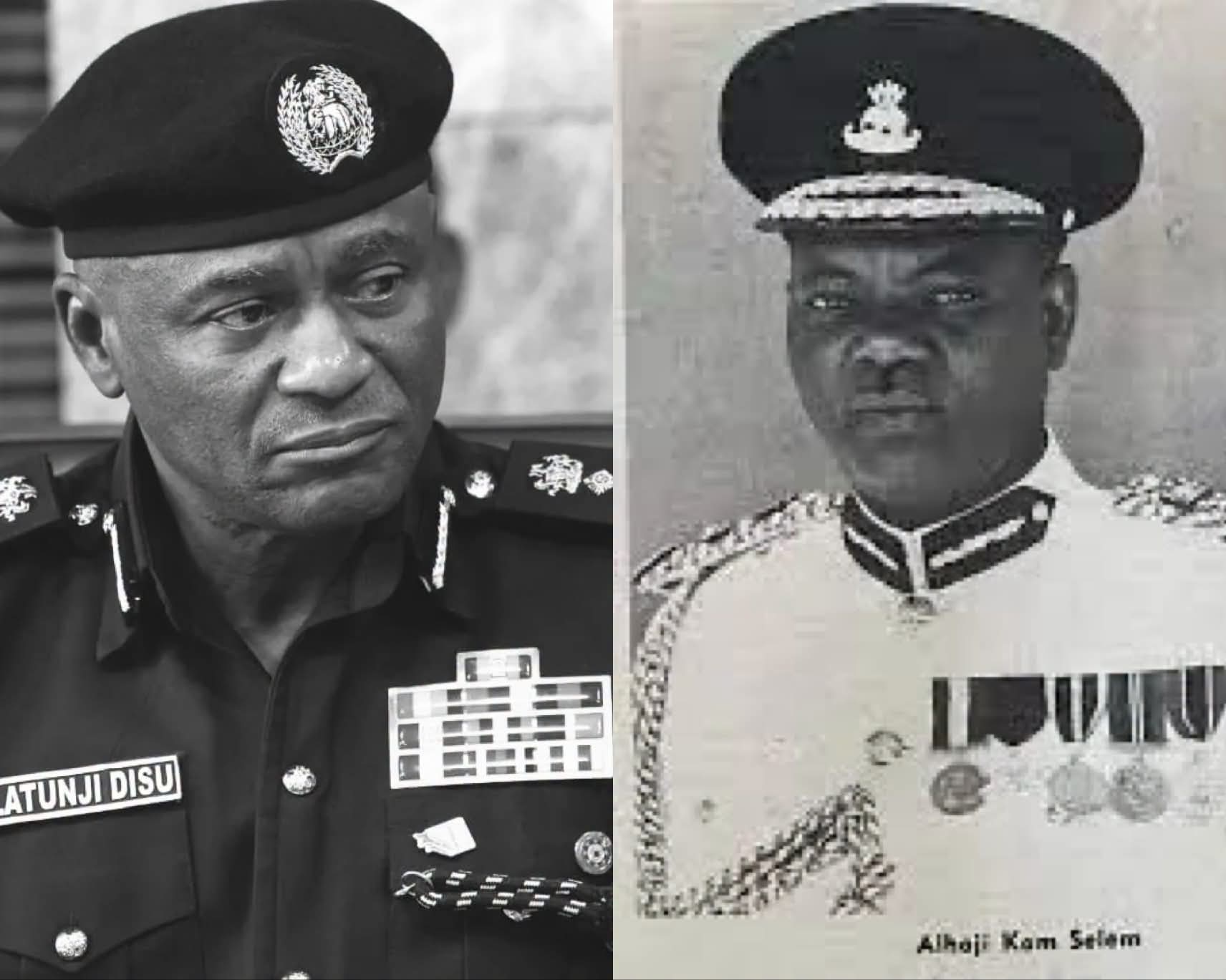
2- After him came Kam Salem, who served from 1966 to 1975 under the military government of General Yakubu Gowon. His tenure fell within a period marked by civil unrest and the challenge of maintaining stability during the Nigerian Civil War and the early years of military rule.
3- Muhammadu Dikko Yusufu took office from 1975 to 1979 during the military leadership of Generals Murtala Muhammed and Olusegun Obasanjo. His period in office came at a time of major restructuring within the military government, and he navigated policing during two administrations that were both committed to reform.
4- With the return to civilian rule in 1979, Adamu Suleiman became IGP under President Shehu Shagari. He served from 1979 to 1981 and represented a shift back to democratic policing. His leadership happened at a time when Nigeria was adjusting once again to civilian governance.
5- Sunday Adewusi followed from 1981 to 1983, still under President Shagari. His tenure experienced increasing social and political tension, shortly before the military intervention of December 1983.
6- The next Inspector General was Etim Okon Inyang, who led the force from 1983 to 1986 under Major General Muhammadu Buhari. He assumed leadership in the early phase of Buhari’s strict military regime and served during a period of political upheaval.
7- In 1986, Muhammadu Gambo Jimeta took charge and remained in office until 1990 under General Ibrahim Babangida. His time as IGP came as Nigeria passed through extensive political changes and attempts at transitioning toward democratic rule.
8- He was succeeded by Aliyu Attah, who served from 1990 to 1993, still under the Babangida administration. Attah managed policing during a period of shifting military strategies and uncertainty as the country struggled to define a stable political path.
9- From 1993 to 1999, Ibrahim Coomassie served as IGP under General Sani Abacha and later General Abdulsalami Abubakar. His tenure covered one of Nigeria’s most controversial periods, especially during Abacha’s dictatorship, and continued until the transition to democracy in 1999.
10- With the return to civilian rule in 1999, Musiliu Smith became the first IGP of the Fourth Republic. He served from 1999 to 2002 under President Olusegun Obasanjo. His leadership came at a time when Nigeria was rebuilding its institutions after many years of military rule.
11- After him was Mustafa Adebayo Balogun, who served from 2002 to 2005 under President Obasanjo. His years in office were marked by efforts to modernise the force, although his tenure later became overshadowed by allegations of corruption.
12- Sunday Gabriel Ehindero followed from 2005 to 2007, also under President Obasanjo. He tried to promote community friendly policing and worked to improve the image of the force at a time when public trust was low.
13- When President Umaru Musa Yar’Adua came into office, Mike Mbama Okiro became IGP from 2007 to 2009. His leadership took place during a relatively peaceful political period, though insecurity in some regions persisted.

14- He was succeeded by Ogbonna Okechukwu Onovo, who served from 2009 to 2010, still during the Yar’Adua administration. His tenure was short and came at a time when Yar’Adua’s health crisis created national uncertainty.
15- In 2010, Hafiz Ringim took command under President Goodluck Jonathan and served until 2012. His tenure was shaped by rising insecurity, especially the growing activities of violent groups in parts of the country.
16- Next was Mohammed Dahiru Abubakar, who served from 2012 to 2014 under President Jonathan. He worked on reforms aimed at improving the capacity of the police, especially in intelligence gathering and rapid response.
17- Suleiman Abba followed with a brief tenure from 2014 to 2015, still under President Jonathan. His leadership came during a tense political period leading to the 2015 general elections.
18- With the election of President Muhammadu Buhari in 2015, Solomon Ehigiator Arase became IGP and served from 2015 to 2016. He promoted transparency and accountability while trying to modernise the force.
19- He was followed by Ibrahim Kpotun Idris, who served from 2016 to 2019 under President Buhari. His time was marked by efforts to reform internal structures and deal with rising security challenges.
20- From 2019 to 2021, Mohammed Abubakar Adamu served as IGP under President Buhari. His tenure faced severe pressures from growing insecurity including kidnapping, banditry and terrorism.
21- Usman Alkali Baba came into office in 2021 and served until 2023, also under President Buhari. His leadership coincided with major national debates about police reform following public demand for better service and improved professionalism.
22- The current Inspector General of Police is Kayode Adeolu Egbetokun, appointed in 2023 - 2026 by President Bola Ahmed Tinubu.

23- The Acting Inspector General of Police is Olatunji Ridwan Disu, appointed in February 2026 by President Bola Ahmed Tinubu following the resignation of Kayode Adeolu Egbetokun. He became the 23rd Indigenous Inspector General of Police and brings decades of operational, investigative, intelligence and administrative experience to the leadership of the Nigeria Police Force. He is expected to strengthen national security, restore public confidence and lead the Force in tackling the country’s growing security challenges.
Which among the names listed above was the best during his years of service to the Federal Republic of Nigeria?
Culled from North book Facebook Page
Comments (0)
No comments yet. Be the first to share your thoughts!