


Kurfi had alleged during an interview on Trust TV that the Katsina State Government sponsored some alleged bandit leaders to perform the 2026 Hajj pilgrimage to Saudi Arabia.
ocuments exclusively obtained by SaharaReporters have revealed that several alleged ‘repentant’ bandits at the centre of the controversy over claims that the Katsina State Government sponsored their 2026 Hajj pilgrimage told police investigators they personally funded the religious exercise, contradicting allegations that public funds were used to finance their trip.
The documents, comprising witness statements, official police correspondence and responses from the Katsina State Pilgrims Welfare Board, formed part of an investigation launched by the Katsina State Police Command following allegations made by Ahmadu Bello University lecturer and public affairs commentator, Dr. Bashir Kurfi.
Kurfi had alleged during an interview on Trust TV that the Katsina State Government sponsored some alleged bandit leaders to perform the 2026 Hajj pilgrimage to Saudi Arabia.
The allegation generated widespread controversy, prompting the Katsina State Government to petition the police. Kurfi was subsequently arraigned before a Chief Magistrates' Court in Katsina on charges bordering on defamation of character and injurious falsehood. He was remanded in prison before being granted bail earlier this week.
However, documents seen by SaharaReporters indicate that investigators recorded statements from community leaders, local government officials, Fulani leaders and the pilgrims themselves, many of whom insisted they paid their Hajj fares from personal resources.
One of the principal witnesses, Salisu Buhari, a retired civil servant and Chairman of the Peace Accord Committee in Danmusa Local Government Area, told investigators that one Ardo Abdulkarim Abdullahi, a Fulani leader, approached him several months earlier to inform him that one Ummaru Mainore, whom he described as a ‘repentant’ bandit involved in ongoing peace efforts in the area, wished to perform the 2026 Hajj.
According to Buhari, he informed the Chairman of Danmusa Local Government, Ibrahim Mohammed, who subsequently contacted the Commissioner for Internal Security and Home Affairs, Dr. Nasiru Babangida Mu'azu.
Buhari stated that after some days, the local government chairman informed him that Governor Dikko Umaru Radda had approved that the applicants could proceed with the pilgrimage process.
According to his statement, the approval merely allowed the individuals to participate in the pilgrimage after security consultations and did not involve government sponsorship.
He further stated that Ummaru Mainore and another individual, Wada Bello, popularly known as Wada Yellow Matazu, deposited a combined sum of ₦13.394 million into the bank account of one Zaharaddeen Umar, who subsequently processed the Hajj payments through a bank draft before the pair travelled to Saudi Arabia.
Buhari maintained that it was only after the pilgrims returned that allegations surfaced on social media claiming the Katsina State Government had financed the pilgrimage.
"It was later we heard that one Dr. Bashir Kurfi came out on Trust TV News on socal media channel that the Katsina State Government paid for them, which is a false allegation," Buhari stated in his statement recorded by police on July 1, 2026.
Investigators also obtained a statement from Ardo Abdulkarim Abdullahi, the Fulani leader representing pastoral communities in the peace reconciliation process in Danmusa Local Government Area.
He explained that Ummaru Mainore approached him seeking assistance to perform Hajj and that he subsequently contacted Salisu Buhari, who introduced the matter to local government authorities.
According to Abdulkarim, the Commissioner for Internal Security eventually informed them they could proceed with the process after receiving approval.
He stressed that government officials neither paid nor offered to pay for the pilgrimage.
Abdulkarim further told investigators that if the Katsina State Government had actually financed Hajj for ‘repentant’ bandits, he himself would have benefited because he also wished to perform the pilgrimage but could not afford the cost.
"So known to me, the Katsina State Government did not give or pay for Hajj to Mainore, Wada Bello or any Fulani man and if the government would pay Hajj to them, I would have been included and as I said before, I did not go to Mecca due to shortage of money from me," he stated.
Another witness, Kamaladin Salisu, a businessman, told investigators that between 10 and 11 ‘repentant’ bandits and their wives participated in the 2026 Hajj exercise.
According to him, they financed the pilgrimage themselves, with some paying in instalments before completing the balance.
He further stated that he personally collected photocopies of several Hajj payment receipts belonging to some of the pilgrims.
According to him, individuals whose pilgrimages are fully sponsored by government would ordinarily not receive payment receipts because they would only be required to submit their passports for processing.
He said the existence of the receipts indicated that the pilgrims personally made the payments.
Police investigators also recorded a statement from the Chairman of Safana Local Government Area, Hon. Abdullahi Sani Safana.
The chairman explained that Fulani leaders in his area informed him that several ‘repentant’ bandits under their supervision wished to perform the pilgrimage.
According to him, he consulted the Commissioner for Internal Security and Home Affairs, who informed him that the individuals were among those participating in the state's peace initiative and were therefore free to travel like every other citizen.
He said the approval only cleared them to participate in the pilgrimage process.
Safana stated that 13 individuals subsequently paid their Hajj fares themselves before travelling to Saudi Arabia.
He insisted the allegation that the Katsina State Government financed their pilgrimage was "false information and misleading."
The police investigation also contains statements from several of the pilgrims themselves.
One of them, Umar Ado Dambafashi, told investigators that he sold 11 cows together with bags of grain to raise approximately ₦7.5 million for the pilgrimage.
He acknowledged that he previously operated under a notorious bandit commander before embracing the state's peace initiative.
According to him, nobody assisted him financially.
He insisted he personally financed the pilgrimage.
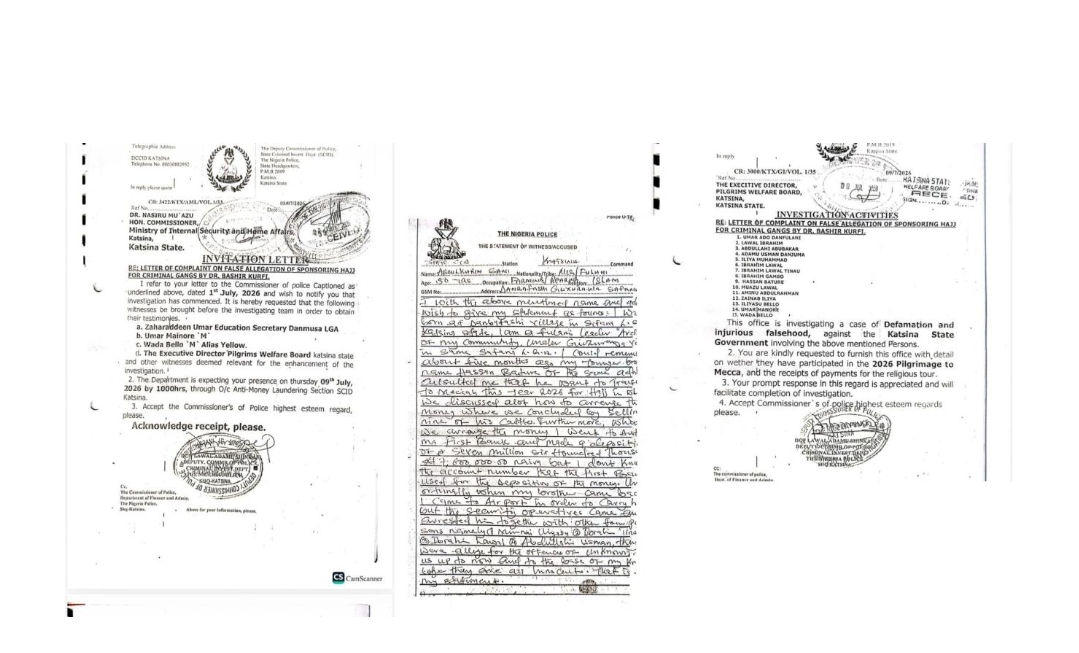
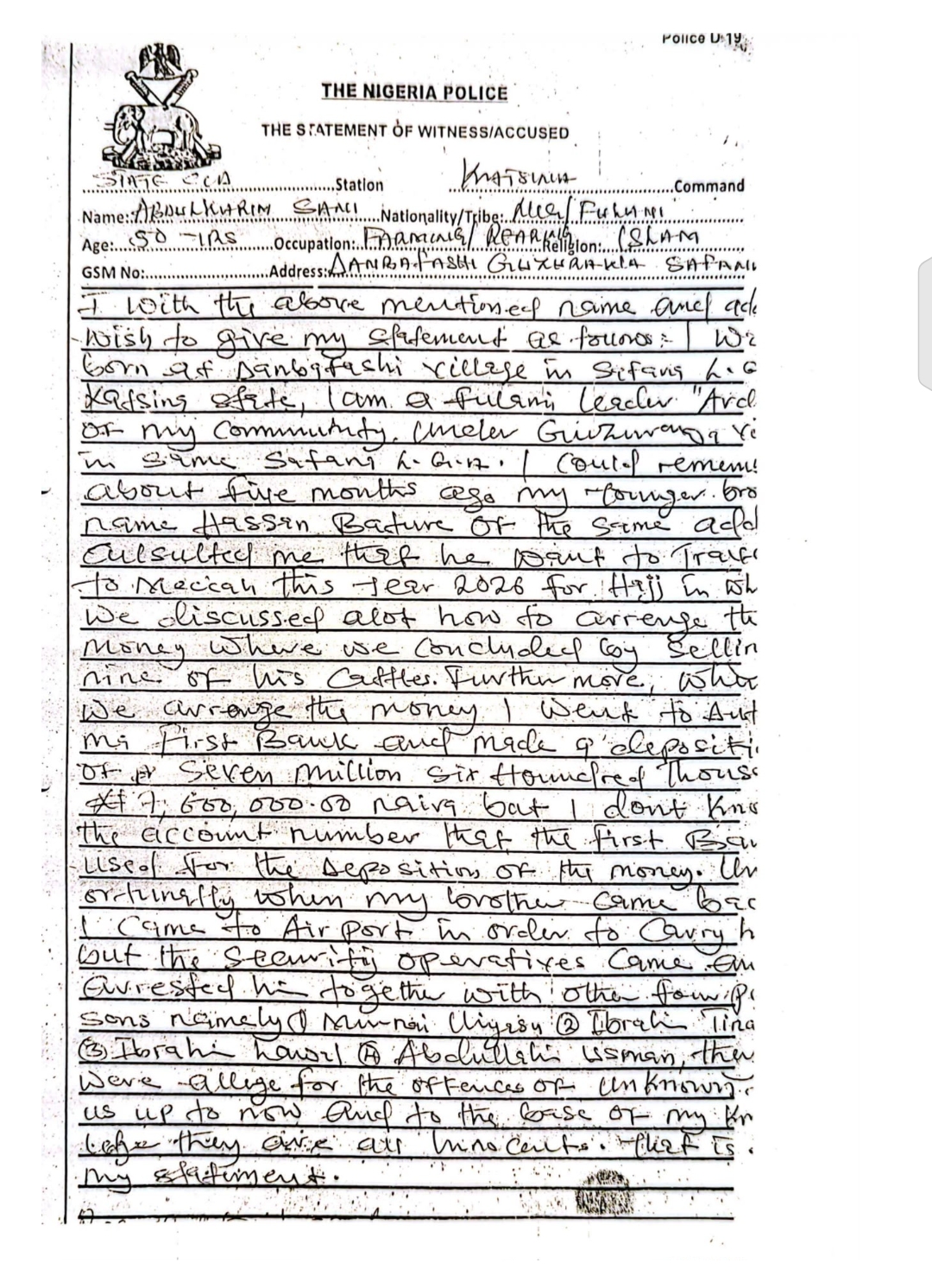
Another witness, Abdulkarim Sani, a cattle rearer and Fulani leader, told investigators that his younger brother, Hassan Bature, financed his Hajj by selling nine cattle before travelling to Saudi Arabia.
He further disclosed that security operatives arrested Hassan Bature alongside four others immediately after they returned from the pilgrimage.
According to him, the family was never informed of the offences for which they were arrested.
Another witness, Ibrahim Gambo, a 45-year-old cattle rearer who identified himself as one of the ‘repentant’ bandits granted amnesty under the state's peace initiative, similarly denied receiving government sponsorship.
In his statement, Gambo said he informed his village head of his intention to perform the 2026 Hajj and was later notified that he could proceed with the pilgrimage after consultations with the relevant authorities.
He maintained that while he obtained approval to travel, he personally paid the Hajj fare.
Likewise, Ilyasu Mondi, a 42-year-old farmer and cattle rearer, told investigators that he financed his own pilgrimage and denied receiving any financial assistance from the Katsina State Government.
Another pilgrim, Lawal Ibrahim, who also described himself as one of the ‘repentant’ bandits participating in the government's peace initiative, explained that he paid his Hajj fare in instalments.
According to him, he initially paid part of the amount before completing the outstanding balance and was later issued an official payment receipt.

Abdullahi Abubakar, another of the pilgrims whose name appeared in the police investigation, stated that although he initially had only about ₦6 million for the pilgrimage, he obtained a loan of approximately ₦1.7 million from a community member to complete the required amount.
Similarly, Amadu Usman, a herder and farmer, told investigators that he initially raised ₦4 million before selling three cows and grain to realise an additional ₦3.693 million, enabling him to complete the Hajj payment.
Their accounts, contained in separate statements recorded by investigators, consistently maintained that they individually financed their pilgrimage despite obtaining official clearance to participate in the exercise.
Police sought documentary evidence
Beyond witness statements, documents obtained by SaharaReporters also show that investigators sought independent documentary evidence from the Katsina State Pilgrims Welfare Board.
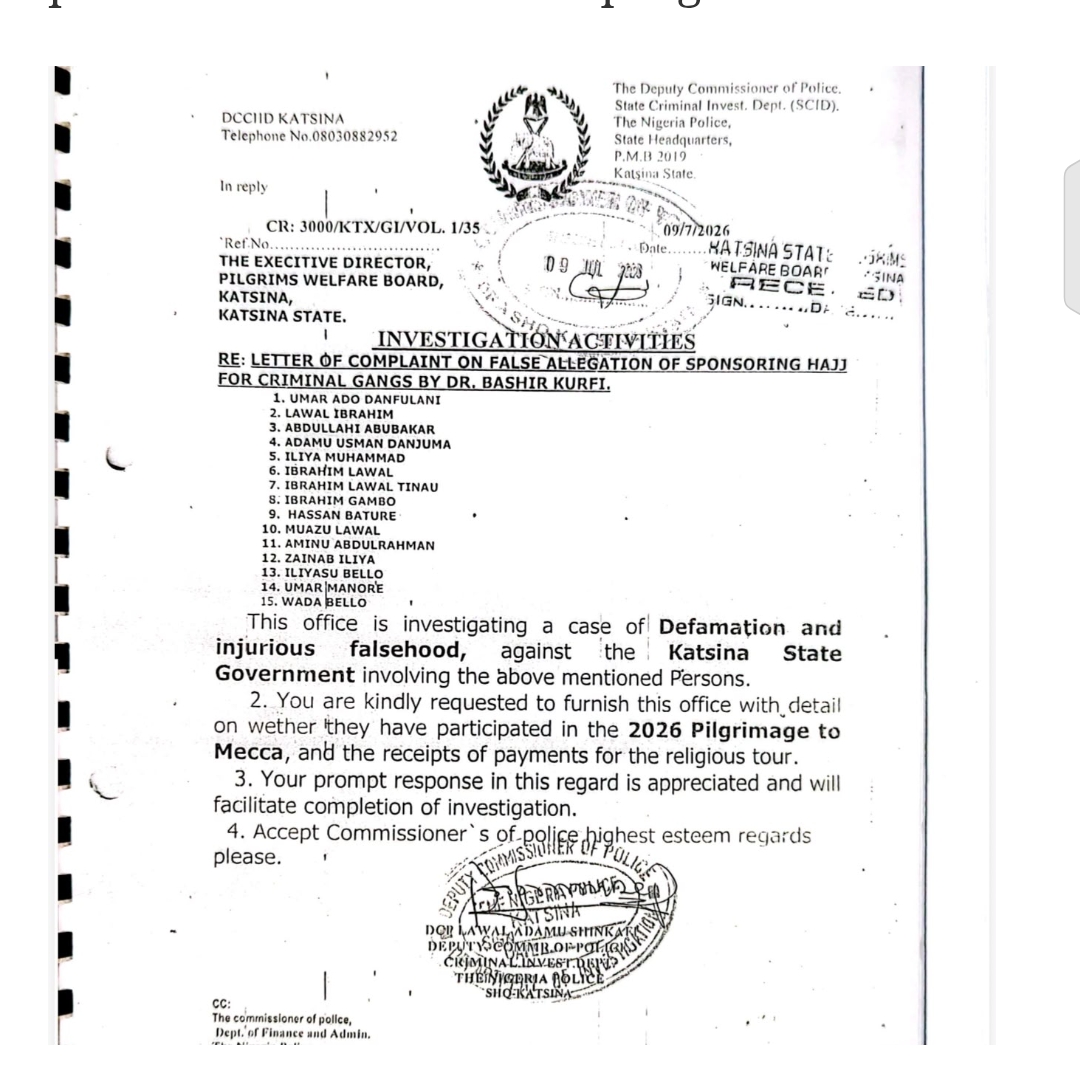
In a letter dated July 9, 2026, addressed to the Executive Director of the Board, the Deputy Commissioner of Police, State Criminal Investigation Department (SCID), requested detailed information on 15 named pilgrims.
The police specifically requested confirmation of whether the individuals actually participated in the 2026 Hajj exercise and demanded copies of their payment receipts.
The letter stated that the information was required as part of investigations into allegations of defamation and injurious falsehood arising from claims that the Katsina State Government sponsored Hajj for criminal gangs.
A day later, on July 10, the Executive Director of the Katsina State Pilgrims Welfare Board, Yunusa Abdullahi Dankama, formally responded to the police.
In the reply, the Board confirmed that all 15 individuals listed by investigators were duly registered pilgrims who completed the 2026 Hajj exercise through the Katsina State Pilgrims Welfare Board.
The Board explained that 13 of the pilgrims registered through the Dutsinma Zone under Safana Local Government Area, while the remaining two registered through the Headquarters Zone.
It further stated that all the pilgrims fully paid their Hajj fares, completed all necessary documentation and travelled through the Board alongside thousands of other pilgrims from Katsina State.
According to the Board, the pilgrims departed Nigeria through the Umaru Musa Yar'Adua International Airport in Katsina after passing through all mandatory security and immigration screening procedures.
To support its response, the Pilgrims Welfare Board enclosed copies of each pilgrim's Hajj payment receipt, passport data page and Saudi Arabian visa.
The documents were forwarded to investigators as part of the ongoing police inquiry.
Police invited additional witnesses
Documents obtained by SaharaReporters further reveal that investigators invited several government officials and witnesses to provide evidence during the investigation.
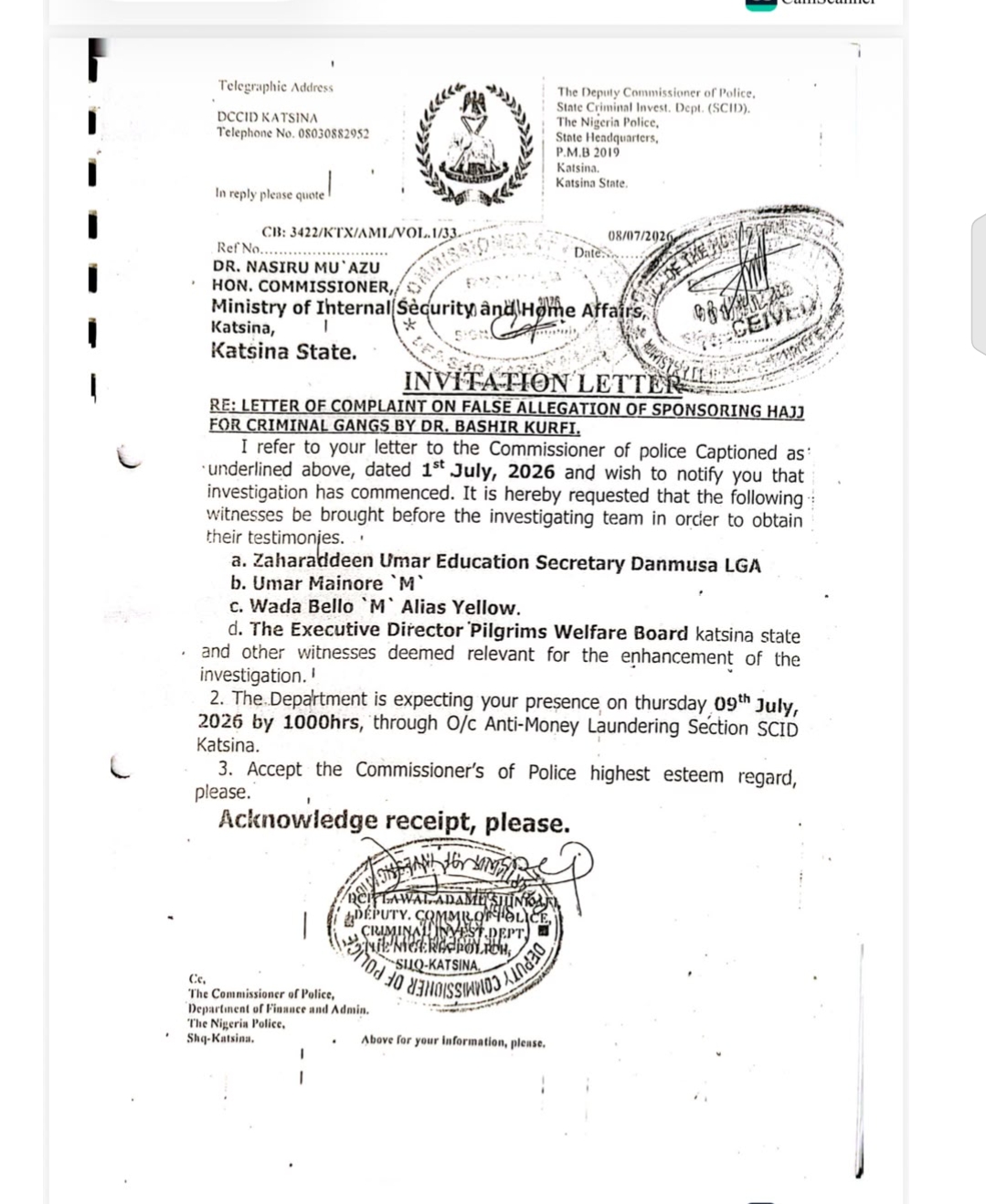
Among those invited were the Education Secretary of Danmusa Local Government Area, Zaharaddeen Umar, Umar Mainore, Wada Bello, popularly known as Wada Yellow, and the Executive Director of the Katsina State Pilgrims Welfare Board.
The invitation, dated July 8, 2026, informed the Katsina State Commissioner for Internal Security and Home Affairs, Dr. Nasiru Babangida Mu'azu, that investigation into the allegations had commenced and requested that the witnesses appear before the State Criminal Investigation Department to assist investigators.
Background to the controversy
The police investigation followed allegations made by Dr. Bashir Kurfi, an Ahmadu Bello University, Zaria lecturer and public affairs commentator.
Kurfi had alleged during a Trust TV interview that the Katsina State Government sponsored some alleged bandit leaders to perform the 2026 Hajj pilgrimage.
The allegation generated national attention and sparked public debate over the state's peace initiative involving ‘repentant’ bandits.
Rather than opening a public inquiry into the allegations, the Katsina State Government petitioned the police.
Kurfi was subsequently arrested and arraigned before a Chief Magistrates' Court in Katsina on two counts bordering on defamation of character and injurious falsehood.
The prosecution alleged that his statements were false, malicious and capable of damaging the reputation of the Katsina State Government and its people.
On July 8, Chief Magistrate Zaharaddeen Kofar Soro ordered that the lecturer be remanded in custody pending further proceedings.
Kurfi was later granted bail by the court earlier this week.
Following his release, the lecturer maintained that he had merely raised an allegation that should have been investigated rather than criminalised.
In a video obtained by SaharaReporters, Kurfi criticised the authorities for imprisoning him instead of examining the substance of his claims.
He also recounted the harsh conditions inside the Katsina Correctional Centre, describing severe mosquito infestation, poor sanitation and the suffering endured by inmates.
Kurfi insisted that if his allegations were false, the appropriate response should have been a transparent investigation capable of establishing the truth.
Arrests after Hajj
Meanwhile, a source familiar with the matter told SaharaReporters that several of the alleged repentant bandits named in the controversy were arrested shortly after returning from Saudi Arabia.
According to the source, the individuals were questioned extensively by police investigators over the allegations before later being released after their statements were taken.
Among those mentioned in the investigation were individuals who admitted they had previously participated in banditry before embracing the state's peace and reconciliation programme.
Several of them explained that although local government officials and traditional leaders facilitated official approval for their participation in the pilgrimage, they personally sourced the money used to pay their Hajj fares through the sale of livestock, agricultural produce, personal savings and loans.
The police investigation documents obtained by SaharaReporters do not indicate that investigators established that the Katsina State Government directly paid the Hajj fares of the pilgrims.
Instead, the investigation records contain witness statements, official correspondence and documentary evidence relied upon by investigators during the inquiry.
The controversy, however, continues to generate debate over the Katsina State Government's engagement with repentant bandits under its peace initiative and the broader public
interest questions surrounding transparency, accountability and reconciliation efforts in the state.
The criminal proceedings against Kurfi also remain before the court.
Culled from Sahara Reporters
Comments (0)
No comments yet. Be the first to share your thoughts!