


A fragile ceasefire between the United States and Iran is facing renewed strain after both countries exchanged fresh military strikes, deepening concerns about a wider conflict in the Middle East and further unsettling global energy markets.
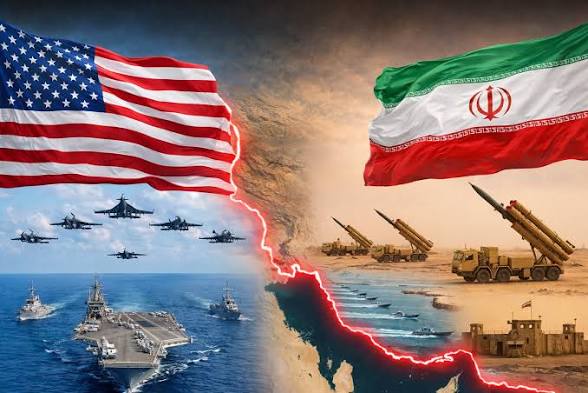
The latest escalation began on Sunday evening when the United States launched coordinated attacks on several Iranian military installations, prompting a swift response from Iran’s Islamic Revolutionary Guard Corps (IRGC), which reportedly targeted American military bases in Kuwait, Jordan, and Bahrain.
According to the United States Central Command (CENTCOM), the military operation commenced at about 5:00 p.m. Eastern Time and focused on key Iranian military assets, including air defence systems, coastal radar stations, missile facilities, and drone operation centres.
The US military said the strikes were intended to safeguard international shipping routes and ensure continued access through the strategic Strait of Hormuz, a critical waterway for global oil transportation.
“US forces are prepared to ensure that freedom of navigation remains available to commercial shipping despite Iran’s continued unwarranted aggression, harassment, threats, and arbitrary declarations,” CENTCOM said in a statement.
Before the US officially announced the operation, Iranian state television reported explosions in several locations, including Sirik, Qeshm, Bandar Abbas, and Jask, suggesting widespread military activity along Iran’s southern coastline.
Iran’s official news agency, IRNA, later reported that one person was killed and four others injured in what authorities described as an American attack in Khuzestan Province.
The renewed hostilities have intensified instability across the Gulf region and further disrupted international energy markets. Iran’s blockade of the Strait of Hormuz has already triggered a surge in global oil prices, fuelling concerns over inflation and potential economic repercussions worldwide.
Tehran has accused Washington of breaching the terms of the interim ceasefire agreement reached earlier this year.

Iranian Foreign Minister Abbas Araqchi condemned the US action, insisting that any agreement between the two nations must be respected by both sides.
“There can only be mutual compliance,” Araqchi wrote on X on Friday.
Echoing that position, Iran’s chief negotiator, Mohammad Baqer Qalibaf, delivered a stern warning on Sunday, declaring that Tehran would no longer tolerate what it sees as unilateral commitments.
“The era of one-sided deals is over. We told you: keep your word or pay the price. Reality is knocking,” Qalibaf wrote on X.
Amid growing international concern, Araqchi held talks with Omani Foreign Minister Badr Albusaidi on efforts to guarantee the safe passage of vessels through the Strait of Hormuz. Oman, which has often played a mediating role between Tehran and Washington, said discussions would continue at both technical and political levels.
The latest crisis also comes against the backdrop of a leadership transition in Iran. The country’s new Supreme Leader, Ayatollah Mojtaba Khamenei, recently vowed to seek revenge for the killing of his father and predecessor, a declaration that has heightened fears of further confrontation.
“We pledge to avenge the blood of the martyred leader and all the martyrs,” a statement attributed to the new leadership said.
With diplomatic efforts struggling to keep pace with military developments, analysts warn that continued hostilities could jeopardise regional stability, threaten global energy supplies, and push the Middle East closer to a broader and more dangerous conflict.


Comments (0)
No comments yet. Be the first to share your thoughts!