Cemeteries are considered a place where history comes alive by many communities around the world. Cloosely linked to the deep historical connection of the local community, they bring residents closer to understanding the past while providing insights into how people lived.
At the heart of the ancient city of Katsina, within the historic grounds of the Katsina Emir’s Palace, lie two revered cemeteries that continue to command deep respect from residents and visitors alike. Separated by lineage but united in honour, the Sullubawa and Dallazawa burial grounds are not tourist attractions, but sacred spaces of history, perseverance , reflection and prayer, quiet reminders of an era many describe as one marked by compassion, discipline and fatherly leadership.
For generations, the cemeteries have been carefully tended by families entrusted with their upkeep.Where history comes alive
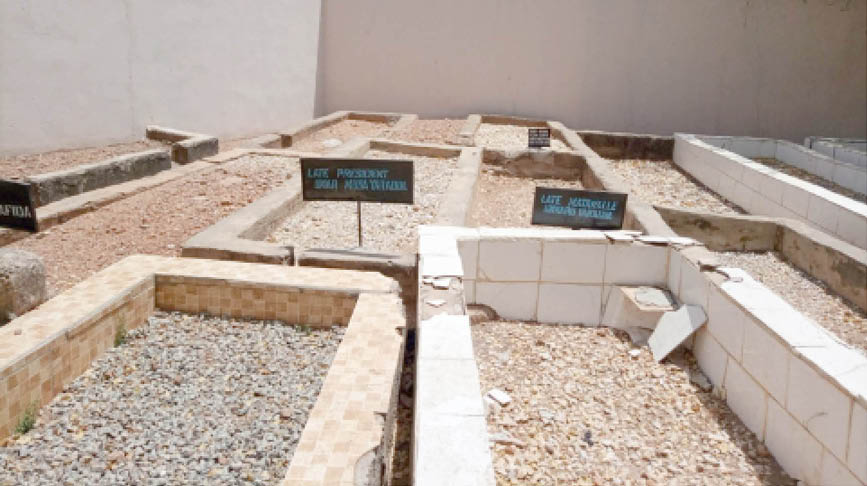
Through the ancient gateway of Kofar Soro, history does not merely echo, it lives. Within the walls of Gidan Korau, the Katsina Emir’s Palace, lies a quiet garden set strategically away from the noise and chaos of the city; a cemetery.
Noticeably not a cemetery open to the public, there are no marble headstones or towering monuments, instead, sand, the gentle sway of date palms trees and silence is what any first time visitor to this cemetery will notice.
Here rests the royal lineage of the Sullubawa dynasty, emirs of Katsina and their wives, buried within the palace grounds in accordance with a longstanding tradition that binds leadership to legacy.
As described by Musa Gambo Kofar Soro, historian and Wakilin Tarihi to the Katsina Emirate, the garden is a sacred archive.
“This place is not just about graves,” he says, standing beneath the shade of a tall date palm. “It is about continuity. It is about leaders who saw the palace not just as a seat of power, but as their eternal home.”
The tradition was profoundly shaped by Emir Muhammadu Dikko, who reigned from 1906 – 1944. During his lifetime, he planted a date palm tree inside the palace garden and expressed a simple but powerful wish, that he be buried beside it.
“He planted that tree with intention,” Musa explains. “It was his way of saying, ‘I will remain here.’”
When Emir Muhammadu Dikko died in 1944, his wish was fulfilled. He was buried near the palm tree he had nurtured, as a symbol of endurance and rootedness. Though the palm tree died recently another one was planted in the same place.
His son, Sir Usman Nagogo, who ruled from 1944 -1981, followed the same path, also planting a date palm tree and instructed that he be buried beside his father.
When Sir Usman passed in 1981, he was laid to rest within the same garden, reuniting father and son beneath the palm trees.
“There is humility in that choice,” Musa reflects. “Despite their authority, they chose simplicity. They chose closeness.”
The tradition continued with Muhammadu Kabir Usman, who reigned from 1981 until his death in March 2008. True to family tradition, he too expressed his wish to be buried within the palace cemetery alongside his father and grandfather. When he died, Katsina mourned deeply, and once again, the sacred ground received one of its own, resting three generations beneath the date palm trees.
Tending to this sacred ground is Sani Isyaku, caretaker and quiet guardian of the mini royal cemetery. Every morning, he sweeps the sandy paths, clears fallen leaves and ensures the dignity of the resting place remains undisturbed and sacred.
“I come here with respect. These are not ordinary graves. These are the leaders of our past, Present and future.” He said softly.
Sani guides visitors, scholars, palace guests, curious youths through the cemetery, explaining the lineage and pointing gently to each resting place.
“The simplicity is deliberate,” he adds. “In Islam, we return to Allah without pride. Even kings return as servants of God.”
The tradition, however, is not only a memory of the past. The present Emir of Katsina, His Royal Highness Abdulmumini Kabir Usman, CFR, son of the late Muhammadu Kabir Usman has also planted his own date palm within the palace garden, keeping with the legacy of his forefathers, he has also expressed his wish that when his time comes, he too be buried in the same royal cemetery alongside them.
For Musa Gambo, this act carries deep meaning.
“It shows that the institution is alive,” he says. “The Emirate is not disconnected from its history. Each Emir understands that he is part of a chain that began long before him and will continue long after.”
The newly planted palm tree stands younger and shorter than the older trees, but strong. Its presence is symbolic, a bridge between generations past and generations yet unborn.
Using the palace grounds as a burial site for Emirs and their wives alone is a longstanding Katsina tradition, reflecting not exclusivity or pride, but sacred responsibility. The palace is the spiritual heart of the Emirate, and those who lead it choose to remain within its embrace.
As late afternoon light filters through the palms, casting soft shadows over the earth, the atmosphere feels almost timeless. Beyond the palace walls, Katsina city moves with modern urgency, where history rests in quiet dignity.
Looking up at the trees planted decades apart, Musa pauses and says thoughtfully, “These date palms are witnesses. They have seen fathers bury sons, and sons bury fathers, husbands bury wives.They have seen tears, prayers, and coronations.”
Nearby, Sani gently smooths the sand near one of the graves before stepping back respectfully.
Under the watchful date palms of Gidan Korau lie Muhammadu Dikko, Sir Usman Nagogo, and Muhammadu Kabir Usman,and one day, as Allah wills, the present Emir Abdulmumini Kabir Usman will join his forefathers in the same sacred soil.
The historic reign of Dallazawa emirs
Prominent community members and historians in Katsina reflected on the legacies of three notable emirs from the Fulani Dallazawa dynasty: Ummarun Dallaje (1807–1835), Amadu Garnakaki (1869–1870), and Malam Musa (1882–1887). During a Visit to the local cemetery behind the emir’s palace at kofar soro a historian Musa Gambo described the reign of Ummarun Dallaje as a foundational period in the consolidation of the emirate’s leadership structure.
“Ummarun Dallaje’s rule from 1807 -1835 came at a critical time in our history. His leadership strengthened the administrative and religious institutions of the emirate under the Dallazawa dynasty. Many of the governance traditions that continued for decades were refined during his reign.” He said.
Community members also reflected on the brief but memorable reign of Amadu Garnakaki, who ruled for a year1869 -1870. “Even though Amadu Garnakaki reigned for just a year, his time in office formed part of the rich tapestry of our emirate’s history,” Musa Gambo added. “Every emir, regardless of the length of rule, contributed to the continuity of leadership.”
Malam Musa, who ruled from 1882 – 1887. Their resting place like that of Muhammad Dikko, sir Usman Nagogo and Muhammadu kabir Usman are few metres apart.
Speaking to Weekend Trust, 65 -year-old Hafsat Yusuf a long=-time resident and neighbor to the Kofar Soro area, narrated that the stories of the emirs have been passed down through generations.
“Growing up, we heard about these leaders from our elders. Their names are part of our identity here in Katsina. It is important that younger generations understand where we come from,” She said
Meanwhile, Usman Abubakar a caretaker and local guide who assists visitors exploring royal historic Dallazawa cemetery in Katsina, emphasised the importance of preserving physical landmarks connected to the Dallazawa dynasty.
“Many visitors come here to learn about the emirate’s past,” Usman noted. “As caretakers of these historic locations, we see first-hand expressions of how interested people are in the stories of leaders like Ummarun Dallaje, Amadu Garnakaki, and Malam Musa. Preserving these sites keeps their memory alive.”
Another caretaker, Sani Isyaku, who oversees the Sullubawa Emir’s cemetery, speaks of his role with humility and pride.
“My younger brother and I make sure the place is always clean. We sweep, water the trees and flowers, and ensure everything is in order. This is not just work to us; but a responsibility handed down from our fathers.”
Sani explained that visitors come regularly, not out of curiosity, but reverence.
“People come mostly to pray, stand quietly, offer supplications and leave. It is about respect, not tourism,” he added.
Among the many who feel a personal connection to the departed emirs is Ibrahim Mohammed, a resident of Yarinchi, a neighbourhood close to the palace. Reminiscing, he said, “I remember how the late Emirs Usman Nagogo and Muhammadu Kabir Usman influenced the recruitment of many young men into the police and military. Those were opportunities that changed families for generations. These are things we hardly see today.” He said.
For Ibrahim and others living nearby, the obligation to remember is woven into their daily lives.
“Anytime we pass by, we offer prayers. As Muslims, we believe the dead need our prayers. Though they are gone, we still feel them deep in our hearts.”
In Kofar Soro, just a stone’s throw from the cemeteries, Yusuf Sule shares similar sentiments. For him, mentioning the burial grounds is itself an act of reverence.
“When we speak about the cemeteries, it is always with respect and emotion. We visit,especially on Fridays and during Sallah celebrations. There is no amount of prayer that is too much for leaders who showed love, humility and compassion to the common man.”
Yusuf also shed light on how the sacred sites are preserved.
“Each cemetery has a family responsible for its care. They are paid for this by the emirate council, with support from the Dallazawa descendants. It is a structured responsibility.”
According to him, the role of caretaker is hereditary, passed down faithfully from one generation to another.
“This duty has remained within the same families for decades,” he said. “That is why many of the caretakers you see today are young men in their 30s and 40s. They inherited it from their fathers and grandfathers. It is a trust that will continue into the future.”
An Islamic cleric in Katsina, who frequents the palace and preferred anonymity, described the cemeteries as places of spiritual reminders.
“My late father left a will instructing us to always pray for the souls of the past emirs and to visit their graves regularly. It is not about personalities; it is about acknowledging leadership, history and service.”
For many residents of Katsina, the two cemeteries are more than burial grounds. They are living symbols of heritage, quiet spaces of gratitude expressed in whispered prayers and bowed heads.
Beneath the shade of carefully watered trees and tended flowers, the legacy of Katsina’s past emirs continues, not in marble monuments or grand ceremonies, but in the faithful prayers of a grateful people.
This article was culled from Daily Trust Newspapers