


BY TAIBAT UMMI YAKUBU
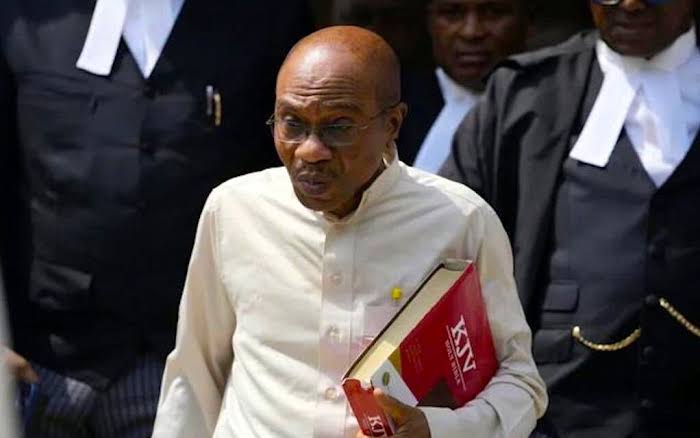
Former Central Bank of Nigeria (CBN) Governor Godwin Emefiele is seeking to avoid presenting a defence in his alleged $6.23 million withdrawal and procurement fraud trial, insisting that the Economic and Financial Crimes Commission (EFCC) has failed to establish a case against him.
The former apex bank chief has asked a Federal Capital Territory High Court to discharge and acquit him, arguing that the prosecution’s witnesses and documentary evidence have not linked him to the alleged offences. But the EFCC has urged the court to reject his application, maintaining that the evidence presented is sufficient to require him to defend himself.
Emefiele is facing a 20-count charge involving alleged breach of trust, forgery, obtaining money by false pretence, conspiracy and procurement fraud. He has pleaded not guilty to all the charges.
At the centre of the dispute are allegations that Emefiele abused his position to favour companies linked to his associates and was connected to the disputed withdrawal of $6.23 million from the CBN’s Abuja branch.
Arguing the no-case submission, Emefiele’s lead counsel, Matthew Burkaa (SAN), said the prosecution had failed to demonstrate how his client personally benefited from the contracts or manipulated the bank’s Tender Board Committee to favour the companies involved.
Burkaa said the first 14 counts concerned contracts awarded to April 1616 and Architekon, with allegations that Emefiele gave unfair advantages to associates, including his wife and brother-in-law.
According to the defence, the evidence showed that Emefiele approved transactions in his capacity as CBN governor, but did not establish that he interfered with the committee’s decisions or instructed its members to award contracts to particular companies.
The lawyer also argued that the two companies had executed the vehicle supply contracts awarded to them, questioning the basis for the alleged procurement wrongdoing.
He further maintained that prosecution witnesses indicated the companies had submitted lower bids than their competitors, while the EFCC had failed to provide documentary evidence showing how they were allegedly guided during the bidding process.
The defence also challenged the allegations relating to the $6.23 million withdrawal, arguing that the prosecution had not adequately addressed claims that signatures on documents used to facilitate the transaction were forged.
Burkaa cited the testimony of former Secretary to the Government of the Federation, Boss Mustapha, who reportedly told the court that his signature and that of former President Muhammadu Buhari had been forged. He added that Emefiele had also told EFCC investigators that his signature was forged.
The defence questioned why the individuals whose signatures were allegedly forged had not been investigated, arguing that the issue raised important questions about the circumstances surrounding the withdrawal.
However, the prosecution presented a different account, insisting that the allegations went beyond the mere approval of contracts or transactions.
EFCC counsel Rotimi Oyedepo (SAN) argued that Emefiele had used his position as a public officer to confer unfair advantages on Architekon, which he said had Emefiele’s wife and brother-in-law listed as directors.
Oyedepo also alleged that the contracts bypassed the CBN Tender Board Committee despite procurement requirements for contracts exceeding the applicable threshold of N10 million to undergo scrutiny.
He further accused April 1616 of being guided to quote an internal price, allegedly depriving other Nigerian contractors of a fair opportunity to compete.

On the disputed dollar withdrawal, the prosecution argued that Emefiele could not simply claim ignorance of the transaction while he was in charge of the apex bank.
Oyedepo referred to testimony that the release of the money required a corresponding naira cover and that the bank operated a system capable of triggering alerts to the governor regarding such transactions.
After hearing arguments from both sides, the court reserved its ruling on the no-case submission for a date to be communicated to the parties.
Meanwhile, Emefiele is facing another legal challenge in Lagos, where the Court of Appeal has reserved judgment in his bid to remove a trial judge from a separate criminal case involving an alleged $400,000 payment.
A three-member panel led by Justice Biobele Georgewill reserved judgment after hearing arguments from Emefiele’s lawyers and the EFCC. Justices Boloukuromo Ugo and Muslim Hassan are the other members of the panel.
The appeal challenges a February 26, 2025, ruling by Justice Rahman Oshodi of the Lagos State Special Offences Court, who rejected Emefiele’s request to withdraw from the trial over allegations of judicial bias.
Through his lawyers, Olalekan Ojo (SAN) and Olawale Fapohunda (SAN), Emefiele argued that the trial judge’s decision to allow a prosecution question created the impression that the court had already accepted the allegation that he received $400,000.
The dispute arose during the examination of the prosecution’s seventh witness, who reportedly testified that a man identified as John Ayoh handed him the money. During the proceedings, prosecution counsel asked the witness whether it was the same money he had said he gave Emefiele in his office.
Emefiele’s lawyers objected, arguing that the question was leading. Justice Oshodi acknowledged that it was a leading question but allowed it under Section 221(3) of the Evidence Act, 2011.
The defence subsequently sought the judge’s recusal, arguing that his ruling appeared to prejudge an allegation that remained disputed and had not yet been fully tested through cross-examination.
Justice Oshodi dismissed the application, holding that the allegation of bias had not been substantiated. Emefiele then appealed, arguing that the decision raised concerns about his constitutional right to a fair hearing before an impartial court.
The EFCC has urged the Court of Appeal to dismiss the challenge, maintaining that the trial judge acted within the law and that the relevant witness testimony supports his decision.
The Lagos proceedings stem from a separate criminal case involving allegations of gratification, corrupt demands and the receipt of property allegedly obtained fraudulently under the Corrupt Practices and Other Related Offences Act, 2000. Count 18 specifically alleges that Emefiele received $400,000. He has pleaded not guilty to the charges.
The two court battles now leave Emefiele awaiting separate decisions: one on whether the prosecution has established a case requiring him to defend the allegations in the FCT trial, and another on whether the Lagos trial judge should have recused himself.
Both matters remain unresolved, and the allegations against the former CBN governor have yet to be finally determined by the courts.



Comments (0)
No comments yet. Be the first to share your thoughts!