


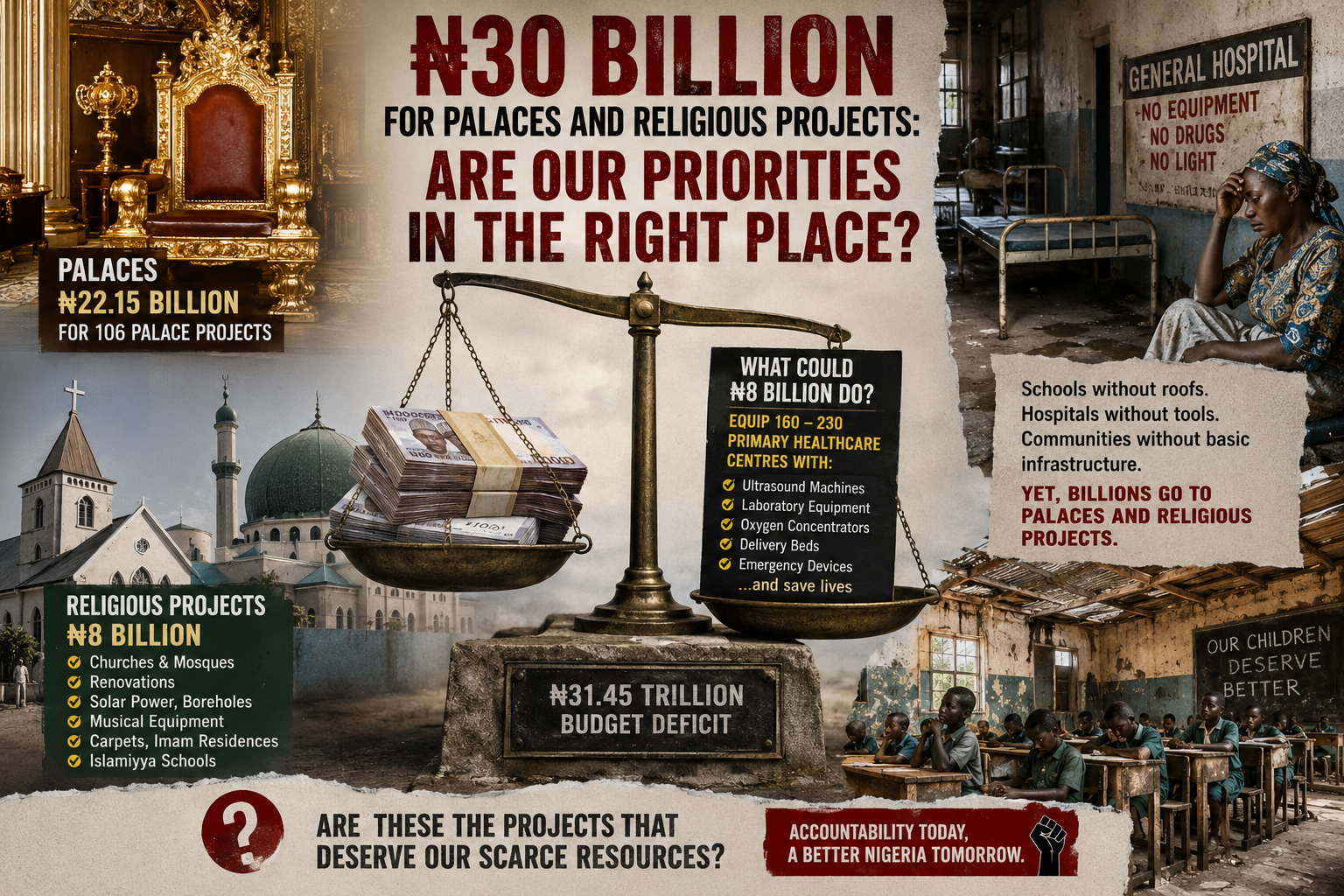
Questions have continued to trail the allocation of ₦30.15 billion in the 2026 budget for the construction, renovation and furnishing of palaces, as well as the execution of religious-related projects across Nigeria.
According to a report released by Tracka, a public accountability initiative of the BudgIT Foundation, ₦22.15 billion was earmarked for the renovation and furnishing of 106 palaces nationwide, while another ₦8 billion was allocated for the construction, renovation and support of churches and mosques across the country.
For many Nigerians, the figures have raised serious concerns, particularly at a time when the country is battling a ₦31.45 trillion budget deficit, rising debt obligations, growing poverty and increasing pressure on critical sectors such as healthcare and education.
The report showed that ₦1.91 billion was allocated to seven church-related projects, while ₦6.14 billion was set aside for 52 mosque projects spread across different states. The projects include the construction and rehabilitation of worship centres, installation of solar power systems, provision of boreholes, musical equipment for churches, carpets for mosques, residences for imams and facilities for Islamiyya schools.
Among the allocations that have attracted public attention are ₦1 billion for musical and cultural equipment for churches in Abia State and another ₦1 billion for solar power installations at mosques in Zamfara State.
The controversy, however, goes beyond the figures. An extensive review of the budget document exposed what many observers describe as glaring accountability concerns. The report revealed that 11 palace projects worth ₦5.85 billion have no clearly identified locations, making public monitoring and oversight almost impossible.
This raises an important question: How can citizens track projects that have no specific locations attached to them?
Even more puzzling is the discovery that none of the 45 Ministries, Departments and Agencies assigned to execute these palace projects has the statutory responsibility to construct royal structures. Instead, billions of naira were reportedly routed through agencies and institutions whose mandates have little or nothing to do with palace construction.
For instance, agricultural colleges, scientific research institutes, tourism agencies and even health-related institutions were listed among those expected to handle palace projects worth billions of naira.
This naturally leads to another question: Why are research institutes, agricultural establishments and health agencies being assigned projects that fall outside their primary responsibilities?
At a time when public hospitals struggle with inadequate equipment and many schools remain in poor condition, the allocations have intensified public debate over government spending priorities.
What makes the issue even more striking is what these funds could potentially achieve if directed elsewhere. Available estimates from medical equipment suppliers indicate that the ₦8.05 billion allocated for religious projects could equip between 160 and 230 primary healthcare centres across the country.
With such resources, hundreds of health facilities could be provided with ultrasound machines, laboratory equipment, oxygen concentrators, delivery beds and other life-saving devices.

This raises another critical question: Should billions of naira be spent on religious and palace projects while many communities still lack functional healthcare facilities?
Amid the growing criticism, Deputy Speaker of the House of Representatives, Benjamin Kalu, defended the ₦1 billion church-related allocation in his Bende Federal Constituency. According to him, the project is not solely for the purchase of musical instruments as widely reported but is part of a broader programme aimed at youth reorientation, moral instruction, crime prevention and community outreach through faith-based organisations.
Kalu argued that nation-building goes beyond roads and physical infrastructure, insisting that government must also invest in the character and value systems of citizens. He further clarified that no funds have been released since the 2026 budget has not yet entered the implementation stage.
While his explanation may address some concerns, many Nigerians remain unconvinced.
Political analyst Jide Ojo is among those who have criticised the allocations. He questioned why government resources should be committed to renovating churches and mosques when schools, hospitals and public infrastructure require urgent intervention.
“Does that make sense?” he asked, expressing concern over the billions allocated to religious projects despite the country's developmental challenges.
His remarks mirror the sentiments of many Nigerians who believe public resources should be channelled toward projects that deliver the greatest benefit to the largest number of citizens.
The debate has also opened another line of questioning. If the government continues to fund Christian and Islamic projects, what happens when traditional religious worshippers demand similar support for their own religious sites and institutions? Can the government fairly justify funding some religious groups while excluding others?
Ultimately, the controversy surrounding the ₦30.15 billion allocation is not merely about palaces, churches or mosques. It is about accountability, transparency and the difficult choices that come with managing limited public resources.
As economic hardship continues to bite and critical sectors cry out for attention, Nigerians are left with fundamental questions that deserve answers: Are these truly the most urgent projects for a country facing numerous developmental challenges? Should public funds be prioritised for palaces and religious institutions when hospitals lack equipment and schools remain underfunded? And in a nation where millions are struggling to make ends meet, are our leaders focusing on the needs that matter most?
Until convincing answers emerge, the questions surrounding these allocations are likely to remain at the centre of public discourse.

Comments (0)
No comments yet. Be the first to share your thoughts!