


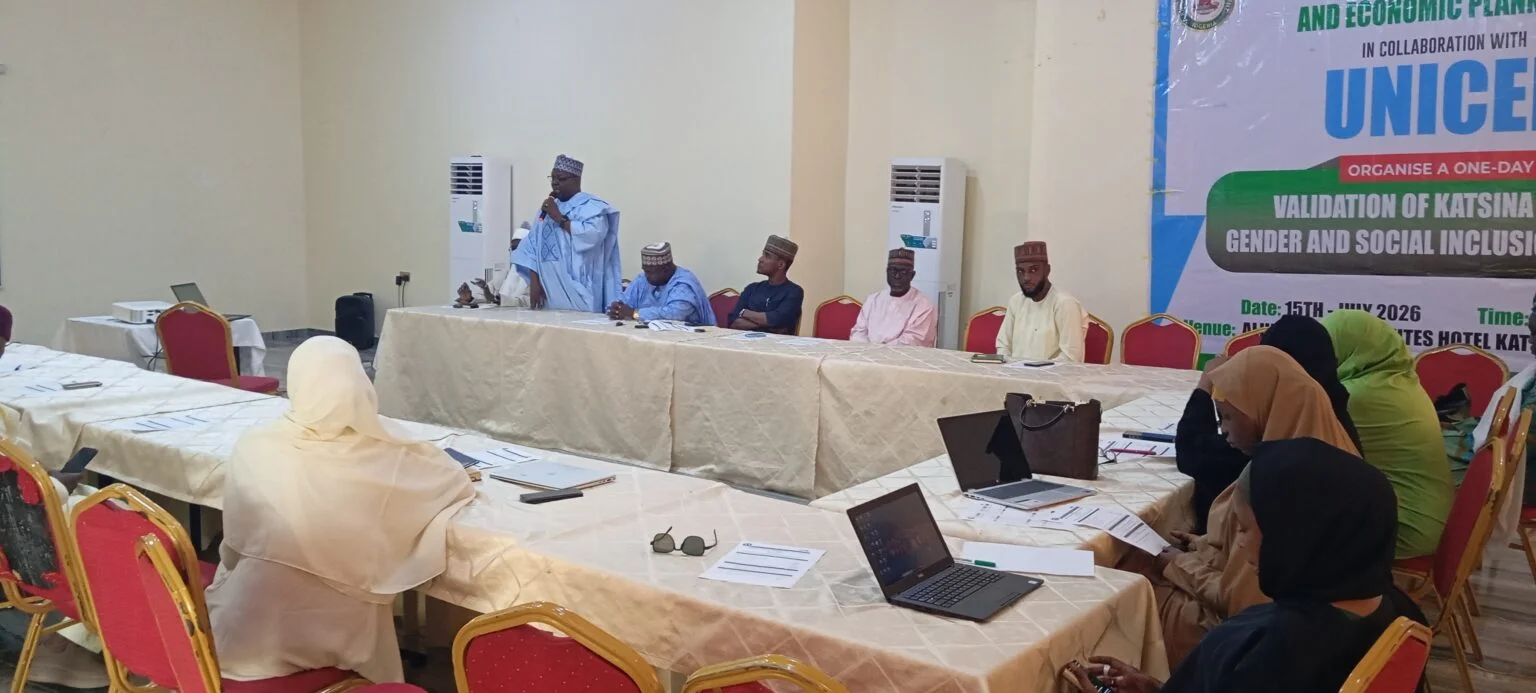
The Katsina State Government and the United Nations Children's Fund (UNICEF) have taken a significant step toward addressing gender inequality and social exclusion with the validation of a comprehensive Gender Equality and Social Inclusion (GESI) report aimed at improving the lives of women, children and other vulnerable groups across the state.
The report, which highlights key challenges facing adolescents and marginalized populations, was reviewed during a stakeholders’ validation meeting organised by the Katsina State Ministry of Budget and Economic Planning in partnership with UNICEF’s Kano Field Office on Friday in Katsina.
Speaking at the event, the Commissioner for Budget and Economic Planning, Alhaji Malik Anas, said the report would serve as a critical tool for shaping policies and interventions that promote inclusive growth and equitable access to opportunities.
Represented by the Statistician-General of the state, Prof. Saifullahi Sani, the commissioner explained that the study was designed to provide government and development partners with reliable data on the social and economic realities of adolescent boys and girls, as well as other vulnerable populations.
According to him, the findings offer valuable insights into the distinctions between gender equality, gender equity and gender inequality, enabling policymakers to develop targeted strategies that address the root causes of exclusion and deprivation.
“The report provides evidence that will help us understand who is being left behind and why. This will allow government institutions to design programmes that are responsive to the needs of women, children and other vulnerable groups,” he said.
Anas stressed that social inclusion remains a cornerstone of sustainable development, warning that persistent inequalities in education, healthcare, employment and access to basic services continue to deepen poverty and contribute to insecurity.
He noted that studies have consistently shown that communities deprived of opportunities are more susceptible to social and economic vulnerabilities, making inclusive development essential for long-term stability.
The commissioner further stated that the validated report would guide ministries, departments and agencies in planning and implementing programmes, while strengthening the state’s commitment to evidence-based policymaking.
He added that accurate data would enable the government to assess the reach and impact of its interventions, particularly among women, children and disadvantaged populations.
Assembly Pledges Legislative Backing
Also speaking, Chairman of the Katsina State House of Assembly Committee on Women Affairs, Ali Abubakar-Albaba, reaffirmed the legislature’s commitment to advancing the rights and welfare of women and young people.
He praised UNICEF and other development partners for their continued support, describing their contributions as vital to complementing government efforts in protecting vulnerable groups.

Abubakar-Albaba disclosed that the Assembly had sponsored and passed several motions and legislative measures focused on child rights, child protection, women’s safety and the fight against domestic violence.
He assured stakeholders that lawmakers would continue to enact and strengthen laws that promote the wellbeing and protection of women and children across the state.
UNICEF Highlights Alarming Findings
Presenting key findings from the report, UNICEF Social Policy Specialist, Fatima Musa, revealed that the organisation commissioned the study in Katsina, Bauchi and Zamfara states to better understand the challenges facing adolescents and marginalized communities.
She explained that the validation exercise was intended to ensure the accuracy of the findings, address identified gaps, and build ownership among stakeholders before the report’s final adoption.
According to Musa, the study examined the realities of women, men, children, persons living with disabilities, youths, older persons and other socially excluded groups.
She disclosed that Katsina, alongside Bauchi and Zamfara, recorded some of the country's most severe forms of adolescent deprivation, particularly in education, healthcare, protection, economic opportunities and civic participation.
The report identified poverty, harmful social norms, child marriage, insecurity and limited access to adolescent-friendly healthcare services as major barriers preventing many young people from reaching their full potential.
Despite these challenges, Musa acknowledged efforts by the Katsina State Government to strengthen the protection of vulnerable groups through key reforms and policies.
She cited the domestication of the Violence Against Persons (Prohibition) Act, the Child Protection Law, the Gender Policy and the National Policy on Safety, Security and Violence-Free Schools as notable milestones.
According to her, the report provides a strong evidence base that will support government agencies, civil society organisations and development partners in designing interventions that promote gender equality and social inclusion.
She added that the document would be forwarded to the committee established by Governor Dikko Radda for final review, validation and adoption.
The validation meeting brought together government officials, lawmakers, development partners, civil society organisations and other stakeholders, who examined the findings and made recommendations aimed at ensuring the report effectively guides future policies and programmes in the state.

Comments (0)
No comments yet. Be the first to share your thoughts!