


By Taibat Ummi Yakubu
Kano and Katsina states are set to benefit from expanded electricity transmission capacity following the inauguration of new power facilities and the commencement of additional projects aimed at easing pressure on the national grid and supporting industrial growth.
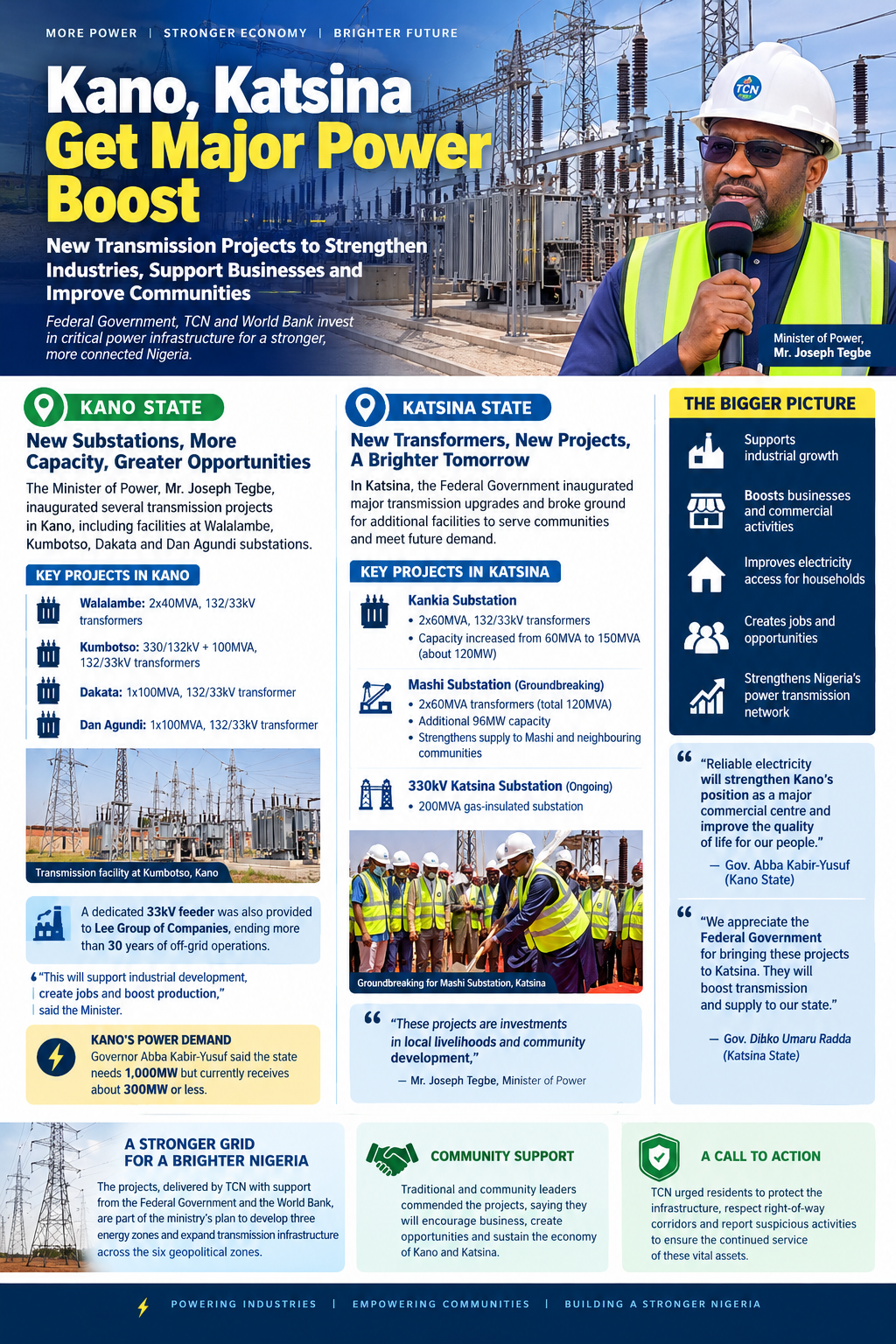
The projects, executed by the Transmission Company of Nigeria (TCN) with support from the Federal Government and the World Bank, include new transformers, upgraded substations and a planned transmission facility expected to serve communities facing growing electricity demand.
The development comes as Kano, one of Nigeria’s major commercial and industrial centres, continues to grapple with a significant gap between its electricity needs and available supply. Governor Abba Kabir-Yusuf said the state required about 1,000 megawatts (MW) to meet its growing demand but currently received approximately 300MW or less.
The Minister of Power, Joseph Tegbe, inaugurated several transmission facilities in Kano, including projects at Walalambe, Kumbotso, Dakata and Dan Agundi substations. The installations are expected to increase the volume of electricity that can be transmitted to the areas served by the facilities.
At Walalambe, the project includes two 40-megavolt-ampere (MVA), 132/33-kilovolt (kV) transformers. Kumbotso received a 330/132kV transformer and a 100MVA, 132/33kV transformer, while Dakata and Dan Agundi each received an additional 100MVA, 132/33kV transformer.
According to Tegbe, the new installations will reduce pressure on overloaded substations, introduce additional supply points and enable the network to accommodate electricity demand that existing infrastructure has been unable to serve adequately.
One of the notable developments is the connection of Lee Group of Companies to a dedicated 33kV feeder after more than three decades of operating off-grid.
Tegbe described the connection as an example of how improvements in transmission infrastructure could support industrial expansion, create employment opportunities and help businesses improve their operations.
For manufacturers and other electricity-dependent businesses, access to the national grid could provide an alternative to relying heavily on private power generation. However, the actual benefits will depend on the consistency of electricity generation, the condition of distribution networks and the overall performance of the power sector.
In Katsina State, the Federal Government has also inaugurated major transmission upgrades while advancing plans for additional facilities to serve communities and accommodate future demand.
At the Kankia transmission substation, Tegbe inaugurated two 60MVA, 132/33kV transformers. The installation increases the substation’s capacity from 60MVA to 150MVA, equivalent to about 120MW of transmission capacity under the stated project specifications.
The additional capacity is expected to improve the substation’s ability to handle demand and strengthen bulk electricity supply to communities within its service area.
The minister also performed the groundbreaking ceremony for a new 132/33kV transmission substation in Mashi. The facility is planned to have a total capacity of 120MVA through two 60MVA transformers.
When completed, the Mashi project is expected to provide an additional 96MW of capacity and improve electricity transmission to the area and neighbouring communities.
Tegbe said issues relating to the acquisition of land, transmission right-of-way and compensation for people affected by the project had been resolved, clearing the way for construction to proceed.
He said the investment was intended not only to strengthen the electricity network but also to create opportunities for local economic development and improve livelihoods.
The minister also inspected ongoing construction of a 200MVA gas-insulated substation at the 330kV Katsina Substation, describing it as another component of efforts to improve transmission infrastructure in the state.
He said the projects were being delivered by the Federal Government through the Ministry of Power and TCN, with funding support from the World Bank for the relevant interventions.
Tegbe added that the ministry was prioritising the development of three energy zones to promote a more balanced electricity supply across the country. He also pledged to coordinate federal power-sector interventions with the Kano State Government.

Katsina State Governor Dikko Umaru Radda welcomed the projects, thanking President Bola Tinubu for approving three transmission substation projects for the state.
Radda said the investments would strengthen electricity transmission and supply, while reaffirming his administration’s readiness to work with the Federal Government to improve access to electricity and encourage economic activity.
He also acknowledged federal support for other infrastructure projects intended to promote development across Katsina State.
In Kano, Governor Kabir-Yusuf, represented by the Commissioner for Power and Renewable Energy, Gaddafi Shehu-Sani, said the state’s estimated requirement of 1,000MW highlighted the scale of the challenge facing its industrial and commercial sectors.
The governor commended the Federal Government, the Ministry of Power and TCN for the interventions, expressing hope that improved electricity infrastructure would support businesses, stimulate industrialisation and enhance residents’ quality of life.
Kabir-Yusuf also disclosed that the state government had paid ₦2 billion in compensation and allocated land to 750 affected people to resolve a longstanding dispute over right-of-way issues along a transmission corridor.
He further expressed optimism that electricity infrastructure projects linking Kaduna and Kano would contribute to improving supply when completed.
TCN Managing Director Sule Abdulaziz said the investments were designed to address transmission capacity constraints and improve the operational efficiency of substations in the two states.
He explained that the upgrade works included modernising control rooms with digital control and protection panels, expanding 33kV busbars and installing additional outgoing feeders.
Abdulaziz said the Mashi substation would help improve voltage performance, strengthen bulk electricity delivery and provide room for future growth in demand.
However, the completion and inauguration of transmission facilities do not automatically translate into uninterrupted electricity for households and businesses. Improved consumer supply also depends on sufficient generation, effective distribution networks and coordination among the different operators in Nigeria’s electricity sector.
The TCN managing director urged residents of host communities to protect the installations against vandalism, respect transmission right-of-way corridors and report suspicious activities around power infrastructure.
He said the company would continue expanding transmission facilities, rehabilitating existing assets and modernising critical equipment across Nigeria’s six geopolitical zones in support of the Federal Government’s power-sector development objectives.
The projects also received support from traditional and community leaders, who said improved electricity infrastructure could stimulate commercial activities and benefit local residents.
Alhaji Mahe Bashir, the Walin Kano, who represented the Emir of Kano, Muhammadu Sanusi II, said the investments would add economic value to Kano and help sustain its commercial activities.
Similarly, Musa, a community leader in Kankia, Katsina State, welcomed the intervention, saying improved electricity transmission could encourage businesses and expand economic opportunities in the area.
For Kano and Katsina, the central test will now be whether the additional transmission capacity translates into more reliable electricity for homes, factories, traders and small businesses. While the new facilities provide room to transmit more power, sustained improvements will require effective coordination across the entire electricity supply chain.
.jpg)

Comments (0)
No comments yet. Be the first to share your thoughts!