


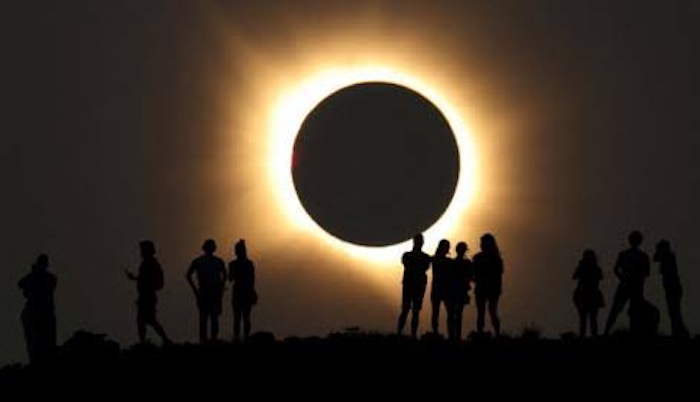
A rare celestial event transformed afternoon skies across Europe on Wednesday, as millions of people gathered outdoors to witness a dramatic solar eclipse that briefly turned daylight into an eerie twilight in parts of the continent.
The spectacle, one of the most anticipated astronomical events of recent years, drew crowds to beaches, parks, observatories and open fields, with many spectators describing the experience as both emotional and unforgettable.
Across the United Kingdom, the Moon obscured more than 90 per cent of the Sun, creating one of the most impressive eclipses seen in the country since the late 1990s. While Britain experienced a deep partial eclipse, observers in parts of Spain, Iceland and Greenland were treated to the far rarer sight of a total eclipse, where the Sun disappeared completely behind the Moon.
As the eclipse progressed, excitement spread through viewing locations across Europe. Families, tourists, scientists and amateur skywatchers watched in amazement as sunlight gradually dimmed and temperatures dropped slightly under darkening skies.
The celestial journey began thousands of kilometres away over Siberia before sweeping across the Arctic region and into Europe, where millions were waiting for a glimpse of the phenomenon.
Favourable weather conditions provided clear views for large parts of England and Wales, allowing many residents to enjoy the event without obstruction. However, cloud cover frustrated some observers in northern parts of the UK, where the eclipse was only partially visible.
The build-up to the event sparked a surge in public interest, with retailers reporting strong demand for protective eclipse glasses. As supplies dwindled, many people turned to homemade viewing techniques, using simple projection devices to safely observe the Sun without risking eye damage.
Scientists explained that a solar eclipse occurs when the Moon moves directly between the Earth and the Sun, temporarily blocking sunlight and casting a shadow across parts of the planet. Although eclipses occur regularly around the world, their visibility depends entirely on location, making each event unique.

The most dramatic scenes were recorded in Spain, where spectators witnessed totality — the brief period when the Moon completely covers the Sun. For a few moments, daylight vanished and the Sun’s brilliant corona appeared around the dark lunar silhouette, creating a striking image rarely seen by the human eye.
Among those who travelled specifically for the occasion was Chilean researcher Yasmin Catricheo, who joined hundreds of spectators in north-western Spain.
She said the atmosphere changed instantly when totality arrived, with people cheering, applauding and sharing the moment with strangers around them.
For many observers, the eclipse was more than a scientific event; it was a reminder of humanity’s connection to the wider universe and the rare natural wonders that continue to inspire curiosity.
Astronomers say total solar eclipses may occur somewhere on Earth every year and a half on average, but seeing one from a particular location is exceptionally uncommon. Some regions may wait centuries before another total eclipse passes overhead.
Experts also noted that eclipse enthusiasts are entering an unusually active period, with several major eclipses expected around the world over the next few years. However, the United Kingdom will miss out on future total eclipses visible elsewhere and will instead experience only partial events.
The next opportunity for Britons to witness an eclipse of similar magnitude is still decades away, making Wednesday’s event a historic occasion for many who seized the chance to look skyward and witness one of nature’s most extraordinary displays.
.jpg)


Comments (0)
No comments yet. Be the first to share your thoughts!