


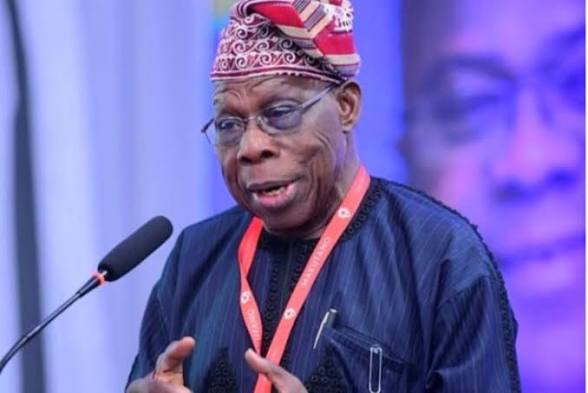
Former President Olusegun Obasanjo has warned that Nigeria must never be allowed to slide into another civil war, declaring that many of the divisions and grievances that fueled the 1967–1970 conflict still persist within the country’s institutions and among its people.
Obasanjo made the remarks on Wednesday in Abeokuta during the presentation of Asaba Massacre, a historical documentation compiled by the Isama Aje of Asaba, Chuck Nduka-Eze. The work, presented at the Olusegun Obasanjo Presidential Library, chronicles events surrounding the controversial killings of civilians in Asaba during the Nigerian Civil War.
Reflecting on the nation’s turbulent past, the former president said Nigeria had already paid too high a price through one civil war and could not afford a repeat.
“Some of the issues that led to the civil war are still with us today,” Obasanjo said. “I once heard General Yakubu Gowon say that Nigeria would not survive a second civil war, and I share that belief. We have fought one civil war too many already.”
He stressed the need for Nigerians to confront painful chapters of history honestly, condemn past atrocities, and commit themselves to preventing a recurrence.
“We must learn from what happened and ensure that we do everything humanly possible to stop such tragedies from happening again. We must be able to say, ‘Never again,’ and mean it,” he added.
Obasanjo acknowledged his role in the civil war but maintained that he could not provide details about the events widely referred to as the Asaba Massacre, explaining that the area was under the command of late General Murtala Muhammed at the time.
“I was involved in the civil war, but whenever people ask me about the Asaba Massacre, I always confess that I cannot give details because I was not in charge of that operation,” he said.
The former president, however, commended Nduka-Eze for undertaking what he described as an important historical project and pledged to study both the written and audio-visual materials contained in the publication.
The author explained that the document was built on extensive research, drawing from eyewitness accounts, recorded interviews, archival records, audio-visual evidence, and established historical scholarship.
According to Nduka-Eze, independent sources consistently recount how federal troops entered Asaba, then a civilian town in the Mid-West region, and gathered residents in public places where they were instructed to demonstrate loyalty to Nigeria by proclaiming “One Nigeria.”
He said testimonies indicate that men were subsequently separated from women and children before large numbers of unarmed male civilians were killed.
“The evidence points to a tragic contradiction,” Nduka-Eze said. “People who openly affirmed their loyalty to Nigeria were nevertheless killed by agents of the same state they pledged allegiance to.”
He noted that while exact casualty figures remain disputed, credible evidence suggests that more than a thousand men may have lost their lives, leaving deep scars on the Asaba community.
Nduka-Eze also echoed Obasanjo’s concerns about Nigeria’s present-day challenges, arguing that many of the tensions that contributed to the civil war remain unresolved.
“Ethnic groups still relate with one another in an atmosphere of suspicion,” he said, warning that the lessons of history must not be ignored if Nigeria hopes to preserve its unity and stability.
Comments (0)
No comments yet. Be the first to share your thoughts!