


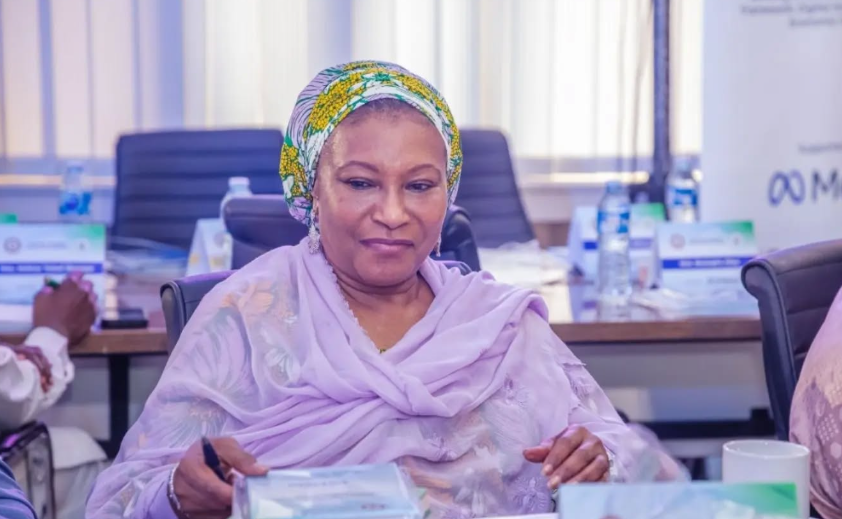
Senator Ireti Kingibe has accused the Federal Government of preparing Nigerians for more economic hardship through the new tax laws, claiming that the legislation requires citizens to pay 25 per cent of their earnings to the government. However, the provisions of the law tell a different story.
Kingibe, who represents the Federal Capital Territory (FCT) in the Senate and belongs to the African Democratic Congress (ADC), made the allegation while addressing supporters at a gathering in Abuja. A video of her remarks, delivered in pidgin English, has since circulated widely on social media.
The senator, who is seeking re-election, urged Nigerians to vote against the ruling All Progressives Congress (APC), arguing that its policies, including electricity tariff increases and tax reforms, have added to the financial pressure on households.
She questioned the justification for introducing new tax measures when many Nigerians are already struggling to meet their basic needs, and alleged that the government had delayed implementing the 25 per cent tax provision because of fears of public opposition.
“How do you expect people to cope? You increased electricity tariffs, but what have you done with the money? Nothing. Now, you want to increase taxes to 25 per cent of everything people earn, when what they currently earn is not even enough to meet their needs,” she said.
Kingibe also urged her supporters to reject the APC in the 2027 elections, warning that retaining the party in power would expose Nigerians to further hardship.
However, her central claim about the tax laws has come under scrutiny because the legislation does not impose a flat 25 per cent tax on every Nigerian's entire earnings.
What the new tax law actually says
Under Section 58 of the Nigeria Tax Act, 2025, personal income tax is calculated using a progressive system, meaning different portions of an individual's chargeable income are taxed at different rates.
The Act provides for a zero per cent rate on the first ₦800,000 of annual chargeable income, followed by rates of 15, 18, 21 and 23 per cent across successive income brackets. The highest rate, 25 per cent, applies to the portion of chargeable income exceeding ₦50 million annually.
This means the highest rate does not apply to every Nigerian or automatically take a quarter of every worker's entire earnings.
For instance, an individual with annual chargeable income of ₦1 million would pay no tax on the first ₦800,000, while the remaining ₦200,000 would be taxed at 15 per cent. On that basis, the tax payable would be ₦30,000, assuming the figure represents chargeable income after applicable deductions and reliefs.
The law also provides exemptions for qualifying minimum-wage earners and other eligible reliefs that can reduce an individual's taxable income.

The four tax reform laws were passed by the National Assembly in 2025, gazetted in September of that year and took effect on January 1, 2026.
Consequently, the claim that implementation has not started is inconsistent with the legislation's commencement date.
Senator stands by her position
When contacted by PREMIUM TIMES, Kingibe maintained that she had told her supporters Nigerians would be required to pay 25 per cent of their earnings under the new tax laws.
She argued that the legislation was a public document that Nigerians could examine for themselves. However, she also repeated her assertion that the government had yet to implement the provisions fully because of concerns about public reaction ahead of the 2027 elections.
“The tax reform bill is a public document, everybody can read it. It is not like I disclose a secret,” she said, adding that she believed the government might be reluctant to implement the measures before the election.
Her explanation, however, does not resolve the discrepancy between her claim and the law's published commencement date.
Tax expert questions the allegation
Okey Udo, a chartered tax practitioner at Vog Global Consult and a member of the education committee of the Chartered Institute of Taxation of Nigeria, also challenged the senator's interpretation.
He described the claim as politically motivated or based on a misunderstanding of the legislation, arguing that the law's provisions and implementation timeline contradicted her account.
“It is politically guided and ignorantly expressed,” Udo said, pointing to the fact that the law had already taken effect.
The controversy highlights a growing political debate over taxation, household finances and the government's economic policies as parties prepare for the 2027 general elections.
While Kingibe has framed the tax reforms as another burden on Nigerians, the legislation establishes a progressive system in which tax liability depends on chargeable income, applicable rates and qualifying exemptions.
With public concern over the cost of living likely to remain a major campaign issue, accurate explanations of the tax laws will be important in helping Nigerians distinguish between the actual provisions of the legislation and competing political claims.

Comments (0)
No comments yet. Be the first to share your thoughts!