


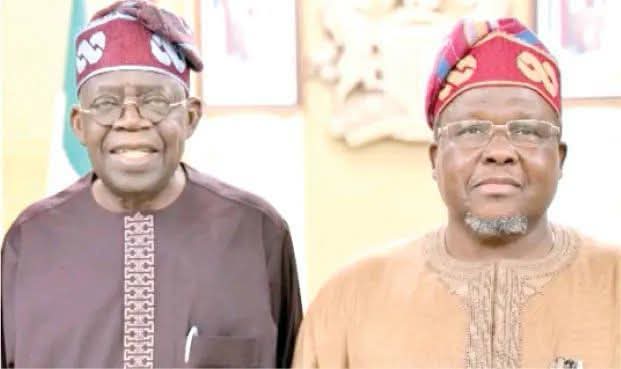
Culled from weekend trust
The Special Adviser to President Bola Ahmed Tinubu on Political Affairs, Alhaji Ibrahim Kabir Masari, has become one of the most influential politicians in the country.
Moving from the backseat of political engagements since his role as a temporary running mate to Tinubu in the buildup to the 2023 elections, where he was termed “Place holder”, he has become the prime mover of political events that have to do with the president, attracting attention and capturing the essence of the presidential campaign.
Investigation by our correspondents has shown that he is undoubtedly the closest politician to the president in northern Nigeria.
Sources, however, told Weekend Trust that not long ago, such political influence belonged to Senator Abu Ibrahim, who Tinubu got acquainted with when both served as senators in 1992 and have remained close since then.
There are others who served as governors with the president between 1999 and 2007, such as George Akume, Joshua Dariye, Ali Modu Sheriff, who also enjoy various degrees of closeness to him. But according to various sources, Masari has become the new political point man of President Tinubu in the North.
After the former Lagos governor emerged as the presidential candidate of the All Progressives Congress (APC), Masari’s name was submitted to the Independent National Electoral Commission (INEC) as his running mate in a placeholder arrangement. The ticket was later changed with Kashim Shettima as the substantive running mate.
Masari stepped aside, saying the decision would allow Tinubu greater flexibility to accommodate wider interests, an act that placed him in the national spotlight.
Following Tinubu’s victory in 2023, Masari was appointed a Senior Special Assistant on Political Affairs; and three years later, elevated to Special Adviser on Political Affairs.
Between rise in fortune and controversies
Masari’s public image peaked when recently, President Tinubu addressed him as “My Waziri” to the hearing of many political leaders in the northern part of Nigeria.
The Waziri title amongst Hausa speakers refers to a position akin to that of a prime minister in a western setting and is usually regarded as the next in hierarchy to a king.
By referring to Masari as Waziri in that manner, many say it was deliberate on the part of the president to accord him more clout and confirm his unofficial position as the closest person to him in northern Nigeria as he is now being called ‘Wazirin Tinubu.’
Many said Masari had indeed done well to sustain the perception that he is no ordinary person in the Tinubu government, as for some time now, he has been seen moving around with the full compliments of one who enjoys the direct support and blessing of the president.
A man who strongly believes that Masari enjoys the full support of the president, but does not want his name mentioned, told our correspondent that: “Wherever he goes on campaign he moves with governors, ministers and top government officials striving to appear with him at public functions. And he usually moves in long motorcades, complemented by the vehicles of other public officeholders that move with him.”
Weekend Trust learnt that it is being whispered among political leaders in the North that Masari is the go-to person for anyone seeking favour from President Tinubu.
A source reliably informed our correspondent that a certain governor from the northwestern part of the country was said to have told a prominent leader in the North that it is in their best interest to cooperate with Masari and do according to his wish for peace to reign.
“He is held in awe because of the power he wields. Some say he promised to replace a certain minister with another person, and before long, the change was effected as he had said,” the source who wants his identity shielded said.
Many political observers said all these had made him to be feared and respected, such that whenever he went to any state, political leaders, lobbyists and others would flock around him.
In one of his recent visits to his home state of Katsina, he was said to have used a chopper to transport himself and his close associates. The glitz and razzmatazz displayed became the talk of the town for a while.
Rise in APC and relationship with Tinubu
Masari’s rise within the APC began with his involvement in the party’s national structure. He served as a national welfare secretary during Adams Oshiomhole’s tenure as the national chairman of the party, gaining exposure to the party’s national machinery and building relationship with governors and legislators.
That experience positioned him as a political organiser rather than a conventional officeholder.
His relationship with President Bola Tinubu became prominent during the 2022 presidential election.
According to Ahmad Mohammad of the Democratic Sustainability Forum, Masari’s trajectory has been less about elective office and more about influence through organisation and proximity to national leadership, as well as top power holders.
“Masari is more visible in activities promoting the Tinubu-Radda political agenda and has engaged different groups across states, including Katsina.
“Such activities have reinforced his position as a link between Abuja and the state’s political networks. That same position has also generated speculation about whether a separate power centre is developing around him,” he said.
As the campaigns for the 2027 elections commence, Masari has arguably overtaken others to be at the forefront of rallying political leaders in the North; and has been doing it with all the controversies that could go with it.
Earlier in the month, he brought together 500 Islamic scholars and religious leaders across the 19 northern states and the Federal Capital Territory to Katsina, after which it was said that they endorsed President Tinubu for re-election in 2027.
In a statement issued by his media office, Masari noted that participants expressed satisfaction with what they described as the Tinubu administration’s efforts to tackle insecurity and address infrastructure and economic challenges in the region.
Among dignitaries who attended the meeting were the Jigawa State governor, Umar Namadi; Kano State governor, Abba Yusuf; Yobe State governor, Mai Mala Buni; Sokoto State governor, Ahmad Aliyu and Kaduna State governor, Uba Sani.
Also present were Deputy President of the Senate Barau Jibrin and the Minister of Housing and Urban Development, Muttaka Darma.
Not long after that, Masari also engineered the coming together of more than 600 senior university lecturers from all the public universities in northern Nigeria to endorse the second term bid of President Tinubu.
At the meeting, which held behind closed doors at the Umaru Musa Yar’adua Centre, Kaduna, those who attended included the Kaduna State governor, Uba Sani; that of Zamfara, Dauda Lawal; Yobe State governor, Mai Mala Buni; Borno State governor, Babagana Zulum and that of Gombe, Inuwa Yahaya. Others include the Minister of State for Defence, Bello Matawalle; Minister of Housing, Muttaqha Rabe Darma and former governor of Katsina State, Aminu Bello Masari.
The next day, Masari also met female Islamic scholars from the 19 northern states along with Governor Uba Sani of Kaduna State.
Speaking at the event, the presidential aide questioned what he described as the basis for opposition to Tinubu, arguing that the president’s major “fault” in the eyes of some northerners was that he was not Hausa.
It is also said that for many observers, his penchant for doling out money at such occasions has proved that he is not acting alone. He is said to have donated not less than N300 million at a meeting with clerics. At the meeting with lecturers, various amounts have been quoted as reaching some of the participants.
The Radda-Masari feud
The reported differences between Radda and Masari attracted attention because of their political history. Radda’s rise was closely associated with former Governor Aminu Bello Masari, having served as chief of staff before heading the Small and Medium Enterprises Development Agency of Nigeria (SMEDAN) and later winning the 2023 governorship election.
Ibrahim Kabir Masari, on the other hand, developed his influence through APC structures and relationship with Tinubu. According to a source close to the state APC leadership, the two men occupy different but overlapping spaces. Radda controls the machinery of the state government and APC structures in Katsina, while Masari has direct access to the Presidency and a prominent role in the national campaign.
“One incident that intensified speculation was the controversy surrounding alleged destruction of billboards bearing images of Tinubu and Masari along Modoji junction to Government House Road in Katsina. Two senior security aides attached to Radda were invited to the Nigeria Police Force headquarters in Abuja for questioning over the incident. It subsequently became part of wider speculation about the relationship between Radda and Masari,” the source revealed.
The source, however, stressed that the billboard controversy alone did not establish a political feud as supporters of both sides rejected suggestions of a disagreement.
But a political analyst, Malam Bashir Gambo Matazu, said the Katsina APC situation was more complicated than a simple rivalry.
“Both Radda and Masari remain associated with the APC and the Tinubu re-election project. The question is whether their different platforms can operate together without producing competing interests over party organisation, mobilisation and influence.
“For Radda, the challenge is maintaining the control of APC structure in Katsina while defending his administration’s record and seeking another term. For Masari, his growing proximity to Tinubu places him within the federal establishment, while his Katsina roots give him grassroots access.
“Distinction matters. Influence is not always determined by an elective office. A politician with access to the Presidency, national party structures and grassroots networks can wield considerable influence even without appearing on a ballot,” he said.
For now, there is no clear evidence that alleged differences between the two political players have developed into open confrontation. What is evident is that both men can influence APC’s calculations differently: Radda as the incumbent governor and leader of the state and Masari as a presidential adviser with senior responsibility in the 2027 campaign structure.
More on relationship between Masari and Tinubu
Multiple sources told the Weekend Trust that the relationship between President Tinubu and Ibrahim Kabir Masari, predates Asiwaju’s ambition of becoming president.
One of the sources, who lives in Katsina, said: “From what I know, Kabir Masari, who Tinubu now calls Waziri, got to know the president through two prominent personalities; Senator Abu Ibrahim as well as former governor of Katsina State, Aminu Bello Masari.”
The source said Tinubu and Abu Ibrahim came a long way and Masari was there.
“They (Tinubu and Abu Ibrahim) share a political history that stretches from Nigeria’s aborted Third Republic to the formation of the All Progressives Congress (APC) with their association linked to opposition politics and efforts to build a political alternative to the Peoples Democratic Party (PDP).
“Although both men served in the Senate during the Third Republic, their political connection extends beyond their legislative careers, particularly through the opposition merger efforts that preceded the establishment of the APC in 2013.
“Throughout the struggle, Ibrahim Kabir Masari, was very close to Senator Abu Ibrahim, who I can call his mentor or god-father and was privy to some of the talks, even though he is younger than Tinubu or the former Katsina Senator in terms of age and political dexterity.
“I am sure those who know the relationship will not dismiss my claim, which I also got to know from credible sources. So, I would not be wrong if I say Senator Abu Ibrahim was instrumental to Masari getting to know Tinubu,” he said.
Abu Ibrahim and Tinubu were elected to the Senate in 1992 during Nigeria’s Third Republic. Ibrahim represented Katsina South Senatorial District, while Tinubu represented Lagos West.
The Third Republic was terminated following the political crisis surrounding the annulment of the June 12, 1993 presidential election. Both men subsequently pursued different political paths during the years of military rule and the return to civilian government in 1999.
Abu Ibrahim later returned to the Senate, representing Katsina South from 2003 to 2007 and again from 2011. Tinubu, meanwhile, became governor of Lagos State from 1999 to 2007 and subsequently emerged as a leading figure in the Action Congress of Nigeria (ACN).

It was learnt that all the while, Masari maintained affinity with both Tinubu and Abu Ibrahim.
Another source said, “A significant link between Abu Ibrahim and Tinubu emerged through the political negotiations that sought to unite opposition forces ahead of the 2015 general elections and Masari was closely following them.
“Abu Ibrahim served as one of the intermediaries between Tinubu, who led the ACN, and former military head of state, Muhammadu Buhari, who led the Congress for Progressive Change (CPC).
“The negotiations eventually contributed to the broader merger of the ACN, CPC, All Nigeria Peoples Party (ANPP) and a faction of the All Progressives Grand Alliance (APGA), resulting in the formation of the APC. The truth is that Kabir Masari was not far from the picture of what was happening,” the source said.
Sources said the other route through which Ibrahim Kabir Masari got closer to Tinubu was the former Katsina State governor, Aminu Bello Masari.
Bello Masari, who had served as Speaker of the House of Representatives between 2003 and 2007, is currently the Chairman of TETFund. He was appointed by Tinubu.
Our source, who knows the relationship, said, “Aminu Masari and Tinubu have come a long way. Also, Aminu Masari and Ibrahim Kabir Masari come a long way.
“When the former governor came to the House of Representatives, the younger Masari was with him in Abuja. He was also partly with him in Katsina when he became governor while strengthening his footing in Abuja.
“Even though I might not be able to tell you how the former Katsina governor linked the younger Masari with Tinubu, what is obvious is that Tinubu is a headhunter, he knows how to poach people because he can easily identify their potential.
“And considering that the president had been building bridges of friendships in the North for a long time, probably because of his ambition, he also spread his tentacles in identifying younger talents that came his way through his contemporaries, such as the senior Masari and Abu Ibrahim. Junior Masari falls in this category,” he said.
The source added that Kabir Masari’s ‘aggressive’ nature when it comes to political negotiations might have drawn him much closer to Tinubu.
“He has been a die hard supporter of Asiwaju for a very long time and he never hides it.
“I recall how he once called out a certain governor during a meeting in his bid to make a case for Tinubu who was nursing ambition for the presidency at the time,” the source said.
Another source added that Kabir Masari has now “overtaken” all other people in terms of closeness to the president.
From Nabanje village to the Presidency
Alhaji Ibrahim Kabir Masari was born and raised in Nabanje village, a quiet agrarian community in Kafur Local Government Area of Katsina State.
Like many children in rural northern Nigeria, Masari’s early life revolved around farming, family and communal routines. He started his education with Qur’anic studies, enrolling in a local Qur’anic school in Nabanje before proceeding to western education.
After attaining the required age, Masari was enrolled at Fammariya Primary School, where he began his formal education. The current headmaster of the school, Malam Yusuf Tanimu, said he was excited that Masari had continued to remember the institution despite rising to a prominent political position.
For Tanimu, the significance is not merely that a former pupil has attained national prominence, but he has remained connected to where his educational journey began. He said the school had witnessed significant improvement through federal government’s intervention with better facilities and a more conducive learning environment.
According to him, the two blocks of four classrooms have witnessed considerable transformation, including provision of furniture, water supply and other facilities supporting teaching and learning.
He said, “These changes have substantially altered the appearance and functionality of the school.”
For the assistant headmaster, Malam Muntari Adamu, the transformation is particularly meaningful because the presidential aide is an old pupil.
“The school has never experienced this level of transformation. I urge politicians who rose to positions of influence to remember their communities and the institutions that ,nurtured them.
Weekend Trust gathered that from Fammariya Primary School, Masari proceeded to Government Day Secondary School, Malumfashi in Malumfashi Local Government Area of the state.
His secondary school years took him beyond his immediate rural environment into a larger urban setting, a progression that residents said shaped the man he would later become, a journey defined by humble beginnings, education and exposure before his eventual entry into business, farming, and later, politics.
Childhood friends recount memories
For those who knew him before political prominence, Masari’s story is as much about personal relationships as it is about public office.
His ward head, Alhaji Muhammad Ayuba Umar, described him as a “no-nonsense person” and recalled growing up with him.
“Kabir Masari is my childhood friend. We grew up together in this community and have remained close till date. Although he has attained a high position in life, Masari has never forgotten his old friends. He has been kind to us. He never looks down on us because of our status,” he said.
Similarly, Alhaji Labiru Musa Kafur, the current Wazirin Kafur and Talban Danejin Katsina, said he had known Masari since childhood, noting: “Though I am older than Masari, we shared schools, markets, political parties and other social activities. Our political journey started during the days of the defunct National Republican Convention (NRC). We were inducted into politics when Aminu Bello Masari was serving as a commissioner in Katsina State.
“What distinguishes Masari among his peers is his trustworthiness. He grew up as a man of the people who could spend all he has to build a formidable bridge between the masses and the government at all levels.
“Masari has proven his trustworthiness among his peers. Perhaps that is what gave him special consideration in the eyes of President Tinubu. His hospitality, dedication and concern is known everywhere in Nigeria. I heard that some states are naming newly constructed streets after him,” Kafur said.
From farmer and contractor to politician
Although recently known as a politician, Masari had been into farming and business from childhood. He played a significant role in agriculture, not only in Nabanje but across Katsina State.
Weekend Trust also gathered that Masari was into construction business for several years before joining politics.
Muhammadu Sagir Umar Nabanje, who identified himself as Masari’s elder brother, recalled working under him at Mubel Integrated Construction Company.
He said: “Masari was involved in major construction projects, including about 1,000 housing units in Bauchi State. It was through construction that he met highly influential politicians across the country, which paved the way into politics.”
Haruna Umar Nabanje, his younger brother, recalled: “There was a time Masari sold his farmland to print posters for some politicians, including Aminu Bello Masari, former governor of Katsina State. He told me to sell the farm and bring the money. He said he would use it to produce posters for Aminu Bello Masari and other politicians.”
Haruna described him as “Gyare tsohon nama” — an expression suggesting a man with deep political experience and resilience.
Among the pioneer politicians Masari associated with were former Governor Aminu Masari, Alhaji Bature Umar Masari, the late former President Umaru Musa Yar’adua and Alhaji Kabiru Dandada.
The presidential aide also supported many less privileged, not only within his immediate community but across Kafur Local Government and Katsina State as a whole. He had supported local business women and men in both cash and kinds. Recently, he gave a cash support of N300,000 each to hundreds of traders across Kafur Local Government, it was gathered.
Many women, especially producers of local groundnut cake (kuli-kuli) and other local foods have benefitted from the gesture, a resident, Muhammad Auwal, said, adding: “The man has also sponsored the education of scores of youths in this community. He has built several feeder roads in the community.
The Minister of Housing and Urban Development, Muttaqa Rabe Darma, an engineer, who has known Masari for over 25 years, also said: “We have been associates in social life, politics, business and agricultural activities.
“Masari has been in the public domain since 1987, when we were in Kungiyar Manoman Arewa. He was a central figure in Kafur at that time. He was in the Social Democratic Party (SDP) and later served as a member of the Peoples Democratic Party (PDP) State Working Committee in 1999.
“Ibrahim is a person who takes any responsibility assigned to him very seriously. Despite this, he never held a position as heavy as the one he is holding now, which is why many did not know him then.
“Masari is a simple and kind person who never places himself above others because he is holding a high position or because he is rich. If you see him mingling with friends, you will never believe that he is the Masari.
“His commitment, honesty and dedication made him one of the closest people to President Tinubu. When we were in Kungiyar Manoman Arewa, the late Umaru Musa Yar’adua was president and I saw the commitment Masari gave to him. It is the same commitment he is giving to President Tinubu today. These are the qualities Mr President saw in him.”
Senator Ibrahim Ida, who said he had known Masari for over 30 years, noted: “In my knowledge of him, he is a good man, always ready to help others achieve their visions irrespective of where they come from. Whatever he says comes from his mind and is genuine. There is nothing artificial about him. If Masari kept for himself what goes to him, he would have been a multi-billionaire by now.
“He is someone you can trust when you need help. If he promises to do something, you don’t need to remind him, he will surely do it.”
The ward head of Nabanje and Masari’s uncle, Alhaji Ayuba Umar, also said, “Kabir is a very humble person. His humility knows no bounds. Despite the position he occupies today, he has not forgotten his people, his roots or this community.”
He attributed several developments to Masari’s efforts, including the Federal College of Agriculture, a divisional police headquarters, road projects, solar-powered electricity facilities and an Islamic centre comprising a modern mosque, school, library, imam’s accommodation and shops.
Another resident, Malam Ibrahim Shehu Nabanje said: “For a long time, we wanted development here. today, we can point to projects that have changed the face of the community.”
Malam Kabir Ayuba, whose father is a childhood friend of the presidential aide, said over 40 graduates secured jobs as forest guards, while others got positions in organisations through him, including the Economic and Financial Crimes Commission (EFCC) and the Federal Inland Revenue Service (FIRS).
Also, Badiya Lawal Gidan Lumo, a primary school teacher at Fammariya, said her experience with Masari convinced her that he does not discriminate on the basis of religion, recalling Masari’s contribution to peace-building efforts on the current insecurity in the area, saying his involvement showed concern for all residents, regardless of faith.
Beyond the Nabanje community, politicians and traditional authorities in Katsina State also offered a broader assessment of Masari’s contributions to the state and country.
For the district head of Kafur, Alhaji Abdulrahman Rabe Abdullahi, Masari’s contributions to the fight against insecurity cannot be overlooked, saying he supported recruitment of local vigilantes and provision of security equipment at a time when insecurity is affecting communities and farming. The College of Agriculture he attracted is expected to commence academic activities soon.
Culled from weekend trust

.jpg)
Comments (0)
No comments yet. Be the first to share your thoughts!