


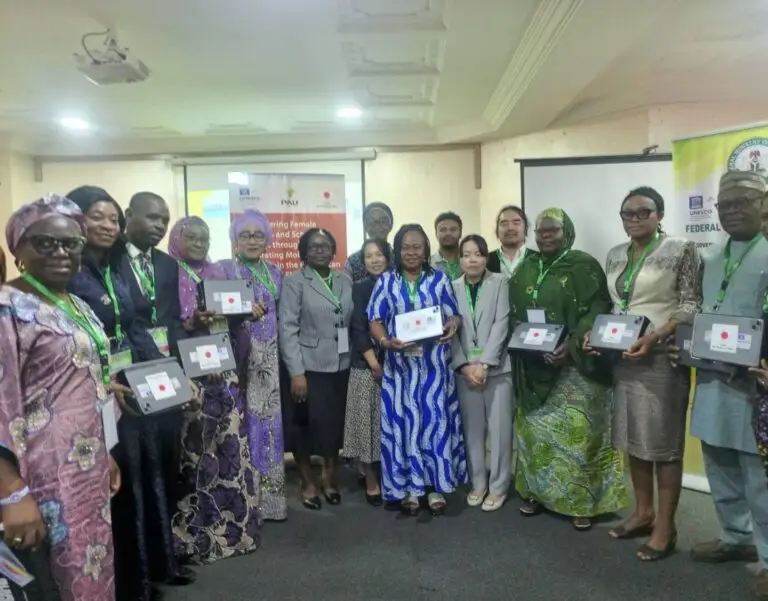
The Federal Government has partnered with UNESCO, the Government of Japan and the Pan African University (PAU) to roll out a major digital learning initiative aimed at strengthening the professional capacity of teachers and school leaders across Nigeria.
The programme, unveiled in Abuja on Tuesday, focuses on equipping educators with modern digital skills through mobile-based learning platforms, with particular attention given to empowering female teachers and educational leaders.
The three-day master training workshop, themed “Empowering Female Teachers and School Leaders through Integrating Mobile-based Learning in the Pan African Virtual and Electronic University (PAVEU) Initiative,” is designed to enhance digital literacy, leadership development and access to continuous professional training.
Speaking at the inauguration, the Minister of State for Education, Prof. Suwaiba Ahmad, said the initiative reflects the Federal Government’s drive to modernise teacher development through technology and innovation.
Represented by the Director of Colleges of Education, Dr Uche Uba, the minister explained that the programme forms part of the Nigeria Education Sector Renewal Initiative (NESRI), a broader effort aimed at improving learning outcomes, strengthening teacher capacity and encouraging innovation within the education sector.
She noted that continuous professional development remains essential for maintaining high educational standards, especially as educators navigate rapidly changing technologies and evolving classroom needs.
According to her, mobile learning platforms offer teachers flexible and accessible opportunities to gain new skills regardless of their location, making the programme particularly beneficial to educators in rural and underserved communities.
Ahmad further stressed that the project prioritises women in education, providing them with tools and leadership skills needed to excel in their roles and contribute more effectively to school development.
She encouraged participants to extend the knowledge gained during the training to fellow teachers and communities, thereby creating a wider impact across the education system.
Also speaking, the Attaché for Development Cooperation at the Embassy of Japan in Nigeria, Ms Akiko Miyazawa, said the initiative demonstrates Japan’s commitment to supporting human capital development and educational advancement across Africa.
Miyazawa disclosed that Japan invested approximately one million dollars in the project, which aligns with commitments made during the Ninth Tokyo International Conference on African Development (TICAD 9) held in 2025.

She explained that the programme seeks to promote digital transformation and inclusive education by providing teachers and school leaders—especially women working in difficult and underserved environments—with flexible access to professional development opportunities.
Addressing participants, Miyazawa described them as key drivers of change whose newly acquired knowledge and skills would ultimately benefit thousands of educators and learners nationwide.
“You are at the centre of this transformation. The expertise you gain here will spread across schools and institutions, helping to shape the future of education in Nigeria,” she said.
In his remarks, UNESCO Abuja’s Acting Officer-in-Charge of the Education Sector, Mr Adeyemi Oladeji, underscored the critical role teachers play in improving educational outcomes and achieving quality education goals.
He noted that the initiative was specifically designed to support educators in remote and underserved communities through innovative, flexible and technology-driven learning solutions.
Oladeji urged participants to become advocates for continuous professional development by encouraging colleagues to embrace digital learning tools and modern teaching approaches.
To support the implementation of the programme, organisers distributed 40 tablets and two sets of edge-computing devices to selected teachers and school leaders, providing them with practical resources for digital learning and training delivery.
The workshop, being implemented by UNESCO’s International Institute for Capacity Building in Africa (UNESCO-IICBA), has attracted participants from Nigeria’s six geopolitical zones and is expected to strengthen the integration of technology into teacher training and educational leadership across the country.


Comments (0)
No comments yet. Be the first to share your thoughts!